
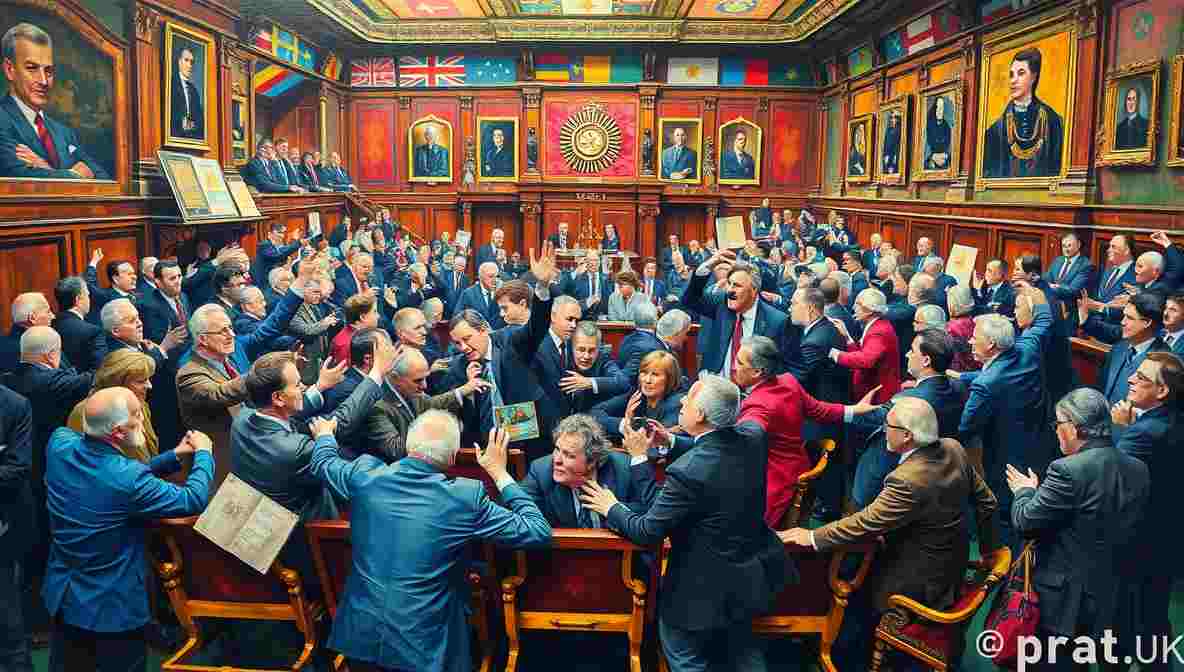
Five Things Everyone Noticed Before Parliament Did
• The House of Commons has not been quiet since 1642 and sees no reason to start now.
• Half of London could heat their flats if someone just attached turbines to Question Time.
• “With respect” remains the most dangerous phrase in British politics.
• Confidence in Westminster rises in direct proportion to available evidence falling off a cliff.
• The Speaker now burns more calories than a Premier League midfielder.
SOURCE: House Of Commons Humour And Prat Observations
House of Commons Declares Shouting a Renewable Energy Source
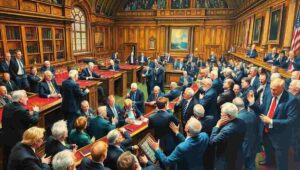
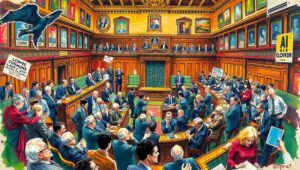
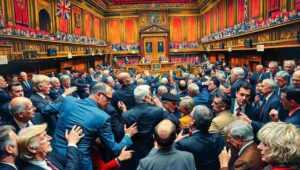
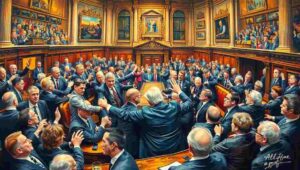
LONDON — In a breakthrough hailed by absolutely no engineers but enthusiastically embraced by several MPs with impressive lung capacity, the UK House of Commons this week announced that shouting will now be classified as a renewable energy source.
Apparently, decibel output now powers half of London. Or at least that is what a government press note implied, before quietly clarifying that it was “symbolic energy.”
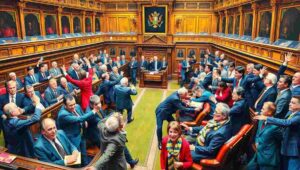
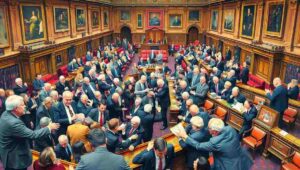
The announcement followed a heated Prime Minister’s Questions session in which opposition benches generated enough vocal thrust to register on a noise-monitoring app used by Camden nightclubs. A leaked internal memo described the chamber as “acoustically nuclear.”
Dr. Cedric Wombleton of the Institute for Applied Loudness, a serious man who owns three decibel meters, explained the science. “When 650 elected officials shout simultaneously, the vibrational frequency could, in theory, toast a crumpet at short range,” he said, adjusting spectacles that trembled from a nearby backbencher’s outrage. “Harnessed correctly, this could power Zone 1 lighting.”
An eyewitness tour guide from Croydon described the moment Parliament peaked. “I bring Americans in to see British democracy,” she said. “Usually they clap politely. Yesterday one asked if this was professional wrestling.”
Officials insist this is green progress. “Britain must lead the world in sustainable shouting,” an anonymous energy staffer confided. “We are exploring wind turbines shaped like MPs’ egos.”
Westminster Introduces New Policy: Facts Optional, Volume Mandatory
As part of its broader decibel initiative, Westminster unveiled what insiders call the “Confidence Act,” a procedural adjustment allowing volume to substitute for verification.
Under the new guidance, if an MP states something with sufficient conviction and at least two aggressive hand gestures, it is provisionally considered “functionally true.”
“We have streamlined governance,” a government whip explained while tapping a laminated chart labelled Loudness Threshold For Believability. “Research shows the public associates volume with leadership.”
That research, it turns out, was conducted in a pub in Islington and involved three pints and a napkin. Still, confidence soared.
A recent SnapGov poll of 2,417 people and one confused ferret found that 63.4 percent believe “whoever sounds most certain must have read something.” Another 21 percent admitted they stopped checking facts around 2016 because it felt “exhausting.”
Opposition MPs embraced the reform. “At last,” one declared, “we can speak from the heart without the administrative burden of evidence.”
Economists were cautiously intrigued. “If belief replaces proof,” noted Professor Delilah Firth of the London School of Pragmatic Optimism, “GDP may respond positively to enthusiasm alone. Markets love vibes.”
Markets, for the record, did not respond. But the vibes were immaculate.
MPs Confirm “Confidence” Now Legally Replaces Evidence
In a symbolic vote carried by the power of synchronized shouting, Parliament formally recognised “confidence” as a procedural asset equal to documentation.
Legal scholars are baffled. “Evidence traditionally involves corroboration,” explained barrister Lionel Hemsby. “Confidence traditionally involves eyebrows.”
Under the revised doctrine, MPs may cite “gut instinct,” “a strong feeling,” or “a man I met on a train” as primary sourcing.
A backbencher from Essex defended the shift. “The public does not want spreadsheets,” he said. “They want certainty. Preferably shouted.”
The Treasury is reportedly testing whether yelling “growth” repeatedly will improve quarterly output. Early trials show morale increasing while mathematics remains unconvinced.
Speaker of the House Requests Whistle, Water Gun, and Emotional Support Labrador
Caught in the acoustic crossfire stands the Speaker, who has formally requested new equipment.
According to documents left accidentally on the tea trolley, the Speaker has asked for:
• A referee whistle rated for Premier League derbies
• A water gun for persistent interrupters
• An emotional support labrador named “Order”
“Refereeing prats is now classified as extreme sport,” a parliamentary aide admitted. “We are consulting Olympic committees.”
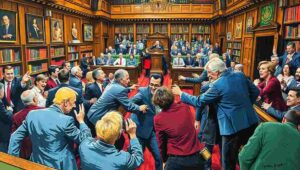
During one recent exchange, the Speaker reportedly burned 800 calories attempting to quiet two MPs arguing about railway electrification while simultaneously defending their respective haircuts.
Archival footage shows the Speaker mouthing “please” into the void while the chamber performed what analysts call “collective competitive indignation.”
Refereeing Prats Officially Recognised As Extreme Sport
The Department for Culture is said to be considering a new category: Parliamentary Endurance.
A fitness tracker worn by an unnamed clerk recorded heart-rate spikes comparable to a London marathon. “You try yelling ‘Order’ for 90 consecutive minutes,” she said. “It is CrossFit for democracy.”
Meanwhile, engineers have begun testing prototype “Commons Turbines” designed to spin whenever backbenchers reach peak fury. Early trials suggest that if a by-election occurs in a marginal seat, the entire Jubilee line could be illuminated.
Critics remain sceptical. “We would prefer solar,” said a resident of Hackney. “But if shouting pays the electric bill, I suppose carry on.”
The Prime Minister’s office released a closing statement insisting Britain remains a beacon of democratic energy. “Our debates are passionate,” it read. “Our voices are strong. Our facts are currently being located.”
As Londoners glance at flickering streetlamps powered by rhetorical outrage, one cannot help but marvel at Westminster’s innovation.
The House of Commons has finally solved the energy crisis.
All it took was turning the volume up.
Disclaimer: This article is a satirical account and represents an entirely human collaboration between the world’s oldest tenured professor and a philosophy major turned dairy farmer. Any resemblance to acoustic reality is purely coincidental. Auf Wiedersehen.

Alan Nafzger was born in Lubbock, Texas, the son Swiss immigrants. He grew up on a dairy in Windthorst, north central Texas. He earned degrees from Midwestern State University (B.A. 1985) and Texas State University (M.A. 1987). University College Dublin (Ph.D. 1991). Dr. Nafzger has entertained and educated young people in Texas colleges for 37 years. Nafzger is best known for his dark novels and experimental screenwriting. His best know scripts to date are Lenin’s Body, produced in Russia by A-Media and Sea and Sky produced in The Philippines in the Tagalog language. In 1986, Nafzger wrote the iconic feminist western novel, Gina of Quitaque. He currently lives in Holloway, North London. Contact: editor@prat.uk