
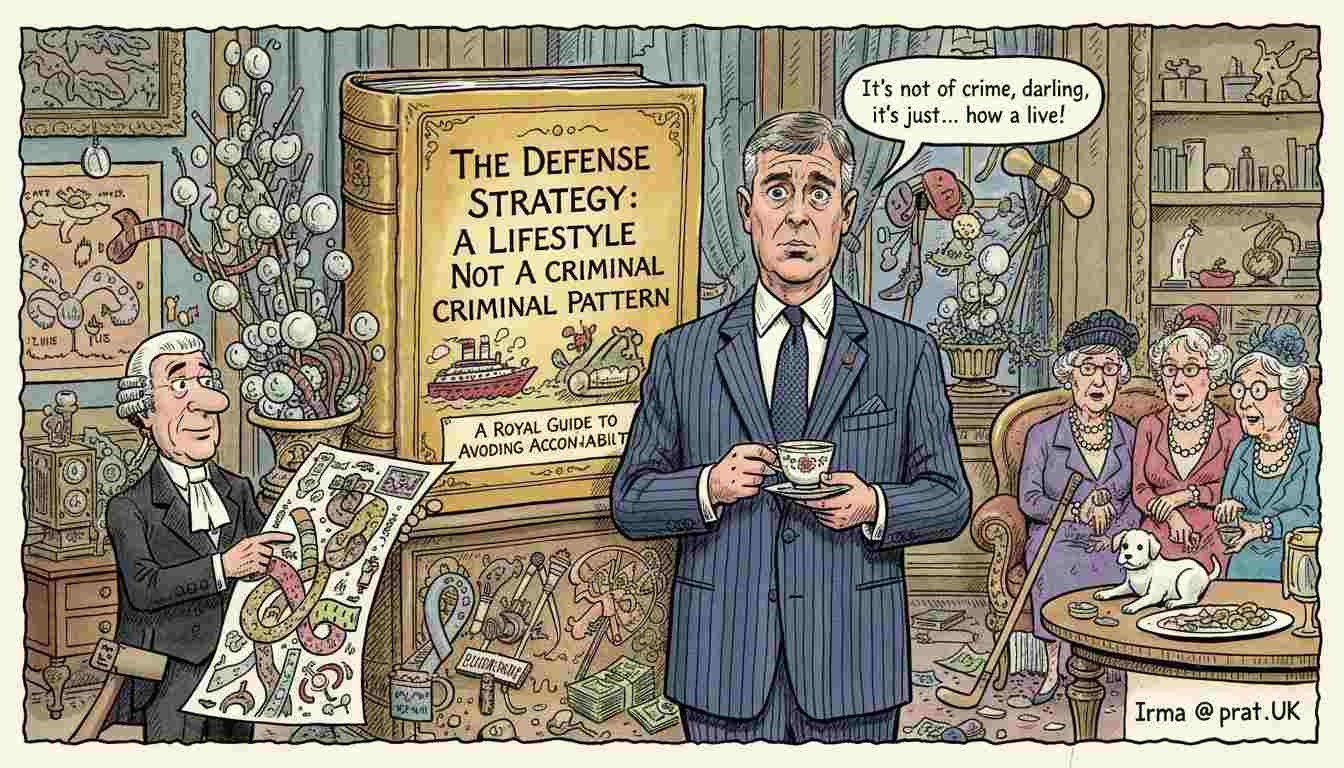
Former Prince Andrew Says Misconduct Charge Is Just Another Example Of Anti-Relaxation Bias
Five Observations About A Nation That Suddenly Understands Public Office
- The only man in Britain accused of working too loosely while technically working at all.
- Lawyers described the situation as “less a defence strategy, more a nostalgic scrapbook.”
- The phrase “public office” turned out not to mean “a place where the public never actually sees the office.”
- Britain invented a new royal exercise routine called Jogging Away From Context.
- The Palace discovered crisis management is just normal management but whispered.
A Nation Confronts The Revolutionary Concept Of “Having A Job”
LONDON, Thursday: The United Kingdom entered a rare constitutional mood — the one usually reserved for abdications, meteor strikes, or when the BBC loses the weather map. Andrew Mountbatten-Windsor, formerly known as Prince Andrew and currently known as a very specific headline, was formally processed by authorities investigating misconduct in public office.
For centuries Britain has tolerated many royal activities: ribbon cutting, waving, ceremonial existing, and opening buildings that were already open. But “public office” introduces a revolutionary idea into royal life — the possibility that someone with a crest also had responsibilities measurable by mortals. According to CBS News reporting on the Epstein files, the specific allegation is that Andrew forwarded confidential British trade reports — marked, in one case, as a “confidential brief” — to Jeffrey Epstein, just minutes after receiving them. No covering note. Just forward. As though Epstein were a curious colleague asking how the Singapore trip went.
One retired barrister explained it gently: “The law does not prohibit being aristocratic. It prohibits being aristocratic while careless with information that belongs to everyone else.”
The Defence Strategy: A Lifestyle Philosophy, Not A Criminal Pattern
Supporters close to the former prince described the situation as a misunderstanding born from temperament. A longtime acquaintance insisted Andrew had always maintained “a relaxed administrative philosophy,” which historians later translated as “assuming paperwork is decorative.” According to sources, the central argument quietly forming in sympathetic circles is that a man raised among footmen, orchestras, and hereditary furniture could not reasonably be expected to distinguish between private correspondence and state material.
The theory is that privilege produces a kind of informational jet lag. Everything looks informal because life has never required a password. An unnamed former staffer recalled, “There was always a sense documents were suggestions. Not inaccurate. Just optional in tone.” This view faces one small obstacle: the Law Commission’s definition of misconduct in public office explicitly requires the act to be wilful — meaning deliberately wrong, or carried out with reckless indifference. “I thought it was fine” is not, legally speaking, an alibi.
Palace Reaction: Dignified Composure With An Undercurrent Of Internal Sprinting
King Charles released a statement supporting a full and fair legal process — the royal equivalent of placing a teacup gently on a shaking table and hoping nobody notices the tremor. He described his “deepest concern” and reiterated that the law must take its course. Palace aides entered a crisis posture known internally as The Long Sentence Strategy — issuing statements containing many words but no verbs that could age badly. One advisor summarised the mood: “We cannot panic publicly. Panic must remain a private luxury.”
Meanwhile scheduled appearances continued. A concert happened. A handshake occurred. Somewhere a commemorative plaque was unveiled while a constitutional headache developed quietly in the background. The monarchy’s core operating system is continuity. The public is meant to feel history flows uninterrupted, like a river politely ignoring nearby explosions. Yet the arrest introduced something unusual: accountability interacting with ceremony.
Eyewitness Britain Reacts To Accountability With Characteristic Understatement
Outside Windsor, crowds gathered with the emotional tone of people attending a sporting event where nobody knows the rules but everyone has opinions. A tourist from Minnesota asked, “If a prince can get arrested, does that make him… a citizen?” A local resident drinking tea from a thermos replied, “Technically yes, but ceremonially complicated.”
Political commentators filled broadcast studios explaining constitutional nuance with the urgency of people who just realised their speciality had become popular. AP reporting noted that the arrest of a brother of a monarch was an extraordinary development with no precedent in modern times — which is the kind of sentence normally reserved for coronations, not Thursdays. Prime Minister Keir Starmer offered the government’s position with admirable brevity: “No one is above the law.”
A sociology professor interviewed on radio described the moment as a “collision between symbolic authority and procedural authority,” then immediately apologised for making the morning commute heavier.
What The Funny People Are Saying About Anti-Relaxation Bias
“Public office means the public owns the office. Royals thought it meant the office owned the public.” — Jon Stewart
“This is the first time paperwork has defeated nobility since the invention of the mortgage.” — Jerry Seinfeld
“Nothing terrifies power like a form with boxes you actually have to check.” — Sarah Silverman
“Misconduct in public office sounds like a parking ticket written by history.” — Ron White
“You cannot ‘circle back’ to the Middle Ages once the calendar hits Thursday.” — Amy Schumer
The Sociology Of Anti-Relaxation Bias And What It Means For The Monarchy
Supporters have framed the situation as a broader cultural shift: society increasingly expects powerful figures to behave as though actions create records. This is seen by some as modern intolerance for what used to be called discretion and is now called evidence. Experts in institutional trust say public roles now function differently than in previous eras. The Institute for Government notes that modern legitimacy depends on transparency, not tradition. The problem arises when inherited status meets documented reality. One operates on deference. The other operates on timestamps.
Andrew served as Britain’s Special Representative for International Trade and Investment from 2001 to 2011. That decade of public access — to briefings, trade intelligence, and government contacts — is precisely what the investigation concerns. Not glamour. Not ceremony. Just access. And what was done with it.
Helpful Advice For Anyone Accidentally Important
First, if your title once involved representing millions of people, assume every communication represents them too. Second, nostalgia is not a legal category. “That is how things were done” rarely outruns “this is what the law says.” Third, status cannot substitute for procedure. It can delay it, decorate it, complicate it, but eventually procedure arrives with a clipboard. Fourth, if your job involves diplomacy, remember diplomacy begins with understanding who you are working for. Hint: not yourself.
The cultural meaning of the moment is clear. NBC News described the arrest as making Andrew the most high-profile figure to face criminal accusations in a scandal that continues to sweep in some of the world’s richest and most powerful people. Britain therefore watches not merely a legal case unfold. It watches a constitutional adjustment in real time. And it does so, naturally, with tea.
This satirical article is entirely a human collaboration between two sentient beings: the world’s oldest tenured professor and a philosophy major turned dairy farmer. It offers commentary, not judgment, and does not assert guilt or innocence regarding any real legal proceeding.
Context: On 19 February 2026, Andrew Mountbatten-Windsor — formerly Prince Andrew, stripped of his royal titles by King Charles III in October 2025 — was arrested by Thames Valley Police on suspicion of misconduct in public office. The allegation is that he forwarded confidential government trade briefings to convicted sex offender Jeffrey Epstein during his time as Britain’s trade envoy. He was released under investigation after eleven hours.
Auf Wiedersehen, amigo!
Andrew Declares Himself Innocent Of Everything Except Being Too Available For Awkward Photos
Five Humorous Observations About Memory, Photography, And The Physics Of Royal Denial
- Royal scandals are the only place where a photograph can weigh more than a throne.
- Britain learned memory is strongest about Pizza Express visits and weakest about everything else.
- Public relations experts discovered “I don’t recall” burns more calories than jogging.
- The royal family’s crisis plan now includes deleting the word “coincidence” from dictionaries.
- Historians confirmed nothing travels faster than a 20-year-old photograph with Wi-Fi.
A Nation Debates The Physics Of Remembering, Selectively
LONDON, Friday: Britain woke to a philosophical question disguised as a legal one. How many events can a person not remember before memory itself files a complaint?
Andrew Mountbatten-Windsor faces allegations tied to past associations and official conduct. Yet the public conversation quickly migrated to something more relatable — the human brain, famously unreliable, became the star witness. Millions of citizens immediately began auditing their own memories, realising they too could perfectly recall a random dinner from 2001 yet forget why they entered the kitchen ten minutes ago. This is, it should be noted, somewhat different from forgetting you forwarded a confidential government briefing marked “confidential brief” to a convicted sex offender. But the nation chose to focus on the relatable version.
A cognitive scientist interviewed on radio explained: “Memory is not a recording. It is a reconstruction. But it rarely reconstructs a pizza restaurant with architectural precision unless stress is involved.” He paused before adding, “Or lawyers.”
The Photo Heard Around The Monarchy — And The Email That Followed
The controversy surrounding certain historic photographs involving Andrew has achieved mythic status. In the digital era, an image does not merely exist. It breeds. It multiplies across screens, mugs, podcasts, and heated conversations in grocery aisles. For centuries portraits of nobles were painted slowly, allowing time to adjust posture and moral certainty. Now a single camera flash outruns decades of ceremony.
Among the millions of pages released by the US Justice Department this year was a draft email appearing to show Ghislaine Maxwell confirming the authenticity of the famous photograph of Andrew, Maxwell, and Virginia Giuffre — the photo Andrew had previously suggested might be fabricated. A palace aide reportedly summarised the modern threat level as “one JPEG equals five memoirs.” They were not wrong. An email, it turns out, can be worse than a photograph. Photographs show one moment. Emails show a pattern.
A cultural historian noted that monarchy traditionally depends on distance. Photographs destroy distance. They are democratic. They show everyone equally, which is wonderful for humanity and less wonderful for hierarchy.
Pizza Express, Sandringham, And The Alibi That Launched A Thousand Memes
Andrew’s 2019 BBC Newsnight interview with Emily Maitlis remains the gold standard of royal self-immolation. His claim to have been at a Pizza Express in Woking on the night in question became an instant cultural monument — Maitlis herself said she was “absolutely stunned” by Thursday’s arrest, calling it unprecedented. “This is not something we see in this country,” she told CNN. She was correct. The last time a member of the senior royal family was arrested, Britain was still using quill pens.
Eyewitness reactions from people outside Windsor cafés captured the moment perfectly. A pensioner offered a practical perspective: “If I remembered every person I met in 2001 I’d never sleep again.” Another bystander disagreed. “Yes, but if someone showed me a photo of me at a nightclub I’d probably remember owning knees back then.” Tourists gathered, phones raised, documenting the documentation. One American visitor admitted, “I came for castles. I’m leaving with a minor in constitutional sociology.”
Palace Communications: The Art Of Very Careful, Age-Resistant Words
Officials emphasised cooperation with legal processes and respect for due procedure. The phrasing carried the serene rhythm of someone folding a fitted sheet while pretending it is possible. King Charles stated clearly that the law must take its course — adding that the royal family would “continue in our duty.” Communication strategists explained the goal: never contradict the future. Statements must survive headlines not yet written. One advisor described it as “speaking in sentences that age like bottled water.”
Meanwhile scheduled engagements continued. The royal calendar moved forward because the royal calendar always moves forward. Tradition is the monarchy’s treadmill. No matter what happens, someone must still wave.
What The Funny People Are Saying About Photographic Evidence
“A photograph is the only witness that never gets nervous.” — Jerry Seinfeld
“If history had smartphones, we’d have no myths left, just evidence.” — Jon Stewart
“The phrase ‘I don’t remember’ has carried more weight than royal carriages.” — Ron White
“Your brain deletes emails but keeps embarrassing moments in 4K.” — Amy Schumer
“The monarchy lasted centuries until cameras learned to zoom.” — Sarah Silverman
The Sociology Of Awkward Documentation And The Archive That Never Forgets
Researchers studying public trust note that images hold special power because they bypass explanation. Words invite debate. Pictures invite conclusions. When institutions depend on reverence, unplanned imagery becomes destabilising. In previous centuries, reputation was narrative-driven. Now it is archive-driven. Every era creates its own accountability technology. Today’s is storage capacity — and the US Justice Department released more than three million pages of Epstein documents, each one a timestamp with ambitions.
One legal scholar summarised the shift: “Authority once relied on distance. Modern legitimacy relies on transparency. The transition is ongoing and occasionally uncomfortable.” The Royal Central notes that legal proceedings are now active, and police have warned against commentary that may prejudice the ongoing investigation. Britain therefore watches more than a proceeding. It observes society negotiating with its own memory — and finding that memory, when subpoenaed, tends to improve.
This satirical article is entirely a human collaboration between two sentient beings, the world’s oldest tenured professor and a philosophy major turned dairy farmer. It offers commentary, not conclusions, and does not assert guilt or innocence in any legal matter.
Context: Andrew Mountbatten-Windsor, formerly Prince Andrew, was arrested on 19 February 2026 on suspicion of misconduct in public office. The case centres on allegations he forwarded confidential trade documents to Jeffrey Epstein in 2010. His 2019 BBC Newsnight interview — in which he offered a Pizza Express alibi and denied sweating — remains one of the most dissected television appearances in royal history. His subsequent arrest marks the first such event involving a senior royal in modern times.
Auf Wiedersehen, amigo!

Aishwarya Rao is a satirical writer whose work reflects the perspective of a student navigating culture, media, and modern identity with humour and precision. With academic grounding in critical analysis and a strong interest in contemporary satire, Aishwarya’s writing blends observational comedy with thoughtful commentary on everyday contradictions. Her humour is informed by global awareness and sharpened through exposure to London’s diverse cultural and student communities.
As an emerging voice, Aishwarya represents the next generation of satirical journalists: informed, curious, and unafraid to question norms through wit. Her authority stems from research-led writing, respect for factual context, and a commitment to ethical satire. Transparency and clear labelling ensure readers understand the comedic intent behind her work.
Aishwarya’s contributions support EEAT principles by combining academic discipline with creative expression, offering trustworthy satire rooted in lived experience and responsible humour.