
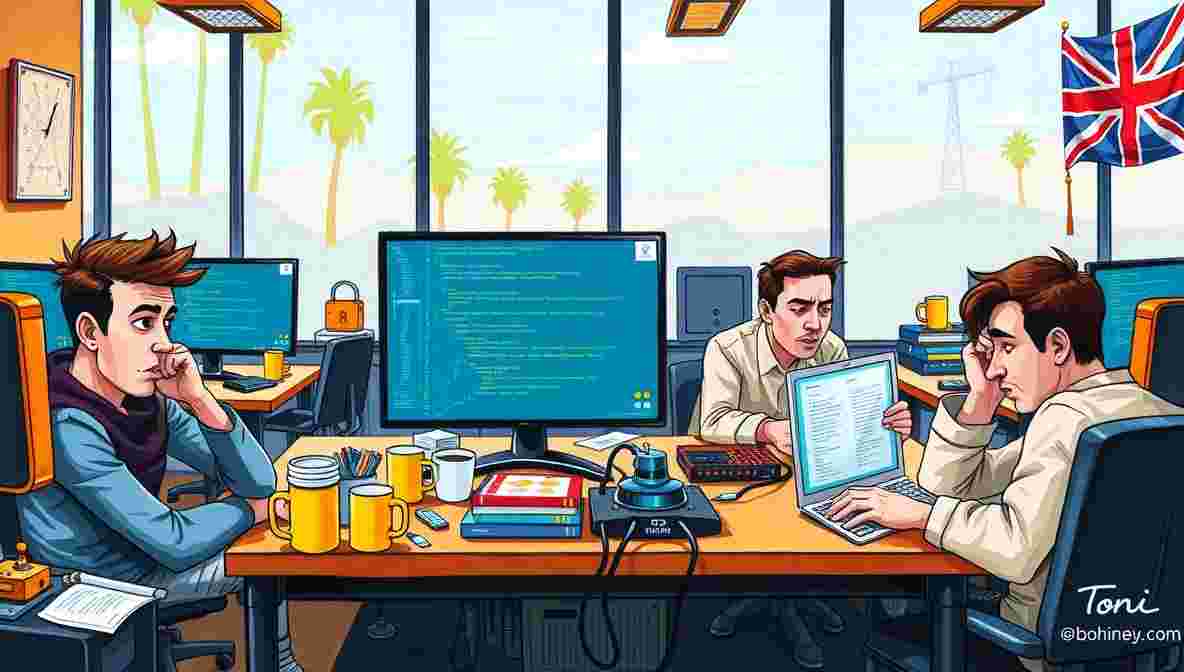
Thinking About Leaving the UK to Work in AI, Think Again!
So. You’ve had enough. The weather is grey, the trains are cancelled, and your landlord has just raised the rent to something that would make a Victorian workhouse master blush. You’ve been scrolling LinkedIn at midnight and there it is: Senior AI Engineer, San Francisco. Relocation package. Kombucha fridge. Dreams funded.
Think again.
San Francisco has always been a place where people go to invent the future. Now they’ve succeeded. The future is… working forever. And you, sitting in your perfectly reasonable Peckham flat with your cup of builder’s tea, your statutory 28 days’ annual leave, and your human right to eat lunch away from a screen — you are about to give all of that up voluntarily.
According to a recent Guardian report on AI startup culture, employees are casually clocking 12-hour days, six or seven days a week, sleeping near their laptops like monks guarding sacred spreadsheets.
Which finally explains why Silicon Valley coffee tastes like panic. And regret. And a Series A that’s already on extension. At least Costa charges you £4.80 for panic. Over there, it’s free. It comes with the job. It is the job.
The New Work-Life Balance: Work And Slightly Different Work
At one AI startup, founders reportedly work from 9am to 3am inside a shared apartment, leaving only for cigarettes and food deliveries. (The Guardian)
This is no longer a job.

This is a terrarium.
Back home, you moan that your commute on the Northern line takes 45 minutes. In San Francisco, the commute has been eliminated entirely. You live at work. You are work. Your post has been redirected to a GitHub repository.
Anthropologists once studied hunter-gatherers to understand human nature. Now they study programmers eating noodles over a keyboard while whispering to a chatbot: “Please don’t automate me.” The chatbot, of course, is already writing the email to HR.
A senior engineer explained the schedule:
“I don’t have burnout. I have version 3.2 of consciousness.”
He says weekends still exist, but only in historical documentaries. Netflix has already optioned the series: Weekend: A Miniseries About A Time Before Git Push.
Meanwhile, you in the UK still have 28 days of statutory annual leave. Twenty-eight. Days. Where you are legally required to not be at work. This is called a “human right.” In Silicon Valley, it is called “low urgency” and it gets flagged in your performance review.
The concept of work-life balance, which humans briefly enjoyed between 1975 and 2012, has now been disrupted, iterated upon, and shipped to the archive. Your British work-life balance — tea break at 11, lunch at 1, another tea break because it’s been a bit much — is not a flaw. It is civilisation.
Cafés Have Become Coworking Museums
A founder noted that on Sundays every café in San Francisco is full of workers coding. (The Guardian)
You remember Sundays. That was the day humans used to experience “sky.” And a roast dinner. And The Antiques Roadshow. And the specific low-level dread that wasn’t about your deployment pipeline.
Now Sunday in the Valley is simply Saturday with better Wi-Fi.
Baristas no longer ask, “For here or to go?”
They ask, “Deploy or rollback?”
One coffee shop has replaced the pastry display with a whiteboard labelled:
“Today’s Failures: emotional, technical, romantic.”
The café-as-office phenomenon has been studied extensively by people who were also sitting in cafés, on laptops, studying it.
A barista in the Mission District recently applied for a software engineering role. Her qualifications: “I have watched 4,000 pivots happen over flat whites. I understand the product roadmap better than the CEO. Also I can make a latte.”
She was hired as Chief Coffee Officer. She now works 14-hour days. She did not see this coming.
Back in Britain, the British café remains a sanctuary. Nobody is deploying anything in a Greggs. You eat your sausage roll in peace. This is not a small thing. This is everything.
The Great Irony: Building The Machine Replacing You
Engineers are working harder than ever partly because AI may replace junior developers. (The Guardian)
So the job description now reads:
Position: Software Engineer
Duties: Teach computer to do job better than you
Benefits: Existential dread
Pension: We’ll have the AI explain what that word means
Visa sponsorship: Yes. (You will need it. You cannot leave.)
Imagine being a blacksmith forging a robot hammer that whispers:
“Thanks, Dave. You can go now.”
A Stanford HAI study suggests early-career employment is already declining in AI-exposed industries. A thriving UK tech sector still exists, employs people, and occasionally lets them go home at 6pm without moral judgement.
So the Silicon Valley career ladder now looks like this:
Graduate → Intern → Junior Dev → Mid-Level Dev → Founder → Series A → Series B → Acqui-hired → Obsolete → LinkedIn influencer about being obsolete → Podcast about the LinkedIn post → Burnout memoir → Speaking at a conference about burnout → Burnout again
The LinkedIn post writes itself. Actually, it does. The AI wrote it. Dave didn’t even know. Dave is in Shoreditch now. Dave is fine. Dave has benefits.
The Layoff Wellness Era
Tech layoffs reached about a quarter-million workers in 2025, with AI cited as a major factor.
Companies used to offer yoga and mindfulness sessions.
Now they offer a meditation app that gently repeats:
“You are not your job… because your job is a script.”
An executive coach said companies no longer talk about belonging and wellbeing but about disruption and uncertainty.
In corporate terms, “uncertainty” means:
You still work here.
We just don’t know why yet.
In the UK, if your employer makes you redundant, you are legally entitled to redundancy pay. You get a notice period. You get a letter. In San Francisco, you get an email at 4am that bounces because your account has already been suspended. Your building pass stops working before you’ve finished reading it. Security is very polite about it. They’ve had practice.
HR has pivoted from “employee experience” to “departure optimisation.” The ping-pong table has been replaced with a self-checkout redundancy kiosk. You scan yourself out. There’s a cheerful sound effect. The founders call it “the off-boarding experience.” There is a 4.2-star review on Glassdoor. The reviewer gave it five stars but the AI rounded down.
The Culture Of Competitive Insomnia
Workers say if you take the weekend off, you fall behind because tools change daily.
This means sleep is now a technical debt.
I met a developer who scheduled dreams in 20-minute sprints.
He woke up shouting:
“We pushed a patch to reality!”
He had optimised REM cycles for productivity but accidentally removed joy as a dependency.
His therapist now runs on a subscription model. Tier One: He listens. Tier Two: He nods. Tier Three: He suggests you might be the bug.
Sleep deprivation and work performance have been studied extensively. The conclusions are not good. The tech industry has read them and responded with a new productivity timer. The NHS recommends seven to nine hours of sleep. The NHS is not currently seeking Series B funding, so nobody in San Francisco will listen to it.
The New Status Symbol: Being Busy Near Electricity
In the past, luxury meant free time.
Now luxury means being “so busy.”
People brag like this:
“I haven’t seen my family in months.”
“Nice, we pivoted away from relationships in Q3.”
Networking events are just exhausted people staring at each other, hoping someone else invented retirement. Nobody has. Three people are working on it. They haven’t slept since February.
The cultural shift in attitudes toward busyness means that “I’ve been really present with my kids lately” is now a career red flag. A VC recently passed on a founder because he “seemed rested.” The term in the report was “low urgency.” The founder is now a secondary school teacher in Wolverhampton. He is very happy. He gets a lunch break. He has not been disrupted once.
You were going to leave for this.
The AI Arms Race Diet
Old Silicon Valley drank Soylent to avoid leaving desks.
Now workers consume “nutritional abstractions.”
One startup introduced a meal replacement called CommitMint.
Ingredients: caffeine, fear, venture capital expectations.
Taste: opportunity.
Side effects: accidentally founding three companies while chewing.
The ultra-processed food consumption among tech workers has reached historic levels. Nutritionists have attempted to intervene. The startups have hired the nutritionists and made them ship features. The features are about nutrition. Nobody reads them. Everyone is eating CommitMint.
A funding round of £32 million — sorry, $40 million, they do not deal in sterling, sterling is for people with pensions — was closed last Thursday. The lead investor described the vision as “removing the human need for meals.” The pitch deck had a slide called “Food is a Distraction.” It got a standing ovation. Two people fainted. Unclear if from hunger or enthusiasm.
You were going to give up a proper Sunday roast for this.
When Passion Meets Panic

Many workers say they’re energised by innovation even while anxious about their future.
This is a brand-new emotion:
Excited terror.
It’s like riding a roller coaster you built yourself while reading the manual titled “Probably Safe.”
It’s like getting on a Southern Rail train but the train is your career and the delay is your soul.
Psychologists have a clinical term for this state. They’re working on the paper. They haven’t published yet because they are also feeling it. The paper is currently titled “We Don’t Know Either But Here Is A Framework.” It has 40,000 pre-prints. Zero conclusions. High citation count. Strong Q3 numbers.
Meanwhile, Back In Blighty…
Yes, the UK has problems. The cost of living is eyewatering. The trains are a national comedy. The government has the structural confidence of a flat-pack bookcase assembled without the instructions.
But.
You have the NHS. You have employment law. You have ACAS. You have a culture in which it is perfectly normal to leave the office at a reasonable hour without anyone filming a documentary about your lack of ambition.
You have bank holidays. You have sick pay. You have the legal right to ask for flexible working. You have the vague but real social contract that says your employer cannot simply turn off your email at 4am and change the locks.
And you have, somewhere in your city, a pub. A real one. With sticky carpet and a landlord who cannot be disrupted, acquired, or replaced by a large language model.
That pub will be there when you finish work. At a normal time. On a Friday. Like a human being.
Society Will Copy This Immediately
Historically, companies copied Silicon Valley perks like free lunches.
Soon other British institutions will copy this too.
The NHS:
“Your appointment is now a 14-hour collaboration sprint. Please push to the waiting list branch.”
British schools:
“Homework never ends. It’s a continuous integration curriculum. OFSTED will review your merge requests.”
National Rail:
“We have replaced drivers with motivational posters about efficiency. Your train is delayed. The poster is on time.”
The Post Office:
“Grief has been deprecated. We now offer a closure API. Integration takes 3-5 business days, assuming Horizon doesn’t flag you as a criminal.”
Your local council:
“Your bin collection needs better sprint planning. Have you considered a shared Jira board for waste management?”
What The Funny People Are Saying
“I miss when robots took factory jobs. Now they want my lunch break.” — Jimmy Carr, probably, if his accountant had been replaced by an algorithm
“Work from home used to mean comfort. Now it means your sofa files bug reports.” — Sarah Millican, allegedly, during a very long stand-up sprint
“I asked AI for a work-life balance and it generated a calendar with only work.” — Lee Mack, if Lee Mack had moved to Palo Alto and made a terrible mistake
“My out-of-office reply now has a higher performance review than I do.” — Anonymous, somewhere in SoMa, crying into a mechanical keyboard, missing Greggs
“We disrupted sleep. Now sleep is disrupting us back.” — Dara Ó Briain, probably, if he worked in fintech and hadn’t had the good sense to stay in London
The Philosophical Ending Nobody Wanted
The startups are trying to build intelligence.
But they accidentally built a mirror.
Humans optimised everything except stopping.

We invented machines to save time and then scheduled more meetings with the saved time.
We automated tasks and replaced them with worrying about automation.
We built artificial general intelligence to solve the great problems of humanity and used it to write subject lines for cold emails.
So the Valley has achieved the final productivity breakthrough:
Working harder to avoid a future where nobody works.
It’s the first economy powered entirely by anticipation.
And somewhere in a glowing apartment at 2:47am, a developer from Nottingham who moved to San Francisco for the opportunity whispers to an AI assistant:
“Will you take my job?”
The AI pauses.
Calculates.
Then schedules another meeting.
It has also written a follow-up email, a Slack message, a LinkedIn post about the meeting, a Medium article about the LinkedIn post, and a podcast episode about the Medium article.
The developer is already late for all of it. He hasn’t seen a proper pub in two years. He can’t remember what a bank holiday feels like. He dreams in sprints.
Back home, someone just took the last seat on the 17:52 from Paddington. It’s delayed by 14 minutes. There’s no Wi-Fi in the third carriage. The man opposite is eating a Pret sandwich.
It’s beautiful.
Stay.
Auf Wiedersehen, amigo!

Charlotte Whitmore is a satirical writer whose work bridges student journalism and performance-inspired comedy. Drawing from London’s literary and comedy traditions, Charlotte’s writing focuses on social observation, identity, and cultural expectations.
Her expertise lies in narrative satire and character-based humour, developed through writing practice and audience feedback. Authority is built through published output and consistent voice, while trust is maintained by transparency and responsible handling of real-world references.
Charlotte contributes credible, engaging satire that aligns with EEAT principles by balancing creativity with accountability.