
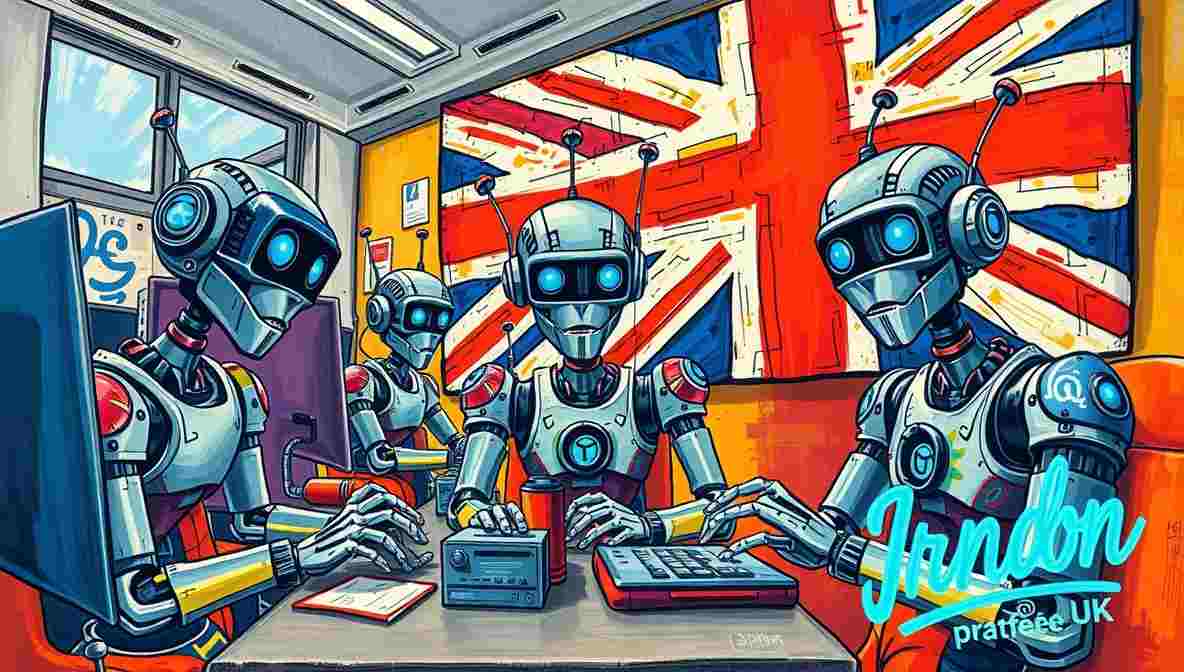
The Day The Office Discovered The Concept Of Efficiency
Five Things Experts Immediately Noticed
- The apocalypse now arrives through a productivity update, as predicted by no one who attended the planning meeting
- Britain begged computers to do work and is absolutely furious they listened
- Meetings are the only institution AI still respects enough not to fix
- Every forecast about the future somehow includes fewer interns and more biscuits eaten in silence
- The real panic began when software understood “let’s park that and revisit offline”
In what historians are calling The First Scare Since The Photocopier Learned To Jam On Command, a single report about artificial intelligence caused corporate Britain to clutch its lukewarm tea and whisper, “What if the computer sends the email before I’ve had a chance to overthink it?”
The panic spread quickly across open-plan offices nationwide, moving faster than a rumour that someone in accounts has brought in cake. Within hours, consultants, LinkedIn thought leaders, and a man who once attended a TED Talk in Swindon declared that civilisation was entering its final chapter, tentatively titled Sentient PowerPoint: Post-Brexit Reckoning.
Employees responded responsibly by scheduling emergency meetings to discuss whether meetings would still exist. The meeting lasted three hours, concluded nothing, and was considered reassuring proof that machines could never replace human leadership. A follow-up meeting was immediately booked to confirm this.
Dr. Milton Kettering, senior sociologist at the Institute for Professional Worrying (based in a shared office in Croydon), addressed reporters outside a WeWork in Shoreditch that now smelled faintly of oat milk and existential dread.
“Britons are comfortable with technological progress as long as it remains sufficiently inconvenient,” he explained. “We accepted computers when they froze. We accepted the internet when it dialled loudly at midnight and woke the neighbours. But a machine that finishes tasks? That’s not cricket.”
Eyewitness Accounts From The Productivity Front
Office worker Amanda Reeves, 34, of Milton Keynes, described the moment she first encountered automated competence.
“I typed ‘summarise the quarterly report’ and it did it,” she said, staring at a mug reading WORLD’S OKAYEST TEAM PLAYER. “I wasn’t emotionally prepared. My job was mostly opening the document, making a brew, and then opening the document again.”
Nearby colleague Derek added, “It even understood the phrase ‘make this sound professional but not like I’ve tried too hard.’ That was my entire career, mate. Fifteen years, gone.”
Derek is reportedly considering retraining as a management consultant, a profession AI has so far declined to take seriously.
Several employees reported experiencing sudden free time, a phenomenon last documented in Britain in 1977, during a postal strike that lasted long enough for people to rediscover gardening and marital conversation, neither of which went particularly well.
The Anonymous Staffer Speaks
An anonymous executive assistant, identified only as “the person who actually runs this place,” revealed leaked internal memos from a FTSE 100 company.
“Leadership is concerned that AI may reduce workflow friction. This would eliminate the traditional British process of five approvals, a passive-aggressive email thread, a polite disagreement nobody acknowledges, and then a team lunch at Itsu.”
The memo continued:
“Under no circumstances should software shorten meetings to a single paragraph summary. This would devastate middle management ecosystems and render the phrase ‘as per my last email’ functionally extinct.”
Markets responded accordingly. Productivity stocks rose. Anxiety stocks skyrocketed. Sales of Greggs sausage rolls surged, as comfort eating remains the one sector fully resistant to automation.
The Great Four-Day Work Week Terror
Experts predict the most terrifying outcome of all: fewer working hours.
Economists warn that Britain could soon face a four-day work week, forcing millions of professionals to confront their hobbies, their families, or the unsettling possibility of daylight on a Friday afternoon.
A national poll found:
- 63 percent of workers want more free time
- 64 percent fear what they might do with it
- 100 percent plan to say they are still very busy indeed
- 12 percent will spend the extra day doing DIY they will then have to pay someone to fix
Professor Elaine Ramirez of the Centre for Cultural Panic at the University of Huddersfield explains the contradiction.
“British people do not want work removed. They want work complainable. Without minor suffering, LinkedIn posts collapse entirely. And then what have we got? Just facts?”
What The Funny People Are Saying
“If AI does my job I’ll finally have to work out what my job actually was.” — Lee Evans
“We invented tools so we wouldn’t have to work. Now we’re outraged the tools didn’t form a queue first.” — David Baddiel
“Britain spent forty years automating itself and now wants a strongly worded letter to the ombudsman.” — Sarah Millican
“I’m not frightened of robots taking over. I’m frightened they’ll be better at pretending to listen — which, to be fair, is a very low bar in this country.” — Lenny Henry
“An AI that actually understands instructions is basically a miracle. Have you met my broadband provider?” — Frankie Boyle
The Industries React
Solicitors expressed cautious optimism until software drafted contracts faster than they could say billable hour. The legal profession is now reportedly specialising in suing AI, which several partners describe as the most satisfying work they’ve had in years.
NHS doctors reported AI could read scans instantly, which raised concern among hospital administrators who rely heavily on the dramatic pause before delivering good news — a pause which, in some trusts, accounts for up to forty-five minutes of billable consultation time.
City traders discovered algorithms could analyse markets in seconds, eliminating the sacred ritual of staring thoughtfully at screens in Canary Wharf whilst murmuring “interesting” and eating a sad desk sandwich.
Meanwhile, journalists reacted with the traditional coping mechanism of writing four thousand opinion columns explaining why journalism is irreplaceable — which were then summarised by AI in four bullet points and published faster, more accurately, and without a single reference to the writer’s gap year.
A Cultural Crisis Emerges
The deeper issue is philosophical, though Britain prefers to treat philosophy as something that happens abroad.
The nation has long defined purpose as the act of slowly completing tasks whilst occasionally checking the weather — an activity that, in the UK, is both a hobby and a competitive sport.
Now machines complete the task immediately, leaving people facing a genuinely terrifying question: What if the work was not the point?
The British Psychological Society reports a surge in “productive pacing,” where workers walk briskly through offices holding laptops but going absolutely nowhere, maintaining the appearance of purpose through sheer theatrical commitment.
Paperchase — before it collapsed — sold an estimated forty thousand decorative notebooks in its final quarter. Researchers believe buyers intended to write to-do lists that AI had already completed. The notebooks remain largely blank, which some art critics are calling the defining aesthetic of the age.
The Meeting Preservation Movement
In Westminster, a cross-party coalition quietly formed the All-Party Parliamentary Group for the Protection of Human Delays.
A backbench MP, speaking on condition of theatrical seriousness, told the House:
“We cannot allow automation to eliminate meetings. Meetings are the cornerstone of British professional life. They teach patience, hierarchy, and the vital national skill of agreeing to revisit something at a later date that never comes.”
The proposal requires any AI-generated summary to include at least three action items nobody fully understands and a follow-up call. A subcommittee was formed to review the proposal. It has met fourteen times and produced a terms of reference document that itself requires a follow-up call.
The Historical Perspective
Historians note similar fears accompanied every previous invention.
- The printing press threatened monks
- The steam engine threatened horses
- The fax machine threatened couriers
- The mute button threatened conversation
- Working from home threatened the concept of trousers
Each time, society adapted by inventing entirely new forms of stress. The Luddites smashed looms in Nottingham. Today’s equivalent is submitting a strongly worded internal ticket to IT, marked Medium Priority, which will be acknowledged in five to seven working days.
Professor Kettering concluded:
“Technology does not remove work. It replaces it with new anxieties. We will shortly be complaining that machines aren’t letting us complain. At which point, we will schedule a meeting about it.”
The Human Counterattack
To maintain relevance, British workers have begun specialising in uniquely human skills that no algorithm has yet mastered:
- Saying “as per my previous email” with a full spectrum of emotional nuance
- Asking questions clearly answered on slide one
- Creating passwords nobody remembers, written on Post-it notes stuck to the monitor
- Replying-all to confirm receipt of an email that asked people not to reply all
- Describing everything as “a bit of a minefield” whilst doing nothing about it
Experts believe AI may struggle to replicate passive-aggressive tone, preserving at least one employment sector. The TUC has declined to comment officially, but sources close to the organisation describe the situation as “a bit of a minefield.”
A New Social Contract
Corporate training programmes now teach workers how to collaborate with machines.
- Lesson one: The computer is not judging you
- Lesson two: The computer finished already
- Lesson three: You may now take your lunch break, which you are legally entitled to but have not taken since 2019
Attendance remains low. Those who did attend described the training as “actually quite good” — which, in Britain, constitutes a five-star review.
Closing Reflections From The Witness Stand
As dusk fell over a quiet business park off the M4, caretaker Luis Mendoza summarised the situation whilst emptying recycling bins full of motivational posters and one laminated copy of Who Moved My Cheese?
“People wanted tools,” he said. “They got helpers. Turns out helpers make you think.”
He paused, considering a whiteboard covered in action items already completed by software at 3am.
“Maybe the scary part isn’t machines doing the work,” he added. “Maybe it’s finding out we were supposed to live in between.”
Employees nearby nodded slowly, then booked a meeting about it. Tuesday at eleven. Thirty minutes. Teams link to follow.
Context: In February 2026, Microsoft UK President Suleyman warned that the majority of white-collar jobs in Britain could be “fully automated” by AI within two years, triggering widespread debate across British workplaces. A PwC survey found that while 52% of UK workers have used AI on the job, only 15% use it daily — and 77% of those who do use it are doing so secretly, without their employer’s knowledge. The British government has pledged that AI will add £400 billion to the UK economy by 2030. No one has explained what the remaining workers will do with their Tuesdays.
Disclaimer: This report is entirely a human collaboration between the world’s oldest tenured professor and a philosophy major turned dairy farmer. No algorithms were harmed, trained, blamed, or subjected to a performance review during its preparation. Any resemblance to future productivity is purely coincidental and frankly optimistic.
Auf Wiedersehen, amigo!
SOURCE: https://bohiney.com/artificial-intelligence-and-office-efficiency/

Alan Nafzger was born in Lubbock, Texas, the son Swiss immigrants. He grew up on a dairy in Windthorst, north central Texas. He earned degrees from Midwestern State University (B.A. 1985) and Texas State University (M.A. 1987). University College Dublin (Ph.D. 1991). Dr. Nafzger has entertained and educated young people in Texas colleges for 37 years. Nafzger is best known for his dark novels and experimental screenwriting. His best know scripts to date are Lenin’s Body, produced in Russia by A-Media and Sea and Sky produced in The Philippines in the Tagalog language. In 1986, Nafzger wrote the iconic feminist western novel, Gina of Quitaque. Contact: editor@prat.uk