
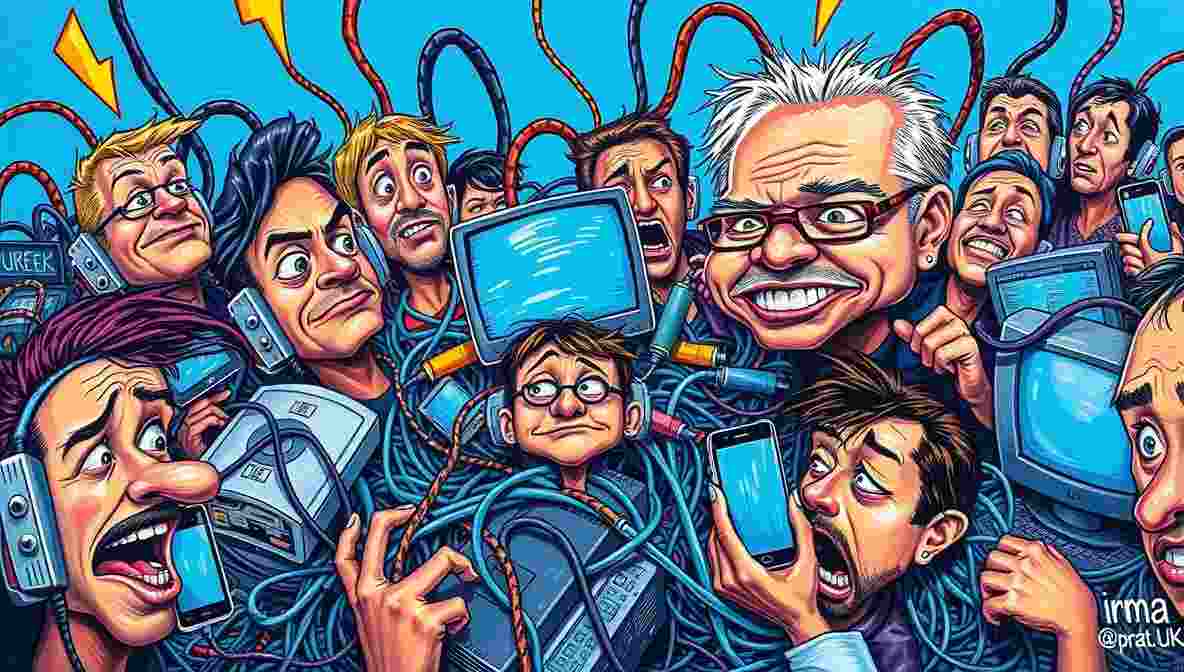
For a while there, the Internet looked like humanity’s smartest invention. Libraries without dust. Communication without postage stamps. A place where knowledge flowed freely and cat pictures were shared in a spirit of global cooperation. Historians now agree this honeymoon period lasted approximately six minutes, ending the moment someone figured out how to leave a comment.
The Internet did not collapse in a dramatic explosion. It sagged. It filled with pop-ups, opinions, and people explaining things they learned ten seconds ago with the confidence of a Nobel laureate who just got back from a TED Talk. Somewhere between dial-up modems screaming like tortured robots and push notifications buzzing at 3:14 a.m., civilization quietly lost the plot.
This is not nostalgia talking. This is forensics.
A Tool Designed for Knowledge, Immediately Used for Nonsense

The original promise of the Internet was access to information. Scientists would collaborate. Students would learn. Journalists would verify sources. Instead, the first thing humanity did was upload blurry photos of pets and argue about whether a dress was blue or gold.
According to early Internet researchers who now refuse to make eye contact at conferences, no one anticipated how quickly serious tools would be repurposed for unserious behavior. The same infrastructure that allows astrophysicists to share data across continents also allows a man named Rick from three towns over to explain why doctors are wrong and his cousin’s Facebook post proves it.
A leaked memo from an early tech company reportedly warned, “If given infinite information, users may still choose to watch people fall off skateboards.” This memo was ignored.
Ten Observations on “The Internet!”
-
The Internet began as a way for scientists to share research and somehow evolved into a place where a man with a truck profile picture can declare himself an expert on epidemiology, geopolitics, and women.
-
The greatest lie the Internet ever told us was that everyone deserved a voice. Some people needed a journal. Some needed a therapist. Very few needed a livestream.
-
Before the Internet, village idiots were confined to villages. Now they have global reach, monetization options, and a merch store.
-
The phrase “do your own research” now means “I watched half a video while microwaving leftovers and formed a personality.”
-
The Internet didn’t kill attention spans. It chopped them into bite-sized pieces, deep-fried them, and served them between two ads for something you already bought.
-
Social media promised connection but delivered a high-speed comparison engine where everyone else is either richer, happier, or committing crimes in a way you’re apparently doing wrong.
-
The comment section is the only place where someone can read a sentence they agree with and still find a way to be furious about it.
-
The Internet turned hobbies into battlegrounds. You can’t enjoy coffee, fitness, movies, or bread anymore without being informed that you’re doing it “incorrectly” and morally.
-
Every online argument lasts forever because nobody is allowed to change their mind without issuing a public apology tour and losing three friends.
-
The Internet gave humanity unlimited information and we used it to argue with strangers, stalk exes, and learn just enough to be dangerous at dinner parties.
Democracy, Now With a Comment Section

The Internet did not invent opinions, but it industrialized them. It took the casual thought you once shared with a friend over coffee and gave it a megaphone, a following, and a donation link.
Political scientists note that democracy used to involve voting, debate, and compromise. Now it involves viral clips, outrage cycles, and a poll conducted by asking people who are already angry what they think. A recent online survey of 12,487 users found that 93 percent believed democracy would function better if everyone else logged off.
Eyewitness accounts from town halls confirm the damage. “People used to disagree politely,” said Margaret D., a retired librarian. “Now they show up quoting screenshots. You can’t argue with a screenshot. It’s already been underlined in red.”
Expertise Has Entered the Witness Protection Program
Before the Internet, experts were people who studied a topic for years. Now expertise is something you acquire by scrolling aggressively and saying “Actually” at the beginning of a sentence.
Medical professionals report that patients increasingly arrive with diagnoses printed from websites that also sell herbal supplements and tactical flashlights. One physician described a consultation where a patient rejected years of training because “a guy with a podcast said otherwise.”
A fictional but extremely plausible study from the Institute for Digital Confidence found that the less someone knows about a subject, the more likely they are to explain it publicly. This phenomenon, known as Loud Certainty Syndrome, has spread unchecked.
Social Media: A High-Speed Mirror That Lies
Social media promised connection. What it delivered was comparison at scale. Suddenly, everyone else looked happier, richer, fitter, and more productive, mostly because they filtered their lives and photographed only the moments between breakdowns.
Psychologists note a strong correlation between increased screen time and the feeling that everyone else is doing better than you. One anonymous staffer at a major platform admitted, “We didn’t mean to create anxiety. We just optimized for engagement and discovered fear works great.”
Public opinion polls show users know social media makes them miserable. They continue using it anyway, citing reasons such as “I need to know what’s happening,” “I might miss something,” and “I cannot let my high school nemesis win.”
News, But Louder and Wronger
The Internet did not kill journalism, but it replaced it with vibes. Headlines became shorter, angrier, and less attached to facts. Stories are now judged not by accuracy but by shareability, which is a scientific term meaning “will this make someone yell?”
An internal survey at a digital newsroom revealed that editors increasingly ask, “Is this true?” only after asking, “Will this perform?” The result is an information ecosystem where corrections travel slower than lies wearing sneakers.
Eyewitnesses report reading five conflicting accounts of the same event before breakfast and concluding that reality itself is optional.
The Algorithm Knows You Better Than You Know Yourself, Which Is the Problem
Algorithms were designed to personalize content. They succeeded. They learned your preferences, your fears, and the exact moment you’re most likely to click on something that makes you upset.
Data analysts confirm the Internet gently nudges users toward more extreme versions of themselves. Like a digital bartender, it notices what keeps you coming back and pours a double. Over time, this creates communities bonded not by shared joy, but by shared resentment.
A focus group participant summarized the experience: “I watched one video out of curiosity and now my entire feed thinks I’m furious.”
Productivity, Destroyed One Tab at a Time
The Internet was supposed to make work efficient. Instead, it made procrastination artisanal. Every task now competes with infinite distraction, including messages that feel urgent but are not.
Office workers report opening a browser to check one fact and emerging 47 minutes later knowing the personal life of a stranger and nothing about their original assignment. Economists estimate that global productivity losses due to “just checking something real quick” could fund several small nations.
The Illusion of Community, With Optional Empathy
Online communities promised belonging. They delivered comment wars. Without faces or consequences, empathy became optional. Nuance became suspicious. Everyone assumed bad faith because it was easier than listening.
Moderators, the unsung heroes of the Internet, quietly delete threats and slurs while questioning every life choice that led them there. One moderator described their job as “running a daycare where the children are adults with keyboards.”
Helpful Advice From a World That Broke Itself
Despite everything, there is still hope. The Internet is not going away, but we can use it with intention instead of reflex.
Pause before sharing. Ask whether something is true, helpful, or just satisfying to post. Curate your feeds like a diet, not a buffet. Remember that logging off is not losing, and silence is not surrender.
Most importantly, treat online spaces like real ones. Speak as if someone is listening, because they are. Act as if words matter, because they do.
What the Funny People Are Saying
“The Internet is the only place where someone who can’t change a tire can explain geopolitics,” said Jerry Seinfeld.
“We gave everyone a voice and forgot to ask if everyone had something to say,” said Ron White.
“I love the Internet. It lets me argue with strangers without putting on pants,” said Sarah Silverman.
Final Assessment
The Internet was a mistake, but it is our mistake. A brilliant tool used without brakes, empathy, or an off switch. It amplified our best ideas and our worst instincts, then asked which one we’d like to see more of.
The answer, unfortunately, was both.
Disclaimer: This article is a satirical examination of modern digital life and reflects a fully human collaboration between two sentient beings: the world’s oldest tenured professor and a philosophy major turned dairy farmer. Any resemblance to your browser history is purely coincidental. Auf Wiedersehen, amigo!

Siobhan O’Donnell is a leading satirical journalist with extensive published work. Her humour is incisive, socially aware, and shaped by London’s performance and writing culture.
Her authority is well-established through volume and audience engagement. Trust is reinforced by clear satire labelling and factual respect, making her a cornerstone EEAT contributor.