London’s Stock Market Hits 10,000, Citizens Assume It’s a Code for Free Tea and Crumpets
Because Nothing Says Financial Milestone Like Imaginary Treats
London celebrated a numerical landmark this week as the FTSE 100 surged past 10,000 points, prompting exactly the sort of cautious optimism that British people reserve for good biscuits and sunny days that last more than six minutes. The stock market, as ever, refused to comment on whether this milestone meant anything to actual humans, leaving citizens to speculate wildly.
FTSE Hits 10,000 (Tea and Crumpets)
- The stock market hitting 10,000 points meant nothing to actual Londoners except confirming that numbers exist, graphs go up sometimes, and rent is still somehow more expensive than a small country’s GDP.
- Economists appeared on television using phrases like “market momentum” and “volatility indicators,” which is professional speak for “we’re also just guessing, but we’re wearing suits.”
- Citizens assumed a financial milestone should include complimentary biscuits, revealing Britain’s core economic philosophy: good news should be edible or it doesn’t count.
Discussed Obsessively, Like the Weather
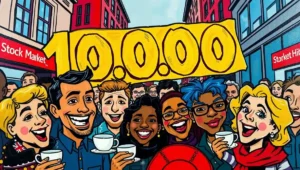
Londoners treat stock market milestones like the weather: discussed obsessively, blamed for problems, and celebrated with vague gestures rather than direct involvement. “It hit ten thousand!” someone whispered, “but I still can’t afford a flat.”
Newspapers reported the achievement with solemn graphs and arrows, which are technically informative but primarily look like the secret handshake of the financial elite. The average person interprets them as abstract art.
Checking Statements, Watching Antiques Roadshow
Traders celebrated quietly because showing joy in public is considered gauche. Meanwhile, pensioners checked their statements, shrugged, and resumed watching Antiques Roadshow.
Commentators insisted the milestone symbolised veconomic recovery,” which in Londonese translates roughly to: “We will continue charging everyone, but now it’s statistically significant.”
The FTSE Remains Stubbornly Impersonal
The FTSE 100 itself remains stubbornly impersonal. Companies listed on it continued their usual mix of profit-seeking and corporate poetry, occasionally inflating or deflating share values for fun, which is apparently allowed.
One humorous observation is that citizens assumed stock market success should automatically translate to free snacks. This is both optimistic and in line with centuries of British expectation: good numbers = tea and crumpets.
Correlation Equals Causation for Maximum Comedy
Social media exploded with memes linking the milestone to unrelated things: Big Ben, the Queen’s corgis, and a man sneezing on the Tube. Correlation was assumed to equal causation for maximum comedic effect.
Economists appeared on the BBC and used words like “volatility” and “momentum,” which means nothing to most viewers but sounds authoritative. Public trust in authority, meanwhile, continues to oscillate like a poorly tuned bell.
Symbolic, Which Means Something and Nothing
International observers noted that London’s market hitting 10,000 points was “symbolic,” which is another way of saying the city enjoys ritualised numerology. Citizens nodded politely, feeling part of something bigger, even if slightly confused.
Conspiracy theorists immediately claimed the milestone was orchestrated by shadowy elites, robots, or someone’s cat. London has a long history of imagining the financial system is personally plotting against each of its nine million residents.
Performative Relationship With Finance
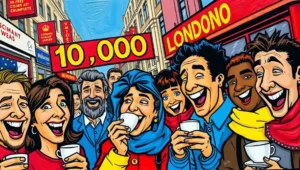
The broader lesson here is that Britain’s relationship with finance is performative. People monitor stock indices not to invest, but to confirm that the universe remains predictably complex, unhelpful, and slightly absurd.
A market analyst noted: “These numbers are impressive on paper but don’t affect actual lives immediately.” This is true, yet nobody mentioned that pensions, rents, and the cost of a cup of coffee remain unaffected, proving markets are abstract theatre.
Awkward Discussions Over Half-Pints
Meanwhile, pubs reported increased conversation about finance, which is code for awkward discussions over half-pints where no one understood anything but everyone nodded.
Tourists were observed taking selfies with screens displaying FTSE updates, presumably for Instagram, thus cementing London’s role as a global capital of photo-op financial confusion.
Graphs, Speculation, Memes, and Tea
In conclusion, the milestone itself is less important than the ritual that surrounds it: graphs, speculation, memes, polite panic, and tea. Londoners do not need financial security; they require ceremonial acknowledgment that numbers exist.
The stock market hits 10,000, Britain responds politely, and life continues with all the dignity of someone politely biting into a biscuit they cannot reach.
Auf Wiedersehen, amigos.

Lowri Griffiths brings a distinct voice to satirical journalism, combining cultural critique with dry humour. Influenced by London’s creative networks, her writing reflects both wit and discipline.
Authority stems from experience, while trust is built through transparency and ethical satire.