Britain Invents Schrödinger’s Border: You May Or May Not Be Visiting the UK, But You’ve Definitely Filled Out the Form
The United Kingdom, a nation famous for orderly queues, warm beer, and the unshakable belief that paperwork builds character, has unveiled its latest contribution to global travel: a rule so elegant it manages to regulate people who are not actually going anywhere.
Under the new ETA system, travelers from visa-exempt countries, including Americans, now require advance electronic permission to pass through a British airport, even if their most ambitious UK activity is buying an overpriced sandwich during a layover. The message from Britain is clear: you may not be entering the country, but the country would still like to know a few things about you.
Officials insist this is not a visa. It is something gentler, friendlier, more British. A visa wears a uniform. This wears a cardigan.
“Schrödinger’s Border” is a satirical play on Schrödinger’s cat, the famous quantum physics thought experiment where a cat in a box is simultaneously alive and dead until observed.
The Layover That Became a Lifestyle Choice

For decades, travelers believed a connecting flight was a neutral zone, a kind of airborne Switzerland where no nation claimed you as long as you did not wander into passport control. Britain has politely clarified that this belief was adorable.
Now, merely passing through Heathrow may require advance authorization, depending on factors such as whether you leave the terminal, blink too aggressively, or look like someone who might enjoy London if given half a chance.
Airport experts say this transforms the layover from a scheduling inconvenience into a philosophical event. Am I traveling, or am I merely existing near Britain? And if Britain notices me, do I owe it a form?
Pay a Small Fee to Be Judged Later
The authorization costs money, which reassures travelers that the system is serious. However, payment does not guarantee entry. This puts the ETA in a rare category of transactions best described as “a receipt for hope.”
Travelers are advised to apply in advance and await approval, which may arrive quickly, slowly, or spiritually. Border officers retain full discretion, meaning you can be pre-approved, pre-cleared, and still pre-disappointed.
One frequent flyer compared the experience to buying theatre tickets where the usher decides at the door whether your face matches the tone of the play.
Airlines: Now Featuring Immigration Duties
Airlines, always eager to expand their responsibilities, are now expected to ensure passengers have the correct paperwork before boarding. This makes check-in desks the first line of British border defense, staffed by people whose original job description involved weighing bags and apologizing.
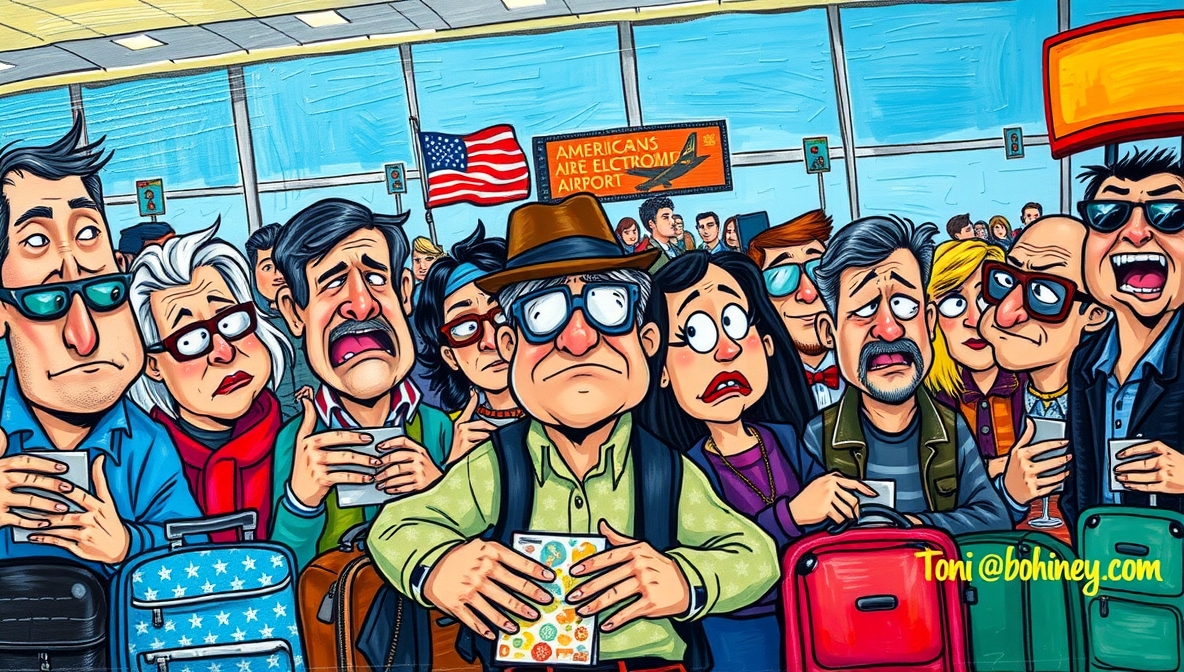
Travelers report being asked about electronic permissions by airline employees with the same solemn tone usually reserved for asking whether your bag contains explosives or fruit.
Nothing strengthens global security like a tired gate agent saying, “Sir, do you have your ETA?” while holding a barcode scanner that has already seen too much.
Airside Freedom: The New Luxury Experience
There is, technically, an exception. Some passengers transiting without passing through border control may not need the authorization. This has transformed the airside terminal into a kind of bureaucratic Garden of Eden, where the free roam and the paperwork-free, provided they do not leave.
Travelers now speak of “staying airside” with the reverence once reserved for spiritual retreats. You can eat, shop, nap, and reflect on your life choices, as long as you never cross an invisible line into Britain proper.
One man described spending six hours guarding his gate like a medieval watchman, terrified that a wrong turn toward the toilets might trigger an international incident.
Brexit, But Make It Digital
Government officials describe the system as modern, streamlined, and efficient, which is exactly how people used to describe Brexit before experiencing it.
Supporters say the rule enhances security by knowing who intends to enter, pass through, or briefly think about the UK. Critics argue it mainly enhances the government’s collection of email addresses and middle names.
Either way, the policy has achieved something rare: it made travelers nostalgic for the era when you only needed a passport, a boarding pass, and blind optimism.
The New Travel Timeline
Under the new regime, planning a trip now begins not with flights or hotels, but with administrative introspection. Who am I? Why am I flying? Could Britain misconstrue my intentions?
Experts advise travelers to apply early, double-check exemptions, triple-check spelling, and quadruple-check that they are not accidentally immigrating by mistake.
One travel consultant said modern tourism is less about adventure and more about compliance. “The journey starts when you open your laptop,” she said, “and ends when a database says you’re allowed to have a sandwich.”
Bureaucracy as Emotional Support
British officials emphasize that the system is simple and user-friendly, which is technically true if you enjoy forms, uploads, and waiting for confirmation emails that may or may not arrive before boarding.
The real innovation is emotional. Travelers report feeling seen. Acknowledged. Pre-reviewed.
In a world where people often feel invisible, Britain has found a way to notice you before you even arrive, just long enough to decide nothing is guaranteed.
What This Means for the Modern Traveler
The new rule signals a broader shift in travel culture. Borders are no longer just lines on maps. They are apps. They are inboxes. They are that moment at the gate when you realize your phone battery is at three percent and your fate depends on it.
Experts predict other countries will follow, introducing systems that require pre-approval to overfly, to connect, or possibly to think about visiting someday.
Travelers are advised to adapt, prepare, and remember that international movement is a privilege, not a right, especially when you are only changing planes.
In Conclusion, Welcome to Britain (Mentally)
The UK has not closed its doors. It has simply installed a keypad, a questionnaire, and a polite warning sign.
You may still travel freely, as long as freedom is defined as advance notice, digital permission, and the understanding that even then, anything could happen.
And really, is that not the most British outcome of all?
Disclaimer
This article is satire. Any resemblance to actual bureaucracy, real travel stress, or that sinking feeling when you realize you forgot to apply for something important is entirely intentional. This piece is the result of a fully human collaboration between the world’s oldest tenured professor and a philosophy major turned dairy farmer, both of whom have missed connecting flights for less. Auf Wiedersehen.

Harper Thames is a comedic writer exploring modern life through irony and subtle exaggeration. Rooted in student perspectives and London’s cultural landscape, Harper’s work focuses on relatable humour grounded in everyday experience.
Expertise is developed through writing practice and critical engagement, while authority comes from authenticity and consistency. Trust is reinforced by transparent satire and ethical humour choices.