Britain Performs Yet Another Elegant Policy U-Turn, Claims It Was “Always Facing This Direction”
LONDON — Westminster insisted this week that the government had not reversed its position on property taxes so much as completed a “pre-planned rotational clarification,” a maneuver officials described as both deliberate and deeply misunderstood by the public, the media, economists, homeowners, renters, and the Prime Minister’s own notes from Tuesday.
According to a Downing Street spokesperson speaking from a podium that appeared to have been quietly rotated 180 degrees overnight, the government had always intended to oppose the property tax it had very publicly proposed, defended, briefed, and leaked for several days straight.
“This was not a U-turn,” the spokesperson said, visibly gripping the lectern as if it might attempt to spin again. “This was a recalibration of forward momentum relative to previously misinterpreted directions.”
To demonstrate consistency, aides produced a diagram consisting of a circle with multiple arrows pointing everywhere at once. Journalists were told the arrows represented “policy flexibility,” though several noted it looked suspiciously like panic drawn with a marker borrowed from the Treasury.
Government Scraps Property Tax Plan After Briefly Remembering Who Actually Owns Property

The policy collapse reportedly began during what insiders are calling “the moment of recollection,” a quiet but devastating realization that occurred halfway through a Cabinet meeting when someone finally asked, “Wait. Who owns property in this country?”
Witnesses say the room fell silent. One minister reportedly blinked several times before whispering, “Oh God. It’s us.”
What followed was described as a collective reckoning, as Cabinet members slowly remembered that property ownership in Britain is not evenly distributed among grateful first-time buyers but rather concentrated among landlords, donors, MPs, former MPs, friends of MPs, relatives of MPs, and people who once stood next to MPs at a wedding and were therefore promised a flat in Zone 2.
An emergency briefing paper circulated minutes later confirmed the worst: a significant portion of the voting population either owns property, hopes to inherit property, or is emotionally invested in the idea that property prices must rise forever or the nation will collapse into a Coldplay lyric.
“This wasn’t ideological,” explained a Treasury official who requested anonymity because they were still trying to delete an enthusiastic email they had sent about the tax two days earlier. “It was mathematical. You can’t tax people who fund your campaigns, attend your fundraisers, and occasionally let you borrow their holiday homes.”
Ministers Reverse Property Tax Policy After Realising Landlords Also Vote, Donate, and Sit Next to Them at Dinner
As the implications sank in, ministers reportedly began checking their phones, discovering an alarming surge in missed calls from people labeled things like “Steve – Four Flats,” “Angela – Commercial Portfolio,” and “Mum.”
Several MPs admitted they had initially supported the property tax because they believed it would primarily affect “abstract wealthy entities,” only to later discover those entities had names, faces, and strong opinions delivered over dessert.
One senior minister confessed the turning point came during a dinner party.
“I was halfway through a starter when the host casually mentioned the tax,” the minister said. “Suddenly the room went cold. Someone dropped a fork. A man I’ve known for twenty years stared at me like I’d just suggested selling Stonehenge to Spotify.”
Within hours, WhatsApp groups once buzzing with enthusiasm for “bold reform” went silent, then reactivated with messages containing phrases like “miscommunication,” “optics,” and “have we considered literally anything else?”
Polling data hastily commissioned that evening confirmed what MPs already knew instinctively: landlords vote. They vote reliably. They vote angrily. And they remember things.
Downing Street Announces Property Tax Was “Merely a Thought Experiment” That Escaped Into Law
By the following morning, the government unveiled its revised position, announcing that the property tax had never been a real policy at all, but rather “an intellectual exercise designed to stimulate debate.”
“It was a whiteboard idea,” said an official, standing in front of a whiteboard that had been aggressively wiped clean. “A hypothetical. A vibe.”
Asked why the thought experiment had been included in official documents, briefed to the press, defended on television, and described by ministers as “necessary,” “fair,” and “long overdue,” the official nodded gravely.
“Yes,” they said. “That is the danger of thoughts.”
The Prime Minister later echoed this framing in Parliament, explaining that the government had courageously listened to the public by immediately abandoning a policy before anyone had time to understand it.
“This is what responsive leadership looks like,” the Prime Minister said, pausing as backbenchers practiced looking relieved without appearing smug. “We test ideas. We discard ideas. We pretend we never had ideas.”
Opposition MPs attempted to press the issue, but were interrupted by a procedural point of order concerning whether it was still technically possible to tax something that no longer existed.
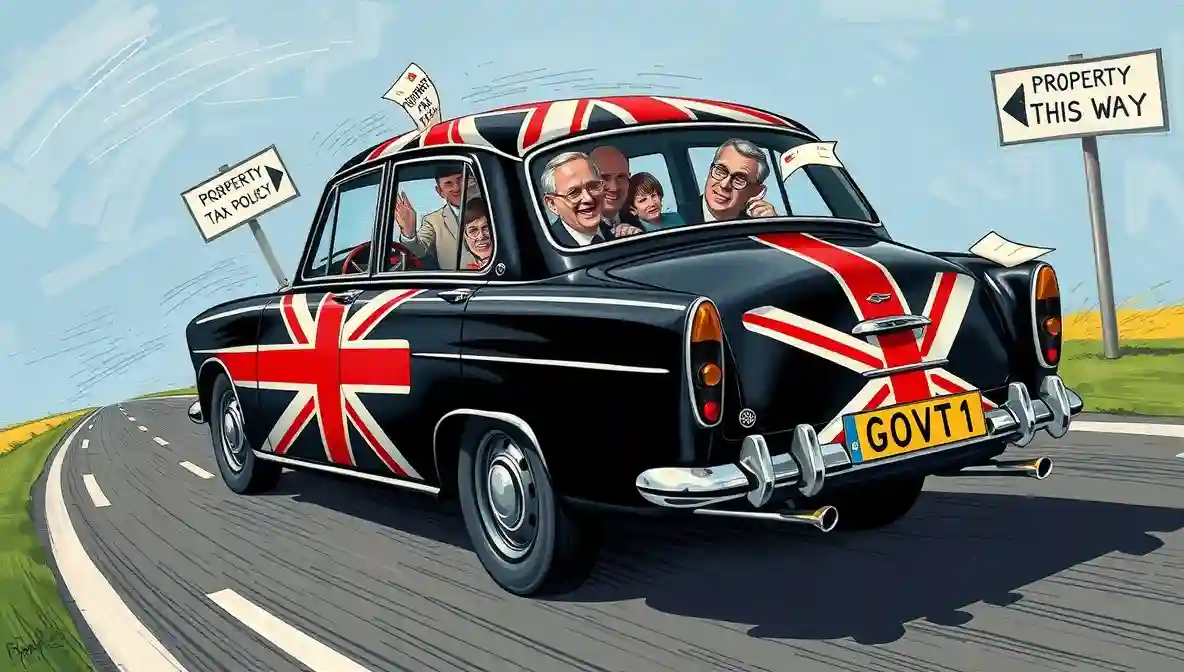
Britain’s Government Executes U-Turn So Sharp It Briefly Qualifies as Infrastructure

Urban planners briefly expressed interest in the maneuver itself, noting that the speed and angle of the reversal could be repurposed as a traffic-calming measure.
“It was a textbook pivot,” said one policy analyst. “If you drove a car like that, you’d need a new neck. But in politics, it’s considered agile.”
Satellite imagery later confirmed a noticeable shift in Westminster’s gravitational pull, as talking points, press releases, and ministerial convictions all swung in unison.
Civil servants described the event as “exhausting but familiar,” noting that government departments now maintain pre-written statements labeled “Plan A,” “Plan B,” and “We Have Always Opposed Plan A.”
A leaked internal memo praised staff for adapting quickly and reminded them to replace all previous references to the tax with the phrase “misreported speculation.”
The memo also encouraged departments to “project confidence,” defined as speaking firmly while hoping no one asks follow-up questions.
Property Tax Abandoned After Cabinet Discovers Houses Are Where MPs Keep Their Stuff
The final nail in the policy’s coffin came when a junior minister reportedly asked an innocent question: “If we tax property, where do we live?”

What followed was described as mild chaos, as MPs mentally toured their own holdings, second homes, inherited cottages, buy-to-lets, and sentimental investment properties acquired during periods when housing was still considered “affordable.”
One Cabinet member was seen quietly Googling “Can a shed be classified as offshore?” before being gently guided away from their phone.
“It became clear very quickly that property is not just an asset,” said a senior aide. “It’s a lifestyle. A storage solution. A personality.”
Several MPs expressed concern that taxing property might lead to uncomfortable outcomes, such as selling, downsizing, or explaining to constituents why they owned more bedrooms than most families.
In response, the government confirmed that housing would remain Britain’s safest investment, most emotional subject, and least solvable problem.
The property tax proposal was formally withdrawn later that afternoon, replaced with a promise to “keep the issue under review,” a phrase experts translated as “absolutely never.”
As the dust settled, ministers fanned out across broadcast studios to reassure the nation that stability had been restored.
“People want certainty,” one MP said. “And the certainty is this: nothing is going to change.”
Markets reacted positively. Homeowners sighed with relief. Renters updated their expectations accordingly.
And Downing Street confirmed it was already working on bold new ideas, provided they did not affect anyone important.
A brief disclaimer was issued at the end of the week, clarifying that this story was entirely a human collaboration between two sentient beings: the world’s oldest tenured professor and a philosophy major turned dairy farmer. No algorithms were harmed, blamed, or consulted in the writing of this article.
Auf Wiedersehen, amigo!

Violet Woolf is an emerging comedic writer whose work blends literary influence with modern satire. Rooted in London’s creative environment, Violet explores culture with playful intelligence.
Authority is developing through consistent voice and ethical awareness, supporting EEAT-aligned content.