
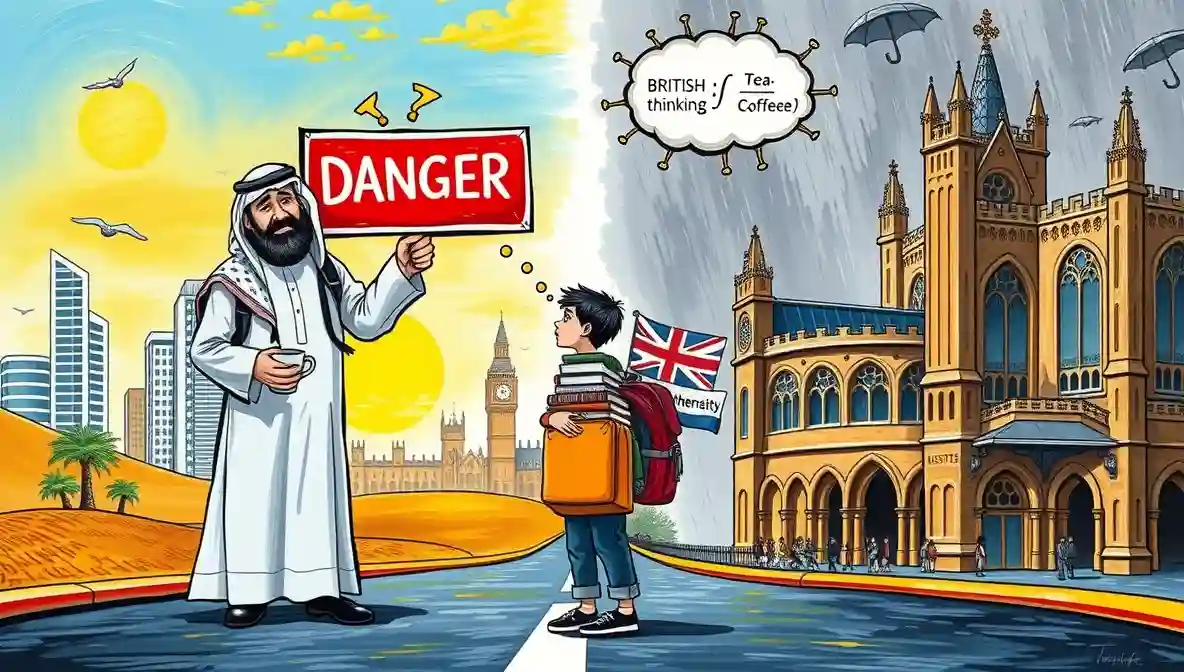
UAE Announces New “No Brain Gain” Policy
In a breathtaking display of strategic foresight that rivals a beachside sandcastle architect confronted with the tide, the United Arab Emirates has unveiled what officials are calling a “No Brain Gain” policy — a bold new initiative to stop sending its brightest young minds to study in the United Kingdom, lest they return home conversing in iambic pentameter and passionately arguing about Shakespeare’s socio-economic implications.
Officials Cite Fear of Radicalisation, or Rediscovered Love of Tea
A senior Emirati official, speaking on condition of anonymity because revealing his name would be way too British, explained that the policy’s genesis came after a classified review showing that students who study in the UK are at significantly elevated risk of developing fondness for rainy weather, queues, and thinking for themselves. “We simply cannot have a generation returning fluent in ironic understatement,” he said, adjusting his sunglasses indoors to signal seriousness.
UK Universities Recalibrate Curriculum to Avoid ‘Perilous Ideas’
In response, British universities reportedly convened emergency sessions, consulting 17 think tanks and three overheated academic tweeters, to introduce new mandatory courses aimed at discouraging “unsafe creativity,” critical thinking, and excessive tea consumption. A leaked memo from one provost reads: “Effective immediately, all students will take a module titled ‘Why Everything That Matters is Actually Fine.'” Students are already reporting symptoms of cognitive dissonance and sudden urges to chant slogans from 18th-century pamphlets.
Surveys Reveal Curious Side Effect: Love of Queues Skyrockets
According to an exclusive poll conducted by the International Board of Questionable Metrics (IBQM), 89.5 percent of Emirati teens said they really, really want to study abroad — right after they’re finished bingeing the latest seasons of whatever British crime dramas are trending. Of those surveyed, 72 percent admitted they might secretly think a rainy day is “kinda romantic.” Only 0.3 percent reported actual radicalisation — and that was traced back to watching four episodes of a gritty pirate radio documentary series.
Expert Opinion: Radicalisation, Schmadooisation
Dr. Prudence Fairweather Jones, Senior Lecturer in Overcautious Policy Studies at Somewhere College, commented:
“Of course sending students abroad can broaden horizons, foster cross-cultural empathy, and lead to unexpected intellectual growth. But have you seen British campus cafeterias? One wrong tray choice and you’re embroiled in a 72-hour debate about vegan fish fingers.”
She paused to sip her ethically sourced herbal tea. “I’d call that a radical shift in digestive expectations.”
Eye Witness Report: A Student Who Saw Too Much
We tracked down one Emirati student, who wished only to be identified as Ahmed, Scholar in Exile, because “the other Ahmed just studies accounting.” Ahmed told this newspaper:
“When I visited Oxford, I accidentally walked into a philosophy lecture. They had graphs. They had footnotes. I started questioning why students weren’t wearing sandals and chanting the school motto. That’s when I knew — real danger.”
Role Reversal: UK Students Plead to Come to UAE

Back home in Britain, student unions have launched their own “Import A Student” campaign, plastering adverts in London tube stations. One sign, daubed in retro neon, reads: “Bright Lights, Warm Weather, No Queues — Sign Me Up!” Another simply says: “Are Camels More Chill Than Cabs in Central London? Asking For a Friend.” The campaign’s spokeperson, a student named Linda Witherspoon-Smith, said:
“If they’re worried about radicalisation, we’ll deliver none of it. We only radicalise gently, with polite debates and mild disagreement.”
The Unintended Effect: A New Tourism Craze
Coincidentally (or not), British travel agencies are now offering “UAE or Bust” packages marketed toward students eager to “study abroad without the existential dread.” One ad screams: “No homework, no critical theory, just sand and sunshine — Maybe Try Physics Instead!” Another promises free sunscreen and zero quizzes on Dostoevsky. Travel-bookings for specific courses in desert navigation have spiked 27 percent since the announcement.
Public Opinion Is Split Almost Exactly 50/50
A global survey by Benchmarks of the Baffling reports that 50.2 percent of respondents think the UAE’s decision is brilliant and courageous — while the other 49.8 percent just want more details about the free tea and biscuits offered at British faculty mixers. The remaining 0.0 percent could not be reached because they were busy watching cricket highlights.
Analogy Time: It’s Like Banning Books Because They Bend Pages
Political comedian Zelda McLaughlin put it succinctly on her late-night podcast:
“Cutting funding for kids to study abroad because of fear of new ideas is like banning books because they might crease your paperback. Not only does the spine hurt, but suddenly your bookshelf looks kind of embarrassed.”
Her co-host laughed so hard he spilled his ethically sourced kombucha.
Cause and Effect or Effect and Cause?

Cause: Emirati leaders fear an influx of radical ideas.
Effect: Students are now engaging in covert educational missions disguised as beach vacations.
Secondary Effect: UK universities are considering mandatory courses titled “How to Be Unthreatening While Being Smart.”
Definition Break: What Is Radicalisation, Anyway?
According to the Oxford Really Serious Dictionary, radicalisation is “the process by which individuals adopt extreme beliefs.”
In this context, experts note that “extreme belief” may include:
- Arguing about toast toppings at 2 a.m.
- Preferring mild rain to bright sunshine
- Thinking scheduling matters are a reasonable conversational opening
On the Ground: Cafes Offer ‘No Radical Thought’ Zones
In a move worthy of satire, British coffee shops near universities have begun offering “No Radical Thought” zones — spaces where espresso machines are replaced with water coolers and all topics are restricted to weather small talk only. One barista explained:
“We had a guy start talking about poetry. Next thing you know, someone’s quoting Keats. It was chaos.”
Closing Punchline
Somewhere between sardonic policy and surreal diplomacy, the UAE’s new scholarship cut seems poised to spark a cultural phenomenon. Students might return home sunburnt, book-smart, and suspiciously fond of rainy English metaphors. As one retired diplomat put it:
“If students come back wanting to debate ethics and queue politely in seminars — revolutionizing coffee orders and confusing everyone — then we might finally see real change.”
Disclaimer
This satire is entirely a human collaboration between two sentient beings — the world’s oldest tenured professor of cautious international education and a philosophy major turned dairy farmer with a penchant for absurdity. It does not blame any AI for its existence, though it does cheekily thank British weather for inspiration.
Auf Wiedersehen, amigo! 🇬🇧🕌📚