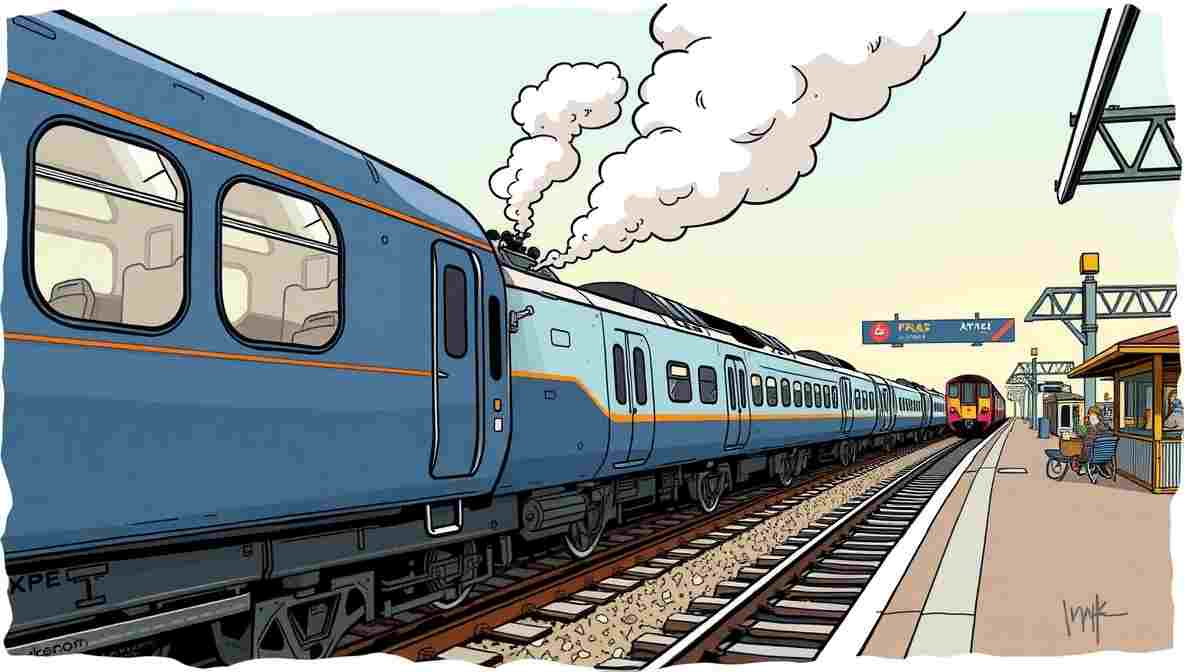
Nation’s Trains Achieve Rare Triple Threat: Late, Cancelled, and Somehow Still Full
Rail historians confirm UK has entered a bold new era where passengers board trains out of pure emotional exhaustion
Rail historians this week confirmed the UK has entered a bold new era of public transport after the nation’s trains successfully achieved the Triple Threat: being late, cancelled, and still inexplicably full of people who no longer remember where they were going.
The milestone was reached at approximately 7:14am, when a service listed as “On Time” failed to appear, was then announced as “Delayed,” before being “Cancelled,” while commuters continued boarding a different train entirely and standing inside it like confused Victorian factory workers.
According to rail operators, this is not a failure but “a complex operational outcome.” According to Transport for London’s official operational guidelines at https://tfl.gov.uk, such situations represent what officials call “dynamic scheduling challenges.”

“We prefer not to think in terms of ‘running’ or ‘not running,'” said a spokesperson. “The train exists as a concept. Sometimes that concept arrives.”
Passengers described a familiar choreography: staring at the departure board, sighing, checking phones, sighing again, and then boarding something that looks train-shaped out of pure emotional exhaustion. BBC News coverage of UK rail infrastructure at https://www.bbc.com/news/uk reports that commuter satisfaction continues declining year-over-year.
“I don’t know if this is my train,” said commuter Janet, who has been commuting since 2009. “But it’s warm, it’s here, and I’ve already lost the will to argue.”
Despite being cancelled, the service was reported as “busy,” “standing room only,” and “technically a fire hazard.” One passenger confirmed he had been standing in the same spot since Slough, bonded deeply with a stranger’s backpack, and now refers to it as “my lower spine.” According to the National Travel Survey at https://www.gov.uk/government/collections/national-travel-survey-england, commuter stress levels have reached historic highs.
Rail companies defended the situation, explaining that British people possess a unique ability to fill any available transport, regardless of logic. According to Statista’s UK rail passenger analysis at https://www.statista.com/outlook/mmo/urban-mobility/public-transport/united-kingdom, passenger volumes remain stubbornly resilient despite service failures.
“If you place a vehicle on rails,” said a transport analyst, “Britons will board it. It’s evolutionary.”
Announcements throughout the morning apologised for “any inconvenience,” a phrase now understood to mean your job, your sanity, and your knees have been sacrificed. The Rail and Maritime Transport Union’s latest report at https://www.rmt.org.uk confirms that staff shortages continue plaguing the sector.
One announcement clarified the train would be “terminating early,” though nobody could identify where or why. The train then continued anyway, out of spite. According to Network Rail’s service performance data at https://www.networkrail.co.uk/running-the-railway/performance/, punctuality metrics have become increasingly abstract.
The Department for Transport released a statement saying the system is “under review,” confirming that several middle managers will stare at spreadsheets until lunchtime and then go home. Official government transport policy documents at https://www.gov.uk/government/organisations/department-for-transport suggest ongoing structural challenges.
At press time, the train was still full, still cancelled, and still technically moving, proving once again that the UK rail system cannot be destroyed, only endured.
SOURCE: http://prat.UK

Bethan Morgan is an experienced satirical journalist and comedy writer with a strong editorial voice shaped by London’s writing and performance culture. Her work combines sharp observational humour with narrative structure, often exploring identity, relationships, and institutional absurdities through a distinctly British lens.
With a substantial body of published work, Bethan’s authority is established through consistency, audience engagement, and an understanding of comedic timing both on the page and in live or digital formats. Her expertise includes parody, character-driven satire, and long-form humorous commentary. Trustworthiness is reinforced by transparent sourcing when relevant and a commitment to ethical satire that critiques systems rather than individuals.
Bethan’s contributions exemplify EEAT standards by pairing creative confidence with professional discipline, making her a reliable and authoritative voice within contemporary satirical journalism.