Shakespeare’s Clowns: How the Bard’s Comic Relief Set a Template for Centuries
The Groundlings Wanted Fart Jokes, and Shakespeare Delivered (While Sneaking in Philosophy)
William Shakespeare, universally recognized as the greatest writer in the English language, spent considerable energy writing parts for clowns who made jokes about willies, exchanged puns about bodily functions, and generally behaved like drunken idiots for the amusement of groundlings who’d paid a penny to stand in the mud. These comic characters—fools, clowns, and rustics—weren’t afterthoughts but essential elements of Shakespeare’s theatrical formula, proving that even the greatest literature requires someone falling over periodically to maintain audience attention, a lesson modern entertainment has thoroughly internalized.
The Globe Theatre: Where High Art Met Low Comedy

Shakespeare’s Globe Theatre operated as democratic space where aristocrats in expensive seats and working-class groundlings in the pit experienced the same performance, though not the same play—nobles appreciated poetry and complex characterization while groundlings waited for the clown to appear and say something about testicles. Shakespeare accommodated both audiences simultaneously, creating layered comedy that worked on multiple levels: clever for the educated, crude for the masses, ensuring everyone got something worth the admission price.
The groundlings’ presence shaped Shakespeare’s writing profoundly. Without them demanding entertainment, he might have written entirely in elevated verse about kings and philosophy. With them, he created Bottom transforming into a donkey, Falstaff getting stuck in a laundry basket, and countless scenes where characters misunderstand words in ways that create accidental innuendo—highbrow literature’s foundation rests partly on lowbrow comedy, whether academics like admitting it or not.
The Penny Seats Created Comedy Democracy
The groundlings—standing-room ticket holders who formed Globe’s largest audience segment—wielded power through their numbers. If they became bored or unsatisfied, they’d throw things, heckle performers, or simply leave, making playwright’s job partly crowd management. Shakespeare’s clowns functioned as pressure valves, releasing tension from tragic plots while keeping groundlings engaged through material requiring no education to appreciate: physical comedy, sexual jokes, and satirical observations about everyday life delivered in accessible language rather than poetic verse.
Will Kempe: Shakespeare’s First Clown and Absolute Liability

Will Kempe, Shakespeare’s original clown actor, specialized in physical comedy and improvisation—meaning he’d ignore Shakespeare’s actual lines whenever better joke occurred to him, driving the playwright toward madness while delighting audiences who came specifically to see Kempe do pratfalls. This tension between writer’s intention and performer’s liberty created early modern version of conflicts between screenwriters and comedic actors, resolved eventually by Kempe leaving the company and Shakespeare writing increasingly specific stage directions like “Exit, pursued by a bear” to limit actors’ creative freedom.
Kempe’s most famous exploit—morris dancing from London to Norwich in 1600 for a bet—demonstrated clowns’ celebrity status exceeded playwrights’. Shakespeare wrote Hamlet and received modest recognition; Kempe danced for nine days and became national sensation. This established pattern persists in entertainment: writers create art, clowns get famous, everyone pretends this makes sense.
Robert Armin: The Clever Clown Upgrade
After Kempe’s departure, Shakespeare hired Robert Armin, a more sophisticated performer who could handle witty wordplay alongside physical comedy. This upgrade allowed Shakespeare to write more complex clown roles—fools who appeared simple but spoke truth, characters who provided comic relief while advancing plot—creating template for modern comedy writing where humor serves narrative purpose beyond just making people laugh.
Armin’s arrival coincided with Shakespeare’s greatest fool characters: Feste in Twelfth Night, the Fool in King Lear, and Touchstone in As You Like It—clowns who comment on action while remaining outside it, speak wisdom while appearing foolish, and generally serve as author’s voice disguised as entertainment. These roles demonstrated comedy’s potential for social commentary, establishing tradition where British comedians believe making people laugh gives them license to pontificate about politics, philosophy, and moral decay.
The Types of Shakespearean Clowns: A Taxonomy
Shakespeare developed several distinct clown archetypes, each serving different dramatic functions:
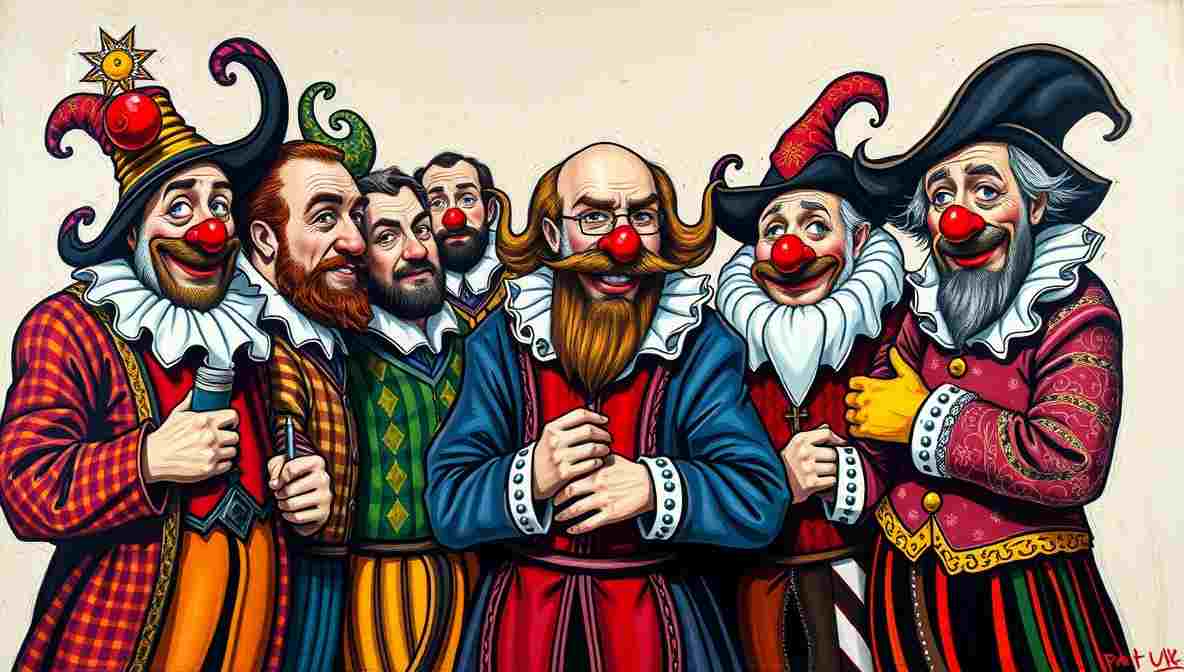
**The Rustic Fool** (Bottom, Dogberry, the Gravediggers): Working-class characters who speak in malapropisms, misunderstand situations, and provide unintentional comedy through ignorance. These characters let educated audiences feel superior while allowing working-class audiences to see themselves represented, however condescendingly—democracy through mockery.
**The Wise Fool** (Feste, Touchstone, Lear’s Fool): Professional jesters who speak truth through jokes, seeing situations clearly while pretending not to. These characters established the British comedian as social commentator, licensed to criticize power through humor in ways that straightforward criticism couldn’t achieve.
**The Bawdy Servant** (Costard, Launce, Speed): Lower-class characters who provide sexual innuendo and physical comedy, usually pursuing romantic interests above their station while making jokes about bodily functions. Essentially Shakespeare’s version of Carry On films, proving that crude humor’s appeal predates modern entertainment by centuries.
Why Clowns Always Survived
Regardless of how tragic Shakespeare’s plays became—murderous kings, doomed lovers, vengeful ghosts—clowns rarely died. This wasn’t sentimentality but commercial calculation: audiences loved clowns and wanted them to survive for potential sequels or future performances. The few exceptions (Mercutio, arguably a clown figure) proved the rule by becoming most memorable deaths in Shakespeare’s canon—killing the funny character creates impact precisely because it’s unexpected.
The Language Games: Puns, Malapropisms, and Double Entendres
Shakespeare’s clowns mastered linguistic comedy through multiple techniques. Puns (which Shakespeare considered high humor, unlike modern audiences who’ve been taught to groan) allowed clever wordplay accessible to educated viewers while often creating accidental sexual innuendo for groundlings. Malapropisms—using wrong words that sound similar to correct ones—created both verbal comedy and class satire, mocking characters’ aspirations to education they didn’t possess.
Double entendres throughout Shakespeare’s comedies allowed performers to deliver lines that meant one thing literally and another thing sexually, letting audiences choose their interpretation based on sophistication or perversion levels. Modern performances must decide whether to emphasize sexual meanings (making Shakespeare’s bawdiness explicit) or play lines straight (pretending Shakespeare wasn’t obsessed with genitalia), with most opting for the former because audiences still find willies funny 400 years later.
The Constable Tradition: Authority Figures as Idiots
Shakespeare’s police constables—Dogberry in Much Ado About Nothing, Elbow in Measure for Measure—established British tradition of depicting law enforcement as well-meaning but incompetent. These characters bungle investigations, mangle language, and somehow stumble into solving crimes despite themselves, creating template for British comedy cops from Inspector Clouseau to Hot Fuzz. The pattern suggests British culture finds authority figures inherently funny, respecting power while mocking those who wield it—democracy through humor.
Physical Comedy in Elizabethan England: Falling Down for Art
Without modern special effects or elaborate sets, Shakespearean comedy relied heavily on physical performance: pratfalls, mistaken identities requiring obvious costume changes, drunken stumbling, and general chaos that required talented physical comedians to execute. The Globe’s thrust stage allowed clowns to interact directly with audiences, creating participatory comedy where groundlings weren’t just watching performance but involved in it—early modern version of crowd work.
Shakespeare’s stage directions occasionally specify physical comedy: “Exit, pursued by a bear” (probably someone in a costume), characters hiding in barrels or under tables, and numerous instances of people falling, running, or generally moving in ways designed to make audiences laugh. This physical emphasis ensured Shakespeare’s plays succeeded even when audiences couldn’t follow complex language—as long as someone fell over periodically, groundlings stayed engaged.
The Clown’s License: Truth Through Humor
Royal court jesters enjoyed unique privilege: license to criticize the king through humor, speaking truths that straightforward criticism would make treasonous. Shakespeare’s wise fools inherit this license, commenting on their social superiors, pointing out hypocrisy, and generally saying things that would get non-clowns executed. This established British comedy’s special status as tolerated criticism—you can mock the powerful if you make them laugh, creating system where humor disarms potential rebellion while allowing limited outlet for discontent.
King Lear’s Fool represents this tradition’s peak: character who speaks devastating truth about Lear’s stupidity while technically just making jokes, disappearing from the play once Lear achieves wisdom because fools become unnecessary when protagonists see clearly. This pattern—fool as temporary guide through delusion—influenced everything from Shakespearean tragedy to modern therapy culture, though therapists charge more than court jesters and rarely sing their observations.
The Legacy: From Globe to Global Comedy
Shakespeare’s clowns established templates that dominate comedy centuries later. The wise fool became the stand-up comedian offering social commentary; the rustic fool became sitcom characters whose stupidity drives plots; the bawdy servant became every crude comedy character in modern entertainment. Even specific techniques—puns, physical comedy, sexual innuendo, satirical observation—persist in recognizable forms, suggesting Shakespeare identified fundamental comedic elements that transcend time and culture.
British comedy’s characteristic mixture of high and low, clever and crude, intellectual and physical—all trace back to Shakespeare’s need to satisfy both aristocrats and groundlings simultaneously. Modern British entertainment maintains this duality: panel shows feature Oxbridge graduates making sophisticated references between dick jokes, exactly as Shakespeare combined poetic verse with bottom jokes 400 years ago.
The Groundlings Never Left
Every comedy audience contains groundlings—people who don’t care about clever structure or thematic resonance, just want to laugh at something silly. Shakespeare recognized this and wrote for them explicitly, ensuring even his most complex plays included accessible comedy for casual viewers. Modern entertainment frequently forgets this lesson, creating art so sophisticated it alienates mass audiences, then wondering why no one watches—Shakespeare never made that mistake because groundlings would literally throw things if bored.
Why Shakespeare’s Clowns Still Matter
These characters, often dismissed as minor compared to Hamlet or Macbeth, actually demonstrate Shakespeare’s genius more clearly than his tragic heroes. Anyone can write poetic soliloquies about death and meaning; creating clowns who entertain uneducated audiences while advancing complex themes requires different skill entirely. Shakespeare’s clowns prove that comedy and profundity aren’t contradictory—the same play can make you laugh and think, sometimes simultaneously, if the writer’s talented enough to manage both.
The clowns also humanize Shakespeare’s plays, providing relief from relentless tragedy or romance, acknowledging that life includes both grief and jokes about flatulence. This tonal complexity makes Shakespeare’s work endure—pure tragedy becomes exhausting, pure comedy becomes shallow, but mixing both creates something resembling actual human experience, where moments of profound seriousness occur alongside moments of absolute ridiculousness, often minutes apart.
The Modern Globe: Keeping Clowns Alive

The reconstructed Globe Theatre maintains Shakespeare’s clown tradition through historically-informed performance, demonstrating these characters’ continuing appeal. Modern audiences standing as groundlings laugh at the same jokes that entertained their Elizabethan counterparts, suggesting fundamental comedy hasn’t changed despite 400 years of cultural evolution. We’re sophisticated enough to appreciate Shakespeare’s poetry, primitive enough to find Bottom’s transformation into a donkey hilarious—exactly as Shakespeare intended.
The Globe’s success proves Shakespeare’s comedy template works across centuries: combine physical humor with verbal wit, make the simple funny and the complex amusing, and trust that human nature’s fundamentals—love of pratfalls, appreciation for wordplay, enjoyment of watching authority figures look stupid—transcend time. Shakespeare’s clowns set standards British comedy still follows, consciously or not, creating template so effective that we’ve never found reason to abandon it entirely, though we’ve certainly tried.
The Clown’s Final Bow
Shakespeare’s clowns matter not just historically but practically, demonstrating principles that make comedy work: know your audience, provide multiple entry points for different sophistication levels, balance high and low elements, and never forget that even during profound artistic moments, someone falling over remains fundamentally funny. These lessons shaped British comedy’s development from music hall to Netflix, creating national style that confuses other cultures by combining erudition with toilet humor, as if both can coexist in single entertainment—which Shakespeare proved they not only can but should.
The groundlings wanted jokes; Shakespeare gave them jokes containing philosophy. They wanted clowns; he gave them clowns who spoke truth. They wanted entertainment; he gave them art disguised as entertainment, so cunningly disguised that they laughed without realizing they were experiencing literature. That’s the ultimate clown move: making people think they’re just having fun while actually teaching them something—though Shakespeare, being wise, never admitted that’s what he was doing, knowing groundlings would throw vegetables if they suspected they were learning. Smart man. Brilliant clown.
Auf Wiedersehen, amigo!

Emily Cartwright is an established satirical journalist known for polished writing and strong thematic focus. Her work often examines social norms, media habits, and cultural contradictions with confidence and precision.
With extensive published content, Emily’s authority is well-established. Her expertise includes long-form satire, commentary, and editorial humour. Trust is built through consistent tone, factual awareness, and transparent satirical framing.
Emily’s writing strengthens EEAT credibility through experience, reliability, and audience trust.