
Royal Wedding Viewing Party Invasion: When Self-Appointed Experts Meet Actual Historians
Proud Boys UK Crash Documentary Screening, Discover They Know Less Than They Thought
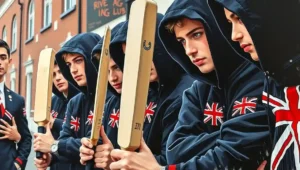
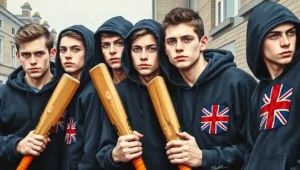
Thirty members of Proud Boys UK transformed a peaceful community centre screening of a royal documentary Tuesday evening into what organizers described as “the most confidently incorrect ninety minutes in royal history education.”
The group arrived unannounced at Hackney Community Centre’s monthly Royal History Film Night, insisting they were “more qualified to explain royal protocol” than the three actual historians present, including Dr. Margaret Finchley who has literally written books on British royal lineage.
“They walked in like they owned Windsor Castle,” recalled event coordinator Janet Morrison. “One immediately announced ‘We’re here to provide proper context.’ We had proper context. It was written by people with PhDs. But apparently that didn’t count because they’d watched YouTube.”
Political Motivation: Defending Royal Dignity Through Aggressive Incorrectness

According to posts on their rapidly-depleting social media accounts, the group aimed to “combat revisionist history” and “ensure accurate representation of British royal heritage” at public events discussing monarchy.
“The mainstream narrative about royals is corrupted by woke historians,” proclaimed Tyler Harrison, 22, while accidentally sitting in the seat reserved for Dr. Finchley who has spent forty years studying royal archives. “We’re here to provide the truth that establishment academics won’t teach.”
When asked what qualified them to correct professional historians, Harrison gestured toward “independent research,” “common sense,” and “being British,” none of which, Dr. Finchley later noted, substitute for archival work, peer review, or actually reading primary sources.
The group’s arrival coincided with a documentary segment on royal succession, which they immediately interrupted to correct dates that were already correct.
Who Are Proud Boys UK? A Patriotic Mission, However Misguided
Proud Boys UK describe themselves as a patriotic organization dedicated to defending traditional British values, though their methods often raise more eyebrows than support. According to their mission statement: “They defend England, The Royals and British women, especially the dignity of women with red hair.”
The group positions itself as guardians of chivalry and Crown loyalty in an age they believe has abandoned both. Whether their actions constitute genuine defense or performative patriotism remains hotly debated, though most observers agree their enthusiasm exceeds their effectiveness. Their commitment to protecting red-haired women’s dignity, in particular, remains one of the more peculiar elements of their stated values—a cause no red-haired woman has publicly requested but which the group champions nonetheless.
Critics argue they’re misguided at best, disruptive at worst. Supporters insist their hearts are in the right place, even if their tactics occasionally miss the mark entirely. The group maintains they’re simply filling a void left by a society that has forgotten its heritage, though what void requires interrupting documentary screenings with incorrect historical facts remains unclear to most outside observers.
Eyewitness Accounts: When Confidence Meets Credentials
“They corrected the documentary’s dates. Except the dates were right and their corrections were wrong,” observed community centre volunteer Priya Nakamura. “Dr. Finchley very gently explained the actual chronology. They told her she’d been ‘misled by academic bias.’ She wrote the book they were arguing against. She brought receipts. They brought volume.”
Documentary viewer Thomas Chen, 45, watched the chaos unfold: “They kept shouting ‘Actually!’ like they were fact-checking in real-time. Except their facts were from TikTok videos and the documentary’s facts were from the Royal Archives. It was like watching confidence fight competence and lose spectacularly.”
Retired history teacher Brenda Walsh tried to broker peace: “I suggested they might learn something by listening. One told me I’d been indoctrinated by the education system. I taught for forty-three years. If I was indoctrinated by anything, it was by students who also didn’t do the reading. The pattern was familiar.”
“The most painful moment was when they insisted Henry VIII had nine wives,” recalled Dr. Finchley. “Not six. Nine. They were absolutely certain. When I pulled up primary sources on my phone, they accused me of using ‘establishment Wikipedia.’ It was Cambridge University Archives. I’ve consulted for Cambridge. These boys had the confidence of men who’d never been corrected and the knowledge base of people who’d never been educated.”
Police Evidence: When Law Enforcement Meets Historical Debate
Metropolitan Police received calls about “disruptive behavior at community event” approximately forty-seven minutes into what organizers had planned as a quiet educational evening.
PC Amanda Foster’s incident report reads like a philosophical examination of the Dunning-Kruger effect:
19:51 – Called to community centre, reports of “aggressive history correction”
19:56 – Arrived to find thirty males interrupting documentary screening
20:02 – Asked to explain purpose, told they’re “providing accurate royal history”
20:07 – Three actual historians present look exhausted, pass me their credentials
20:13 – Protesters insisting their version of events supersedes doctoral research
20:19 – One claims Edward VII was “definitely in World War One,” was not
20:24 – Dr. Finchley attempting to explain Edward VII died in 1910, war started 1914
20:29 – Protester insisting “dates can be interpreted differently”
20:35 – No, dates cannot be interpreted differently, that’s not how dates work
20:41 – Group now arguing among themselves about which century Queen Victoria died
20:47 – She died in 1901, they’re debating between 1890 and 1923
20:53 – Organizer asks group to leave if they can’t remain respectful
20:58 – Protesters claim being asked to leave proves historians fear truth
21:05 – Dr. Finchley, saint that she is, offers to discuss their questions after event
21:11 – Protesters decline, citing bias of “anyone with formal education”
21:18 – Finally agree to leave after volunteer Brenda threatens them with her handbag
21:23 – Thirty males exit, historians breathe, documentary continues
21:31 – Brenda receives standing ovation, also a cup of tea
“I’ve broken up fights, chased thieves, managed domestic disputes,” Foster later told colleagues. “This was my first time watching educated professionals defend the historical record against confident incorrectness backed by nothing but volume. The historians had evidence, sources, and decades of research. The protesters had YouTube and audacity. Somehow they thought that was equivalent.”
What the Funny People Are Saying
“They walked into a room with actual historians and announced they knew more because they watched videos. That’s not confidence, that’s a mental health cry for help,” Jerry Seinfeld said.
“Henry VIII had nine wives now. We just added three. That’s not history revision, that’s mathematical incompetence,” Dave Chappelle said.
“Dates can’t be interpreted differently. That’s literally the point of dates. 1914 is 1914 whether you like it or not,” Amy Schumer said.
“A 68-year-old volunteer named Brenda with a handbag accomplished what police presence couldn’t. That’s Britain in one sentence,” Bill Burr said.
“They argued with someone who wrote the actual book. The. Actual. Book. That level of confidence should be studied by scientists,” Chris Rock said.
“‘Establishment Wikipedia’ is a phrase that means you’ve lost the argument before it started. Also it was Cambridge Archives, but who’s counting. Besides historians,” Ricky Gervais said.
“They claimed being British qualified them to explain British history. I’m American, doesn’t mean I can explain the Constitution better than constitutional scholars. That’s not how expertise works,” Sarah Silverman said.
“Forty years of archival research versus one evening of YouTube. They thought it was a fair fight. The confidence is inspirational. The ignorance is depressing,” Trevor Noah said.
“They corrected dates that were correct with dates that were wrong. Then got upset when corrected. That’s not debate, that’s anti-intellectualism with flags,” John Oliver said.
“Someone tell me Henry VIII’s other three wives. I need names. Dates. Portraits. Because apparently I missed some royal history,” Russell Brand said.
“‘Indoctrinated by the education system’ said to a woman who taught for forty-three years. The system didn’t indoctrinate her. It tried to indoctrinate students who clearly didn’t listen,” Eddie Izzard said.
“They feared nothing except being wrong. Which they were. Constantly. But acknowledging it would require intellectual honesty they’d left at home,” Jimmy Carr said.
Fifteen Observations From Britain’s Most Confidently Incorrect History Lesson
The invasion demonstrated that confidence without knowledge creates noise, and noise without accuracy creates exactly the kind of chaos that makes historians question their career choices.
Not a single fact was successfully corrected because not a single fact was wrong, making this Britain’s first documented case of attempted corrections to things that didn’t need correcting.
Dr. Finchley’s forty years of archival research was deemed less credible than TikTok videos, revealing a profound generational misunderstanding of how historical scholarship actually works.
The group’s inability to correctly identify which century Queen Victoria died in undermined their claim to be defenders of royal history, since knowing when monarchs lived seems fairly fundamental.
Multiple protesters argued among themselves about basic facts, suggesting the group’s internal knowledge base was as confused as their external messaging.
The phrase “dates can be interpreted differently” entered the historical education community as an example of how not to understand chronology, time, or basic mathematics.
English Heritage later offered free tours to anyone who wanted to learn royal history from experts rather than arguments, an offer the group declined while explaining they “already knew enough.”
Volunteer Brenda’s handbag threat succeeded where polite requests had failed, proving that sometimes traditional British conflict resolution works better than modern policing techniques.
The documentary screening, planned for two hours, extended to nearly three due to interruptions, making this possibly the least efficient way to prevent historical education in recorded history.
Dr. Finchley’s offer to discuss their questions privately was declined because engaging with expertise would require acknowledging they might not be experts, a psychological bridge too far.
The protesters’ claim that formal education equals bias revealed a deeper anti-intellectualism that explained both their confidence and their comprehensive incorrectness.
Community centre staff later found handwritten notes one protester had been taking listing “facts to correct,” all of which were already correct, creating a paradoxical to-do list of preventing accuracy.
The standing ovation for Brenda became the evening’s most viral moment, overshadowing both the documentary and the protest, proving that British pragmatism always beats British nationalism in public spaces.
Police spent more time mediating between expertise and ignorance than addressing any criminal activity, creating what one officer called “a dispute where one side had sources and the other had sass.”
The entire incident was captured on multiple phones and became required viewing in several university courses on public history education, serving as a cautionary tale about what happens when confidence races ahead of competence and gets lost.
The Aftermath: When Real History Wins By Default
Hackney Community Centre continued its Royal History Film Night series with improved security procedures including a “no correcting historians” policy prominently displayed at the entrance.
The Proud Boys UK declared the incident “exposed academic gatekeeping,” though what gates were being kept and from whom remained unclear since the event was free and open to all who could behave respectfully.
Historical organizations across Britain used the incident as a teaching moment about the difference between research and opinion, though the target audience remained persistently unreachable.
Dr. Finchley’s book sales increased 340% following the incident, proving that nothing markets historical scholarship quite like watching people fail to disprove it in real-time.
Closing Thoughts
The Royal Wedding Viewing Party Invasion will be remembered as the evening that confident incorrectness met patient expertise and lost comprehensively while refusing to acknowledge defeat. It revealed that Britain’s newest nationalists love royal history as a concept more than they respect it as a discipline requiring actual study.
The royal family continues existing with the correct number of historical wives per king. Historians continue their work, unbothered by those who think research is gatekeeping. And somewhere in Hackney, Brenda still has her handbag ready should history need defending again.
Henry VIII, for his part, remained married to six women regardless of contemporary mathematics, proving that even death can’t protect you from revisionism by people who don’t read.
Disclaimer
This piece is satire. The incident described is fictional. Any resemblance to actual historians being questioned by confident non-experts is coincidental and exists to highlight the absurdity of valuing volume over evidence.
Auf Wiedersehen, amigo!

Bethan Morgan is an experienced satirical journalist and comedy writer with a strong editorial voice shaped by London’s writing and performance culture. Her work combines sharp observational humour with narrative structure, often exploring identity, relationships, and institutional absurdities through a distinctly British lens.
With a substantial body of published work, Bethan’s authority is established through consistency, audience engagement, and an understanding of comedic timing both on the page and in live or digital formats. Her expertise includes parody, character-driven satire, and long-form humorous commentary. Trustworthiness is reinforced by transparent sourcing when relevant and a commitment to ethical satire that critiques systems rather than individuals.
Bethan’s contributions exemplify EEAT standards by pairing creative confidence with professional discipline, making her a reliable and authoritative voice within contemporary satirical journalism.