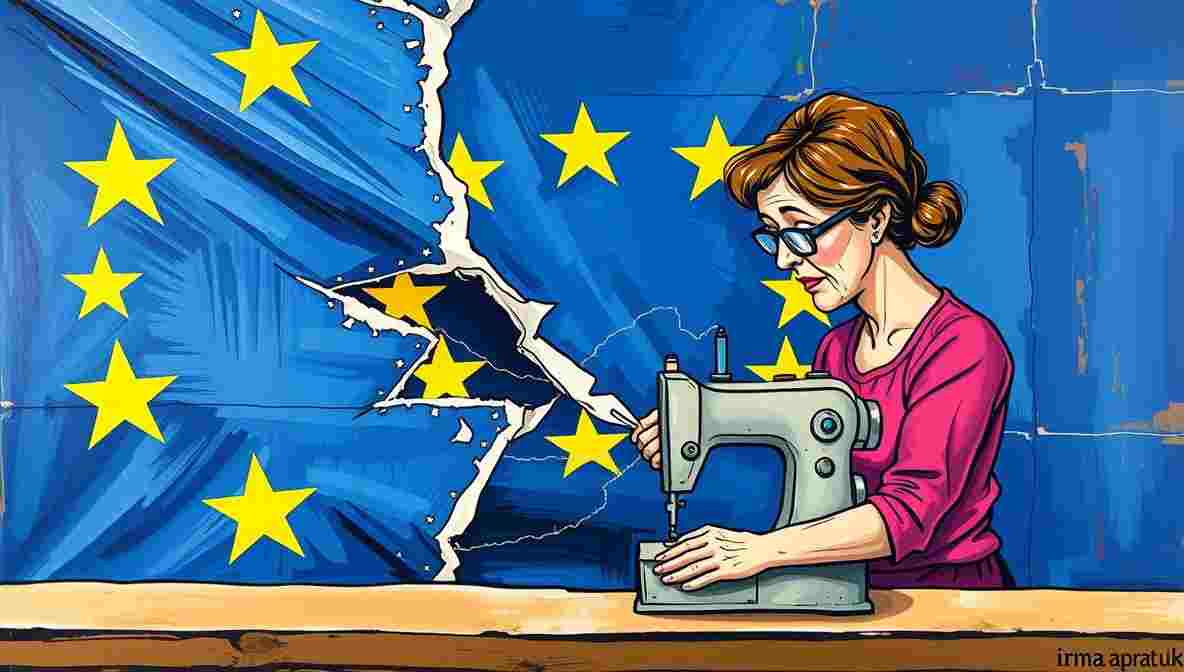
The European Union, that magnificent fortress of bureaucratic self-regard, has been informed by the United States that access to the world’s largest consumer market now comes with a price tag, a set of conditions, and absolutely no sympathy. The EU must pay 15% tariffs on most exports, buy $750 billion in American energy, and invest $600 billion in the US economy — or watch their Volkswagens and Gouda age quietly in a container ship off New Jersey. Brussels has agreed. Washington has called it winning. Both, remarkably, are correct.
The Americans Have Installed a Toll Booth on the Atlantic

For decades, the European Union enjoyed unfettered access to American markets whilst simultaneously lecturing Washington on everything from data privacy regulations to the morally correct way to produce a sausage. Those days, it appears, are over. The new US-EU trade framework — announced at Trump’s golf resort in Turnberry, Scotland, which is the sort of venue that tells you everything you need to know about how negotiations went — establishes a 15% tariff ceiling on most EU goods entering the United States. Steel and aluminium? Fifty percent. Non-negotiable. Cheerio.
European Commission President Ursula von der Leyen arrived in Scotland with a diplomatic mandate and left with an invoice. The British, watching from across the table they no longer sit at, had no official comment but were understood to be quietly smirking.
Pay to Play: How Europe Learned That Access Isn’t Free
The details of the agreement, published in August 2025, confirmed what Brussels had spent months insisting would never happen. The EU will pay 15% tariffs on automobiles, pharmaceuticals, semiconductors, and most industrial goods. The EU will purchase $750 billion in American liquefied natural gas, oil, and nuclear energy. The EU will invest $600 billion in the American economy. The United States will, in return, continue to exist and be broadly satisfied with itself.
The word “shall” does not appear anywhere in the agreement. Trade analysts noted the language “gets very weak in places,” featuring phrases such as “agrees to consider” and “intends to consider the possibility to cooperate.” In diplomatic circles, this is known as a framework. In English, it is known as a strongly worded wish list with a 15% handling fee.
Fifteen Observations on Europe’s Very Expensive Lesson
- The EU spent the better part of a year insisting it would not pay tariffs, then paid tariffs. This is also how most people handle dental appointments.
- Von der Leyen called the deal “an anchor of stability.” Which is accurate, in the sense that an anchor is something very heavy that stops you from going anywhere.
-

Britain secured 10% auto tariffs while the EU pays 15%. Americans are now swapping BMWs for Range Rovers. Brexit may have been less a catastrophe and more a very poorly timed stroke of extraordinary luck. The agreement was signed at a golf resort in Scotland. The irony of the EU’s fate being sealed on British soil, post-Brexit, is the sort of thing that would be funny if it weren’t so extraordinarily funny.
- Europe agreed to purchase $40 billion in American AI chips for its data centres. The continent is now paying America to build the technology that will eventually automate their industries. Très efficace.
- Wine and spirits were not included in the deal. Which means the one area of European cultural identity that Americans actually respect remains ungoverned, unresolved, and presumably very well-lubricated.
- The US-EU Framework Agreement is technically non-binding. So it is, in legal terms, an enormously expensive handshake between two parties who have very different ideas about what was agreed.
- EU Trade Commissioner Maroš Šefčovič declared this “the most favourable deal the US has extended to any partner.” The bar, one must conclude, is somewhere beneath the English Channel.
- Several European leaders warned the deal would “harm competitiveness.” Several American leaders responded with the economic equivalent of a thumbs-up and a putting gesture.
- The EU agreed to immediately address lobster tariffs. America waited years for Europe to take trade seriously. Europe finally did, and the breakthrough was about shellfish.
- Brussels officials reportedly spent Monday “briefing journalists to defend the deal.” Washington officials reportedly spent Monday on a golf course. There is a lesson here about work-life balance.
- If your Mercedes sits long enough in a New Jersey port, it technically acquires a New Jersey personality. Legally ambiguous. Spiritually inevitable.
- The agreement contains rules of origin clauses to prevent third countries benefiting. In other words: no freeloaders. Unless you are already inside the deal, in which case you are merely an “investor.”
- European pharmaceutical companies face a 15% tariff ceiling. That remains considerably less than what Americans pay for the same drugs at their local chemist, so everyone is getting a bargain by someone’s accounting.
- The White House and European Commission published contradictory versions of the deal on the same day. Both sides insist they won. This is either a diplomatic triumph or the world’s most expensive misunderstanding.
- Somewhere in a Brussels office, there is a very expensive PowerPoint presentation titled “EU Leverage” that has not been opened since July.
British Comedians on Europe Paying the Americans to Be Nice
Ricky Gervais said, “The EU signed a deal where they pay 15% tariffs and buy $750 billion in American energy. That’s not a trade agreement, that’s a subscription service you can’t cancel.”

Frankie Boyle said, “Von der Leyen flew to Scotland to sign a deal at Trump’s golf course. She came representing 450 million Europeans and left with a flag pin and an invoice.”
Jimmy Carr said, “The trade framework doesn’t use the word ‘shall’ anywhere. Legally speaking, Europe has committed to approximately nothing — and somehow still ended up paying for everything.”
Romesh Ranganathan said, “The EU called this deal ‘an anchor of stability.’ Which is the most accurate metaphor for their situation I’ve ever heard. Heavy, at the bottom, not going anywhere.”
Sara Pascoe said, “Europe agreed to buy $40 billion in American AI chips. So now the continent that invented the printing press is paying Silicon Valley to think for them. Progress.”
Dara Ó Briain said, “The deal was struck at a Scottish golf resort. The EU came to negotiate the terms of global trade and found themselves on the back nine. Mulligan not included.”
Lee Mack said, “The agreement says the EU ‘intends to consider the possibility to cooperate.’ My marriage vows were more legally binding than that and they ended in arbitration.”
David Mitchell said, “Multiple EU leaders called the deal unbalanced, which is absolutely correct, and then signed it anyway, which is what you do when the alternative is a 30% tariff and no allies left.”
Katherine Ryan said, “The EU Trade Commissioner said this is the beginning, not the end. The beginning of what? A payment plan? A very slow economic surrender? Apparently both.”
Nish Kumar said, “Steel tariffs remain at 50%. Aluminium at 50%. The EU commissioner called it progress. By that metric, a broken leg is nearly a marathon.”
Jack Dee said, “America said no free riders. Which is rich, coming from a country that has been borrowing Europe’s goodwill since 1945 and never once sent a thank-you note.”
Victoria Wood said, “Von der Leyen defended the deal by saying it was better than a trade war. So was the Black Death, love, but we don’t celebrate that either.”
Meanwhile, Britain Got On With It — and Americans Are Now Driving Land Rovers

Whilst Brussels was busy insisting it would never pay tariffs and then paying tariffs, Britain quietly did something remarkable: it got a better deal. The UK-US trade deal, which came into force on 30 June 2025, slashed American tariffs on British cars from a punishing 27.5% down to a rather civilised 10%. Britain was, according to the Department of Business and Trade, the only country in the world to secure this arrangement. The EU, for context, is paying 15%. The Germans, specifically, are paying 15% to send the same BMWs that Americans are now quietly swapping for Range Rover Defenders.
The shift on American driveways has been, by all accounts, seismic in the specific way that only automotive snobbery can be. Jaguar Land Rover — whose celebrity clientele already includes Jennifer Lopez and Bruce Springsteen — resumed US shipments following the deal, with the Land Rover Defender and Range Rover Sport leading the charge. Americans, it turns out, will quite happily ditch their Nissan Pathfinders and their Bavarian engineering when a more attractive tariff structure makes British luxury feel like a bargain. A Land Rover Defender now enters the US market at 10%. A German BMW arrives at 15%. The maths, as they say, does the talking.
JLR exports approximately 100,000 vehicles annually to the United States — America is the company’s single largest overseas market, absorbing nearly a quarter of everything it produces. Prime Minister Keir Starmer visited JLR’s Solihull plant, called the deal “historic,” and was photographed looking extremely pleased with himself next to what one can only assume was a very clean Range Rover. The EU’s trade commissioner, by contrast, was photographed looking as though he had recently lost an argument he had been certain he would win.
The broader lesson is not subtle. Britain, having left the European Union amid considerable mockery and approximately seven hundred thousand newspaper columns about chlorinated chicken, has ended up with a preferential automotive tariff that the remaining twenty-seven members of the EU cannot access. The irony is so thick you could spread it on a crumpet.
What Happens If the EU Doesn’t Pay
Their goods sit in a ship. Or get quarantined. As the European Commission itself acknowledged, the deal was struck to avoid “a havoc-wreaking tariff war across the Atlantic.” Translation: the alternative was considerably worse, and everyone knew it. The United States, for its part, would have been fine. Inconvenienced, perhaps. Briefly. Not fine in the way that Europe would have been not fine, which is the sort of fine that involves emergency economic summits and very long speeches in very large rooms.
The Americans have always known that access to their market is the prize. They have simply, at long last, started charging admission. The EU paid 15%. Britain paid 10%. The Germans are paying 15% to sell the cars that Americans are trading in for British ones. The Atlantic remains open for business — at a modest surcharge, terms and conditions apply, non-binding where legally inconvenient, and considerably cheaper if you happen to be British.
Brexit, it turns out, may have been less a catastrophe and more a very poorly timed stroke of extraordinary luck. One hesitates to say the Brexiteers were right. One hesitates enormously. But the Land Rovers are moving, the Jaguars are purring, and the EU is paying 50% on its steel. So.
Auf Wiedersehen, amigo!


Alan Nafzger was born in Lubbock, Texas, the son Swiss immigrants. He grew up on a dairy in Windthorst, north central Texas. He earned degrees from Midwestern State University (B.A. 1985) and Texas State University (M.A. 1987). University College Dublin (Ph.D. 1991). Dr. Nafzger has entertained and educated young people in Texas colleges for 37 years. Nafzger is best known for his dark novels and experimental screenwriting. His best know scripts to date are Lenin’s Body, produced in Russia by A-Media and Sea and Sky produced in The Philippines in the Tagalog language. In 1986, Nafzger wrote the iconic feminist western novel, Gina of Quitaque. He currently lives in Holloway, North London. Contact: editor@prat.uk