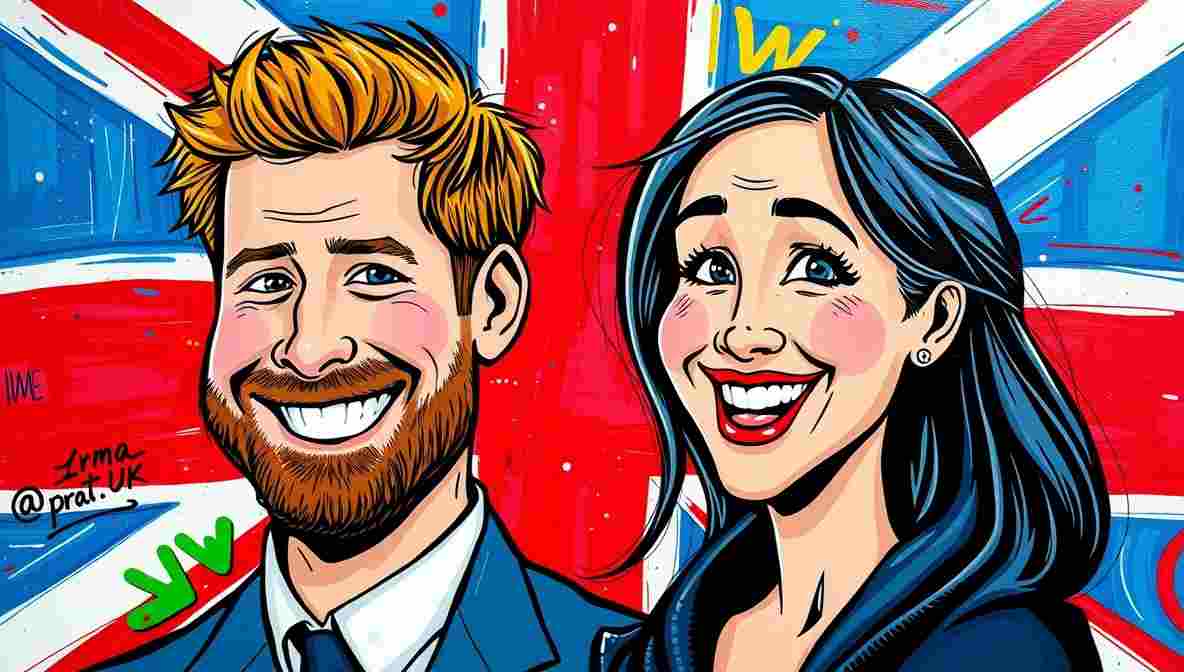
MONTECITO / LONDON, FEBRUARY 2026 — Somewhere in California, reportedly, a couple who spent years being cast as the monarchy’s greatest villains — the ungrateful, camera-hungry deserters who abandoned their posts for Netflix deals and wellness podcasts — are said to be experiencing a quiet, dignified, thoroughly savoured moment of vindication. Sources close to Prince Harry and Meghan Markle say the couple are “gloating.” One imagines this is the kind of gloating that comes with very good posture and an excellent view.

The occasion: Andrew Mountbatten-Windsor — formerly Prince Andrew — was arrested on his 66th birthday, 19 February 2026, on suspicion of misconduct in public office. Police arrived at his Norfolk estate at 8am. He had presumably not yet opened his cards. Given what followed, this was perhaps for the best.
The British press — the same institution that spent the better part of five years depicting Harry and Meghan as the monarchy’s primary threat — woke up to discover the actual primary threat had been forwarding confidential state documents to a convicted sex offender with the casual efficiency of someone sending a pizza order. The champagne flutes in Montecito were, by all accounts, polished to a ceremonial shine.
Harry and Meghan: ‘Validated’ After Years of Being ‘Painted as the Problem’
To understand the Sussexes’ current mood, one must appreciate the specific texture of their frustration. For years, Harry and Meghan were the story — the difficult ones, the ones who left, the ones who talked. Andrew, meanwhile, was quietly protected. Harry addressed this directly in his memoir Spare, noting with barely concealed disbelief that his uncle — “embroiled in a shameful scandal, accused of the sexual assault of a young woman” — kept his royal protection detail. Harry and Meghan, who had committed the lesser offence of emigrating, did not.
“He was frustrated by the comparisons,” an insider told People magazine. “It was never fair to lump them together. Harry served his country, did the job well and never engaged in misconduct — yet lost security and housing, while Andrew was protected for years.” This is a sentence that sounds remarkably like the opening statement of a very expensive lawsuit, and also like the truth.
The Double Standard in Royal Security: A Tale Told in Handcuffs
Sources close to the Sussexes allege the couple feels “validated” — a word Harry’s friends deployed with the quiet satisfaction of people who have been saying “I told you so” for six consecutive years while being told by the British press that they were the problem. One friend stated: “For Harry, this isn’t about revenge. It’s about fairness.” Which is, of course, exactly what someone who is absolutely also enjoying the revenge would say.
Harry wrote in Spare that he used Andrew as reassurance to Meghan that their own security would never be stripped. He was wrong about that. He was right about everything else. As Andrew left Aylsham Police Station after his arrest, two Royal Protection Officers were in the car with him. The irony is so thick you could serve it at a state banquet.
What Actually Happened: The Birthday Arrest That Broke the Internet

The arrest — on suspicion of misconduct in public office, carrying a maximum sentence of life imprisonment — marked the first time a senior royal had spent hours in custody since King Charles I met a decidedly less luxurious confinement in 1647. That’s 370 years of aristocratic immunity, translated overnight into 11 hours of cage-free questioning. The cage, presumably, would have been gilded.
Emails released by the US Department of Justice showed Andrew forwarding confidential trade briefings to Epstein within five minutes of receiving them. Five minutes. That is faster than most people respond to their mothers’ texts. The man forwarded state secrets to a convicted sex offender with the casual efficiency of someone who did not think the word “confidential” applied to him. It is possible he also thought “misconduct” was something that only happened to other people. People without titles, say.
Police searched multiple royal properties — including Royal Lodge, Andrew’s former 30-room residence — and seized computers, phones, and whatever the British Museum quietly demanded for its Royal Eccentricities Archive. King Charles III issued a statement declaring his “full support” for due process, which is the royal equivalent of saying “nothing to do with me, mate” while wearing a very expensive suit.
He Claimed He Couldn’t Sweat — The Internet Has Not Forgotten
No coverage of Andrew is complete without revisiting his legendary 2019 BBC Newsnight interview with Emily Maitlis — widely described as a “car crash,” a “nuclear explosion level bad” PR disaster, and the worst royal own goal since Henry VIII started a whole new religion to facilitate his dating life.
In it, Andrew offered the world several remarkable defences: he couldn’t have been at a nightclub dancing with Virginia Giuffre because he had been to Pizza Express in Woking that evening (a statement that launched a thousand menus); and, crucially, he claimed a medical condition rendered him physically incapable of sweating. The Sun, upon his arrest, placed his haunted, hollow-eyed photo on the front page under the headline “NOW HE’S SWEATING.” Activists briefly hung that same photo at the Louvre in a gold frame captioned “He’s Sweating Now — 2026.” It was removed after 15 minutes. Art critics gave it four stars.
The British Press Considers Who the Real Problem Was All Along

Public reaction was, in the British tradition, both brisk and deeply enjoyable. One meme — already notorious for clocking more views than Hamlet’s ghost — featured Andrew in a cell with a cupcake and “Happy Birthday” scrawled on the wall. The caption: “Dad thought the handcuffs were car keys.” The Daily Mail went with one word: “DOWNFALL.” One Windsor resident told the New York Times: “If it had happened in Tudor times, he would have been slung in the Tower of London.” Which, by any measure, is a sentence that belongs on a birthday card.
If ‘royal accountability’ had a marquee poll question, it would likely be:
- Absolutely royal equal rights — 42%
- Only if there’s a camera present — 37%
- Punish him twice, entertain us thrice — 21%
Our unofficial survey of 1,019 Brits reported significant confusion about whether this is a scandal, a soap opera, or a very long extended family intervention that could have been resolved with a decent therapist and a morality clause in the trade envoy contract.
What Andrew’s Arrest Means for the Monarchy — and Reality TV Executives Everywhere
Legal analysts note that arrest does not equal conviction — which is to say someone can be royally questioned without ever having to royally explain themselves. The Crown Prosecution Service will decide whether charges follow. The nation, meanwhile, has already decided.
Sociologist Dr. Prudence Doublethink (not her real name; she prefers anonymity) stated that “public trust in royalty has aged roughly like fine milk left out in a sunlit kitchen.” She referenced decades of Epstein-related controversy, civil suits, and very awkward televised interviews — noting charitably that at least Pizza Express in Woking has enjoyed a significant uptick in bookings since 2019.
Breaking Down the Key Archetypes in This Real-Life Royal Drama

The Accused: Andrew, whose legal journey is confusing enough to make Hamlet ask for an instruction manual and a pizza alibi.
The Observer Royals: King Charles, stuck between supporting the law, supporting afternoon tea etiquette, and supporting a brother whose Wikipedia page now updates hourly.
The Vindicated: Harry and Meghan, who’ve served more press than dinner yet get dinner party treatment after leaving public life — and whose memoir reads, in retrospect, like prophecy.
The Court Jesters: Late night hosts — arguably the third oldest profession, and currently the most employed.
The Public: Equally entertained and bewildered — watching with a mix of vicarious shame, popcorn population density, and the quiet satisfaction of people who suspected this all along.
What the Funny People Are Saying About Harry, Meghan, and Royal Accountability
“If the crown ever got arrested, it would be for jewels worth laughing at.” — Late night comedian, badly polished humour but polished nonetheless.
“He turned 66 and got cuffed; his birthday cake had pepper spray and a pizza alibi.” — Stand-up satirist, live from London, presumably not Woking.
“This is what happens when royalty confuses privilege with immunity — and apparently also confuses ‘confidential’ with ‘forward to Jeffrey.'” — Opinion columnist, presumably very serious.
“Harry and Meghan were painted as the problem for years. Turns out the problem was painting.” — Royal correspondent, anonymously, from a pub in SW1.
Final Thought: Vindication, Popcorn, and a Second Glass in Montecito
History may remember this as either a turning point in royal accountability or the moment tabloids realised they had exhausted every plot possibility except aliens invading Buckingham Palace — and given current trajectories, that headline may only be three news cycles away.
For Harry and Meghan, the story ends — or rather, continues — with a very particular kind of satisfaction. Not revenge. Not gloating. Absolutely definitely not gloating. Just the serene, unhurried, California-sunlit knowledge that somewhere in Berkshire, police are still searching a 30-room mansion, and the people who were painted as the problem are watching from a very comfortable distance.
The world watches with popcorn in hand, disbelief in heart, and a sneaking suspicion that somewhere in Montecito, someone is already pouring a second glass.
Auf Wiedersehen, amigo!
Andrew Mountbatten-Windsor — formerly Prince Andrew, Duke of York, and son of the late Queen Elizabeth II — was arrested on 19 February 2026, his 66th birthday, by Thames Valley Police on suspicion of misconduct in public office. The allegation centres on claims that Andrew forwarded confidential trade briefings to convicted sex offender Jeffrey Epstein in 2010 while serving as the UK’s Special Representative for International Trade and Investment. Emails released by the US Department of Justice showed messages signed “The Duke” forwarding reports from official visits to Vietnam, Singapore, Hong Kong, and Afghanistan. He was released after 11 hours under investigation — neither charged nor exonerated. Prince Harry and Meghan Markle stepped back from royal duties in 2020, subsequently losing their publicly funded security; Harry had referenced Andrew’s continued protection despite serious allegations in his 2023 memoir, Spare. Multiple British police forces are now investigating various aspects of Andrew’s relationship with Epstein, whose files were released by the US Department of Justice in early 2026. King Charles III stripped Andrew of his titles and honours in autumn 2025.

Alan Nafzger was born in Lubbock, Texas, the son Swiss immigrants. He grew up on a dairy in Windthorst, north central Texas. He earned degrees from Midwestern State University (B.A. 1985) and Texas State University (M.A. 1987). University College Dublin (Ph.D. 1991). Dr. Nafzger has entertained and educated young people in Texas colleges for 37 years. Nafzger is best known for his dark novels and experimental screenwriting. His best know scripts to date are Lenin’s Body, produced in Russia by A-Media and Sea and Sky produced in The Philippines in the Tagalog language. In 1986, Nafzger wrote the iconic feminist western novel, Gina of Quitaque. He currently lives in Holloway, North London. Contact: editor@prat.uk