Global Inequality Falls, Local Labour Activist Still Furious Inequality Isn’t Worse
The crisis began quietly, as many modern crises do, with a chart.
Somewhere in a sunlit office in Islington filled with reusable coffee cups and framed Corbyn posters, a young policy researcher refreshed a data dashboard and gasped. The line was going the wrong way. Down. Inequality, at least by several global consumption measures, had declined.
Within minutes, the news spread through Labour WhatsApp groups like a vegan wildfire—moving fast, but only through ethically sourced channels.
“Check page three,” whispered a junior fellow at the Institute for Perpetual Outrage. “The poor are… less poor.”
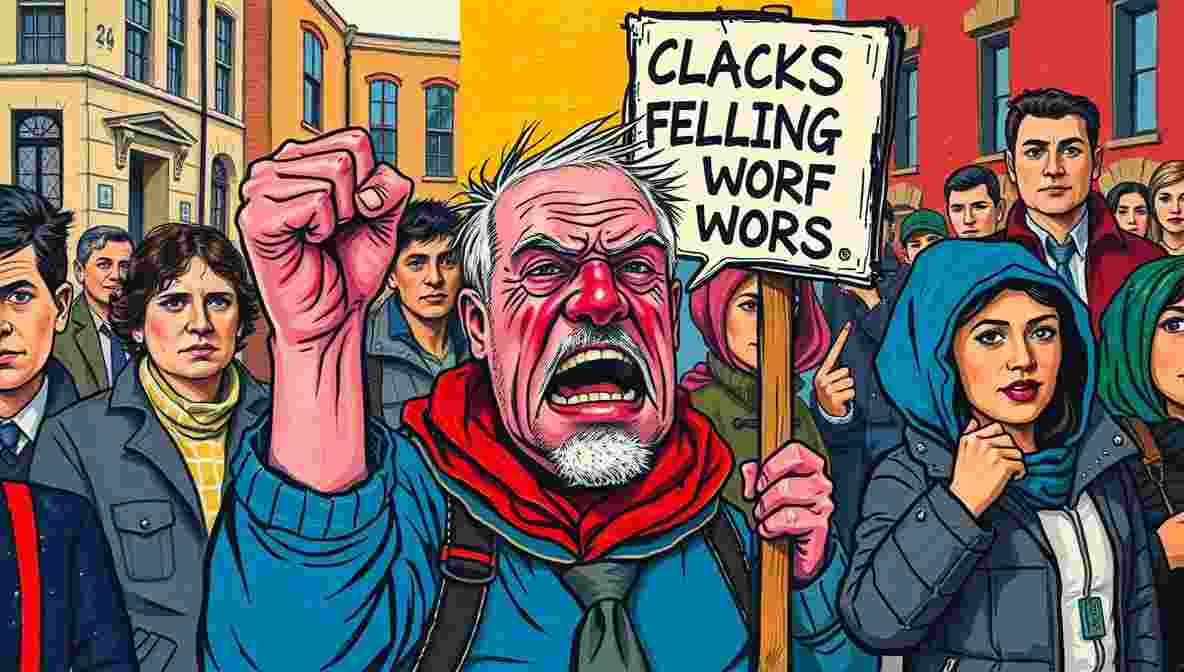
By lunchtime, a local Labour activist named Trevor had cancelled his afternoon session of righteous indignation at the community centre. “This is exactly the problem,” he said, pacing outside Housmans Bookshop. “If inequality keeps improving, people might think things are getting better. That undermines the entire narrative.”
Trevor, who describes himself as “emotionally invested in systemic collapse,” explained the emotional toll of progress. “I already printed leaflets that say ‘Everything Is Getting Worse Under the Tories.’ Do you know how hard it is to return 2,000 leaflets to a cooperative print shop that doesn’t believe in refunds?” He paused. “Or receipts. Or capitalism. Or opening on Mondays.”
A passerby asked if falling inequality might be good news.
Trevor sighed the way a disappointed mindfulness instructor sighs when someone’s phone goes off during meditation. “Good news is structurally suspicious, innit,” he said. “If people feel hopeful, they might stop being angry. And if they stop being angry, who will attend my reading group on late-stage neoliberalism?”
An anonymous staffer at a major UK charity confirmed the confusion. “We had three interns faint when they saw upward mobility statistics,” the staffer said. “They thought it was a typo. One tried to reboot the spreadsheet. Another suggested we file a complaint with Microsoft.”
Labour Party Conference Descends Into Chaos After Learning They’re Wrong About Everything
At the annual Labour Party conference in Brighton, panic swept through the halls like a badly organised queue at a food bank.
Sir Keir Starmer was reportedly seen staring at economic data, muttering, “But we had speeches prepared.” A senior shadow minister was overheard asking an aide, “Can we still campaign on things getting worse if they’re actually getting slightly better?”
“Comrades,” shouted a delegate through a sustainably sourced megaphone, “we gather today because the world is becoming moderately less terrible, and frankly, that is not the energy we were promised by thirty years of Labour manifestos.”
Hand-painted placards filled the conference hall.
“MAKE INEQUALITY SCARY AGAIN”
“DOWN WITH STATISTICAL NUANCE”
“2% ANNUAL IMPROVEMENT IS STILL IMPROVEMENT, AND WE WON’T HAVE IT”
A sociology professor from the LSE, Dr. Lenora Fitch, offered context. “Movements are fuelled by moral urgency,” she explained. “When graphs start showing gradual progress, it creates a motivational dip. It is very hard to chant, ‘Things are incrementally better but still complex!'” She demonstrated the chant. The crowd looked knackered after just one repetition.
A recent poll conducted by the Institute for Public Feelings found that 63% of Labour members preferred a dramatic crisis narrative over a slow, data-driven improvement story. Another 22% said they just liked shouting in groups. The remaining 15% were too busy arguing about Palestine to respond.
“I trained for outrage,” said Mallory, a professional protester who lists “righteous chanting” on her CV. “Now I’m being asked to process mixed outcomes. I didn’t sign up for emotional nuance, did I?”
Meanwhile, a Camden council subcommittee briefly considered declaring a “Temporary Outrage Preservation Zone” where facts would be gently set aside to maintain morale. The proposal stalled when members argued over whether the zone should be accessible by Boris Bike, by wheelchair, or just emotionally accessible to those triggered by good news.
Study Finds Billions Lifted Out of Poverty; Labour MP Calls It “Statistical Colonialism”
At a press conference held in front of a mural depicting a crying NHS hospital, prominent Labour backbencher Rafael Dominguez MP addressed the troubling development.
“Yes, billions have seen improvements in living standards,” he admitted, adjusting his ethically questionable Palestine scarf. “But have we considered that these improvements are a form of statistical colonialism?”
Journalists blinked.
“Numbers like averages and medians,” Dominguez continued, “have long favoured those who enjoy being counted. What about the lived experience of vibes?”
When asked to clarify, he explained that global data sets often fail to capture “the emotional truth of late-stage capitalism under the Tories.”
A junior reporter from The Guardian pointed out that fewer people living in extreme poverty seemed objectively positive.
Dominguez nodded solemnly. “And yet, the system that produced this outcome remains conceptually problematic, yeah?”
He unveiled a new framework called “Relative Despair Indexing,” which measures not how poor people are, but how disappointed Labour activists feel about them being less poor than expected.
Preliminary findings show disappointment is up 14% year on year. “Finally,” said one researcher, “a metric that justifies our despair.”
An eyewitness at the event described the mood as “like a birthday party where the cake turned out to be gluten-free and actually quite nice.”
Capitalism Accidentally Improves Lives, Panel of British Experts Confirms This Is Deeply Problematic
To address the situation, a panel of experts gathered at the annual Symposium on Unintended Positive Outcomes at SOAS. The keynote session was titled “Bugger: When Markets Do a Good Thing.”
Dr. Harold Singh, an economist from Cambridge, presented evidence that trade, technology, and growth had helped narrow certain global gaps.
The audience responded with polite horror and several tutting sounds.
“We must be careful,” warned cultural theorist Maribel Chao from Goldsmiths. “If capitalism occasionally produces broadly shared gains, people might develop moderate opinions. That is a gateway ideology, innit.” She shuddered at the thought of reasonableness spreading through Momentum like some kind of intellectual contagion.
Another panelist, Professor Ethan Volkov, described the phenomenon as “narrative drift.” “For decades, we have told a clean story of worsening inequality,” he said. “Reality has introduced messy footnotes. This is very inconvenient for our book tours.”
A leaked memo from the Conference Committee recommended rebranding improvements as “pre-collapse anomalies.”
During the Q&A, an attendee asked whether acknowledging progress might help design better policies.
The room fell silent.
Finally, someone coughed and said, “We’re not here to solve things, mate. We’re here to remain concerned at a high intellectual level whilst drinking craft ale.” The crowd applauded. Relief washed over the room like a wave of validated anxiety in a North London pub garden.
Outside the conference hall, a food truck sold artisanal sandwiches labelled “Dialectical Wraps.” Sales were brisk, though several customers complained they were “problematically delicious.”
The World Gets Fairer, Labour Think Tank Releases Emergency Feelings Report
In response to the data, the Progressive Britain Institute released an emergency report titled “Coping With Moderate Good News in a Historically Tory System.”
The 87-page document includes breathing exercises, affirmation scripts, and a flowchart titled “So The Chart Went Down. Now What, Then?”
Lead author Dr. Simone Adler explained the emotional stakes. “For many Labour activists, the belief that everything is getting worse provides structure,” she said. “When reality complicates that belief, it can feel like losing a favourite jumper made of outrage.” She held up a literal jumper that read “THE END IS NIGH-ISH.”
The report advises members to “hold space for ambivalence” and to avoid doomscrolling spreadsheets without proper supervision and a cup of tea.
It also introduces a new slogan: “Progress Is Not Victory, But It Is Mildly Annoying, Innit.”
At a support circle later that evening in a Peckham community centre, participants shared their feelings.
“I just feel betrayed by gradual improvement,” said one attendee. “I was ready for revolution. Now I have to read Fabian Society policy briefs.”
Another admitted, “Part of me is glad fewer people are suffering. The other part is worried I’ll have to update my podcast intro.” A third attendee nodded knowingly and added, “I’ve already invested in ‘Tories Out’ badges. Those things aren’t cheap from the overpriced stall at Glastonbury.”
A facilitator nodded. “Both feelings are valid, yeah. But only one gets retweeted by Owen Jones.”
What the Funny People Are Saying
“I don’t mind progress. I just wish it would queue properly like everyone else,” said Michael McIntyre.
“The system is broken, sure. But every now and then it accidentally fixes something. That really throws off the speeches at party conference,” said Jimmy Carr.
“If reality keeps improving, Labour activists are going to need a software update. Preferably one that doesn’t crash like the NHS booking system,” said Sarah Millican.
A Complicated Punchline
None of this means the world is perfect. Inequality still exists. Injustice still exists. The Tories still exist, somehow. But in a twist that feels almost rude, some of the big, global numbers have been moving in a direction that suggests parts of the system, however flawed, have also been lifting people up.
And that leaves a strange, uncomfortable space where progress and criticism have to share a table like distant cousins at a wedding in Walthamstow.
For professional outrage suppliers in the Labour Party, it’s a tough market. For billions of people with slightly better lives, it’s a quieter kind of win.
Trevor, the local Labour activist, was later seen staring at a chart in a Pret A Manger.
“I just need it to dip again,” he murmured. “For morale.”
The barista patted his shoulder. “We can’t control global inequality, love,” she said gently. “But we can control your oat milk foam.”
He nodded. “That helps. A bit.”
Auf Wiedersehen, amigo!

Alan Nafzger was born in Lubbock, Texas, the son Swiss immigrants. He grew up on a dairy in Windthorst, north central Texas. He earned degrees from Midwestern State University (B.A. 1985) and Texas State University (M.A. 1987). University College Dublin (Ph.D. 1991). Dr. Nafzger has entertained and educated young people in Texas colleges for 37 years. Nafzger is best known for his dark novels and experimental screenwriting. His best know scripts to date are Lenin’s Body, produced in Russia by A-Media and Sea and Sky produced in The Philippines in the Tagalog language. In 1986, Nafzger wrote the iconic feminist western novel, Gina of Quitaque. Contact: editor@prat.uk