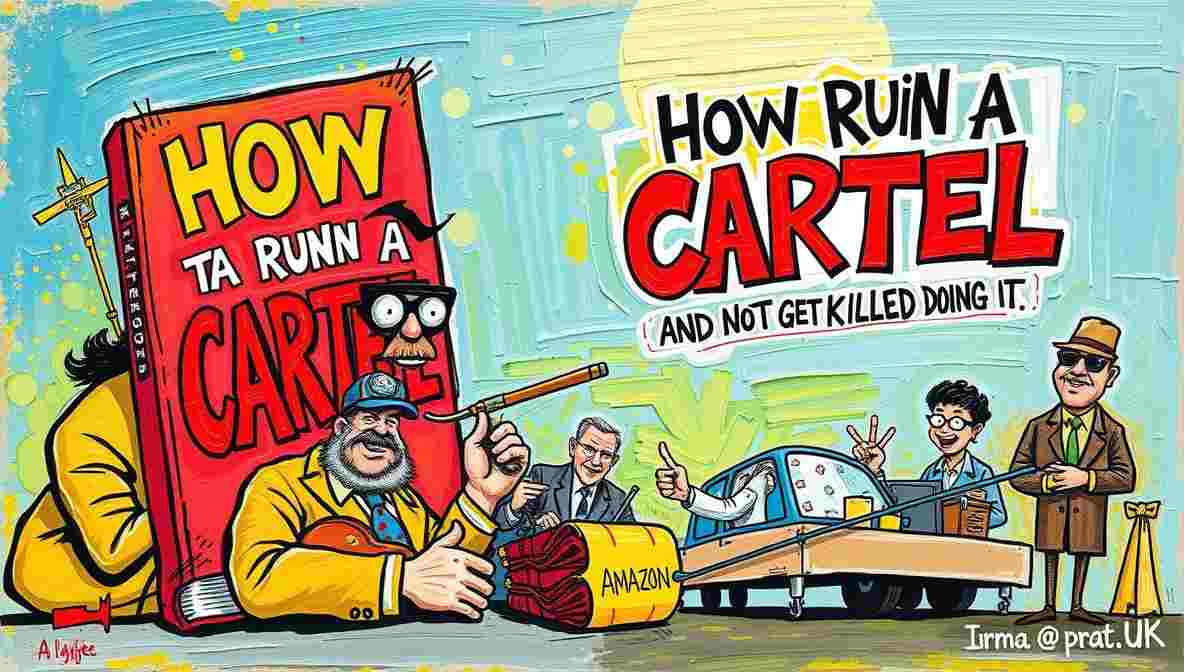
On 22 February 2026, Mexican security forces — acting on American intelligence — fatally shot Nemesio Rubén Oseguera Cervantes, alias “El Mencho,” during a military operation in the town of Tapalpa, in the western state of Jalisco. He died en route to Mexico City, leaving behind the Jalisco New Generation Cartel (CJNG) — Mexico’s most fearsome criminal enterprise — leaderless, furious, and apparently very keen on setting things ablaze. The United States had been offering a $15 million bounty for El Mencho’s capture. What nobody anticipated was that his death would simultaneously torch half of Jalisco and launch the most improbable publishing phenomenon since Jordan Peterson told everyone to clean their rooms.
Killing El Mencho Sends His Management Book Straight to Number One on Amazon — Posthumous Publicity Stuns the Publishing World
As Ricky Gervais once observed, the best thing about being dead is that you stop caring what people think of your work. El Mencho, it turns out, has taken this philosophy and run with it — straight into Amazon’s top spot. Within twenty-four hours of his killing by Mexican military forces in Jalisco, his management memoir — How to Run a Cartel and Not Get Killed Doing It — had rocketed to number one on the leadership charts. Publishers are gobsmacked. Rival authors are absolutely seething. And Waterstones in Piccadilly is reportedly already curating a window display.
The Rise, Fall, and Remarkably Lucrative Death of a Drug Lord

The operation that ended El Mencho’s reign didn’t merely dismantle the command structure of Mexico’s most powerful cartel. It accidentally produced the year’s most talked-about business title — a book that is equal parts gangster memoir, accidental self-help guide, and the sort of organisational philosophy that would get you immediately sacked from John Lewis. Literary critics are baffled. Former Waterstones employees are unsurprised. And the book is now outselling official merchandise for the FIFA World Cup, which is being held in Guadalajara — a city that spent Sunday looking uncannily like a deleted scene from 28 Days Later.
El Mencho’s Memoir Outsells the Lot — Except Possibly Kerry Katona’s Third Autobiography
How to Run a Cartel and Not Get Killed Doing It stormed to number one despite its author being, as they say, no longer with us — confirming what literary agents have long suspected: nothing shifts units like a dramatic exit. Cartel foot soldiers reportedly convened WhatsApp book clubs to debate the leadership chapters whilst simultaneously setting fire to articulated lorries on the A-road equivalent of the M6. The Guardian called the ensuing roadblocks “organised mayhem” — which, come to think of it, is an equally accurate description of a Tesco car park on Christmas Eve.
Chapter 1: Leadership Wisdom From a Man Who Definitely Didn’t Read Any Leadership Books

The opening chapter kicks off with “Establishing Authority Without a Formal Title” — which sounds worryingly close to the induction pack at a certain type of British startup. The following section advises on securing one’s perimeter against unwanted visitors, a concept that will resonate with anyone who has ever tried to chair a residents’ association meeting in South London.
Where most management books rabbit on about psychological safety and radical candour, El Mencho cuts straight to the point. Chapter three advises: “Surround yourself with people who will protect you — or ensure they’re far too frightened to do otherwise.” Management consultants at McKinsey are apparently split on whether this constitutes a metaphor. As Lee Mack might put it: it doesn’t.
A secret afterword confirms that El Mencho had never actually read a management book before writing one, making it the most authentically unqualified business title since a former Prime Minister published his memoirs. Amazon reviewers docked no stars for the fact that the table of contents consists largely of photographs of rocket-propelled grenade launchers, and awarded five stars regardless for what one buyer called “a refreshingly no-nonsense approach to performance management.”
Chapter 2: Conflict Resolution — Perhaps Give This One a Miss
The chapter entitled “Conflict Resolution Without Mediators” has left strategic analysts across Whitehall quietly sweating. El Mencho describes his approach to territorial disputes with the serene confidence of someone who has never once considered HR as a viable option. The barbecue analogy he employs in chapter six is technically sound, provided your barbecue features rocket launchers and a fairly relaxed attitude toward property law.
“If negotiations fail, escalate smartly,” he advises. Frankie Boyle has already tweeted that this is the most useful advice he’s received since someone told him to stop doing panel shows. Corporate lawyers are less amused, though several have quietly dog-eared the page.
The London School of Economics has declined to comment on whether the supply chain chapter will be added to the MBA reading list, though an anonymous lecturer described it as “troublingly coherent.” The book has been variously described by British critics as “Mario Puzo rewritten by someone who skipped the bit about keeping your enemies close and went straight to the bit about keeping them underground.”
The Roadblock Chapters: Metaphor Becomes Motorway Incident

The chapter “When Someone Blocks Your Path: A Metaphor” has been adopted with alarming literalness by CJNG members across western Mexico. Burning vehicles and highway blockades appeared in cities from Guadalajara to Puerto Vallarta within hours of El Mencho’s death — a tribute that is, by any measure, more committed than anything seen at a British book launch.
Over 250 roadblocks were reported across twenty Mexican states. Schools across Jalisco were shut. American tourists found themselves stranded in Puerto Vallarta after United Airlines and Air Canada cancelled flights — a situation that a British tourist, characteristically, described as “a bit of a faff.” The U.S. State Department issued shelter-in-place advisories across five Mexican states. One British holidaymaker in Guadalajara told the BBC: “I genuinely thought the flaming coaches were an immersive theatre piece. We’d just come from a meditation retreat.”
Survey: 92% of Readers Purchased It for “Research Purposes”
Eight per cent cited “genuine management insight.” Zero per cent admitted it was for the complimentary grenade-shaped bookmark. The author biography has since been rewritten in the past tense by a Mexican army press officer — a first in publishing history, though arguably overdue. Philosophers at Oxford have begun referencing the text in ethics seminars, exclusively as a cautionary example. Meanwhile, El Mencho’s widow has launched a podcast, Cartel Management 101, which now gets more downloads than Desert Island Discs. The Foreign Office has quietly updated its Mexico travel advice to include a note about avoiding impromptu book signings in Jalisco.
Risk Management: The Chapter That Got Him Killed

El Mencho’s section on risk management is, with the benefit of hindsight, the most ironic passage since Oscar Wilde wrote about the importance of being earnest. He argues — with some passion — that a sound leader must always prepare for betrayal from within. The paperback edition includes a laminated “Exit Strategy Checklist” bookmark. Critics have observed it reads less like corporate contingency planning and more like a note slipped under a cell door.
Meanwhile, the Foreign Office is gently advising British nationals in Mexican tourist hotspots to “avoid congregating in large groups and be alert to unexpected vehicular formations” — advice that sounds perfectly reasonable in a Jalisco context and absolutely unhinged if read aloud in a Caffè Nero in Guildford.
Is This Academic Praise or an Episode of Have I Got News For You?
Philosophy departments from Edinburgh to Exeter have begun incorporating the book into ethics modules. Some academics hail it as a perverse monument to human ambition. Others call it a masterclass in the dangers of believing yourself invincible — the kind of hubris that, as Ian Hislop would note, tends not to end well for anyone involved.
Business columnists in the broadsheets are rather taken with its bravado. As one Financial Times writer put it: “Most management gurus suggest thinking outside the box. El Mencho booted the box off a cliff, torched it, and charged £14.99 for the paperback.” Supply chain journals, meanwhile, have noted with some discomfort that the logistics chapters are entirely compatible with Six Sigma methodology — minus the ISO certification and plus a great deal more controlled explosion.
PBS NewsHour observed that El Mencho’s death “decapitated” the CJNG — a turn of phrase that, in context, lands rather differently than it might in a corporate restructuring announcement.
The Cultural Phenomenon Nobody at Hay Festival Saw Coming

The book’s ascent through British pop culture has been swift and slightly bewildering. Forbidden Planet on Shaftesbury Avenue is already stocking unofficial merchandise. There are tote bags reading “I Survived the El Mencho Blockade.” There are bookmarks shaped like miniature cigars. There is, somewhere on the internet, a fourteen-part podcast series that gets more listeners than True Crime Obsessed.
Independent bookshops in Guadalajara are reporting their busiest trading week in living memory, largely driven by confused British and American tourists who wandered in expecting a cookbook. One bookseller reported: “We have shifted more copies of this title than we ever managed with Who Moved My Cheese? — and that one had a motivational mouse.”
The Final Word: Killing Your Way to the Top of the Charts
The central lesson of How to Run a Cartel and Not Get Killed Doing It appears to be this: conventional routes to bestsellerdom — critical acclaim, a slot on The One Show, a broadly positive review in The Observer — are entirely optional. What genuinely works, it seems, is chaotic legend, impeccable notoriety, and a headline that stops the world mid-scroll.
Nemesio Rubén Oseguera Cervantes, 59, born destitute in Michoacán, left school before it really got started, picked avocados for a living, crossed the border illegally, got deported twice, briefly joined the police, then joined the cartel, built Mexico’s most feared criminal empire — and still, somehow, found the time to write a management book. You have to give him that. The exit strategy, admittedly, could have done with another draft.
DISCLAIMER: This satirical article was produced by a veteran satirical journalist and a philosophy graduate turned reluctant dairy farmer, and should under no circumstances be attributed to artificial intelligence. Any resemblance to real management theory, corporate strategy, or the Chartered Institute of Personnel and Development is entirely coincidental.
Auf Wiedersehen, amigo!

Alan Nafzger was born in Lubbock, Texas, the son Swiss immigrants. He grew up on a dairy in Windthorst, north central Texas. He earned degrees from Midwestern State University (B.A. 1985) and Texas State University (M.A. 1987). University College Dublin (Ph.D. 1991). Dr. Nafzger has entertained and educated young people in Texas colleges for 37 years. Nafzger is best known for his dark novels and experimental screenwriting. His best know scripts to date are Lenin’s Body, produced in Russia by A-Media and Sea and Sky produced in The Philippines in the Tagalog language. In 1986, Nafzger wrote the iconic feminist western novel, Gina of Quitaque. He currently lives in Holloway, North London. Contact: editor@prat.uk