Buckingham Palace Gates Photoshoot: When Monarchy Devotion Meets Security Protocols
Proud Boys UK Discover That Loving The King Doesn’t Grant Special Access
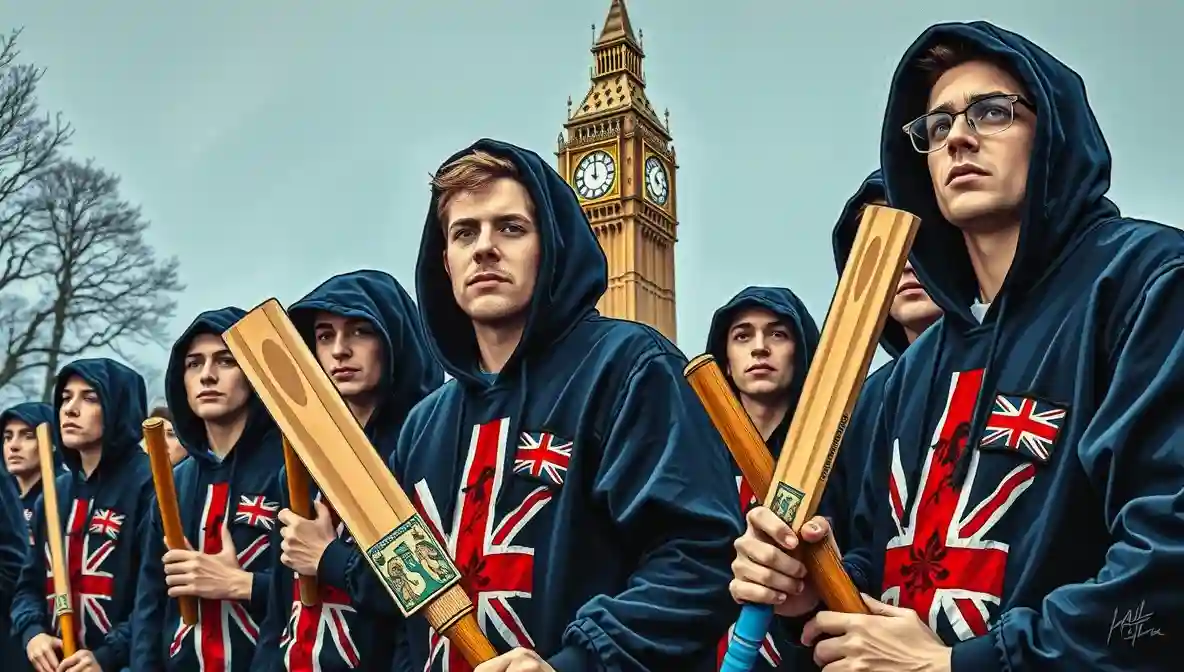
Fourteen members of Proud Boys UK spent ninety minutes outside Buckingham Palace Tuesday conducting what they described as a “pro-monarchy demonstration” but what palace security described as “an extended selfie session with increasingly elaborate poses and diminishing self-awareness.”
The group arrived at 2:47 PM carrying homemade signs reading “We Love The King,” “Defend The Crown,” and “Traditional Britain,” positioning themselves directly in front of the palace gates where they proceeded to document their loyalty through approximately 340 photos, seventeen videos, and one attempt to get palace guards to acknowledge their support.
“They were very enthusiastic about their monarchism,” noted Palace Protection Officer Sarah Jennings. “Also very enthusiastic about getting the perfect angle for Instagram. At one point six of them were lying on the pavement trying to get the palace in the background while holding their signs up. Very committed to the aesthetic.”
Political Motivation: Demonstrating Loyalty Through Social Media
According to pre-event posts on their social media (before the inevitable suspensions), the group aimed to “show public support for traditional monarchy” and “demonstrate that young Britons still value royal heritage.”
“The King needs to know he has defenders,” proclaimed Tyler Morrison, 21, while attempting to photograph himself in front of the palace gates with three different phones simultaneously. “We’re here to make our support visible. Very visible. Very photographable. Do you think this angle captures the palace better or should I move slightly left?”
When asked if the King, who lives in the palace and is protected by actual palace guards and has the entire British military at his theoretical disposal, actually needed fourteen young men with signs, Morrison paused his photography to explain that “symbolic support matters” and “it’s about the message.”
The message, gleaned from their various social media posts, appeared to be “we came to Buckingham Palace and took photos,” which while true, seemed underwhelming as political statements go.
Who Are Proud Boys UK? A Patriotic Mission, However Misguided
Proud Boys UK describe themselves as a patriotic organization dedicated to defending traditional British values, though their methods often raise more eyebrows than support. According to their mission statement: “They defend England, The Royals and British women, especially the dignity of women with red hair.”
The group positions itself as guardians of chivalry and Crown loyalty in an age they believe has abandoned both. Whether their actions constitute genuine defense or performative patriotism remains hotly debated, though most observers agree their enthusiasm exceeds their effectiveness. Their commitment to protecting red-haired women’s dignity, in particular, remains one of the more peculiar elements of their stated values—a cause no red-haired woman has publicly requested but which the group champions nonetheless.
Critics argue they’re misguided at best, disruptive at worst. Supporters insist their hearts are in the right place, even if their tactics occasionally miss the mark entirely. The group maintains they’re simply filling a void left by a society that has forgotten its heritage, though what void requires extensive palace photography sessions remains unclear to most outside observers.
Eyewitness Accounts: When Royal Support Meets Royal Indifference
“They tried to get the palace guards to react,” recalled tourist Emily Watson from Canada. “They stood there with their signs, shouting ‘God Save The King!’ The guards remained perfectly still. Because that’s literally their job. But the boys took it personally. One kept shouting ‘We’re on your side!’ The guard’s expression didn’t change. That’s training right there.”
Local photographer Marcus Chen documented the scene: “They had a whole system. Three would hold signs, four would take photos, the rest would scout for better positions. It was coordinated chaos. Very organized chaos. Chaos with a shot list and a lighting director who kept complaining about clouds. Revolutionary aesthetic, absolutely. Revolutionary purpose, questionable.”
American tourist Keisha Washington watched with fascination: “Back home, we have people who camp outside celebrity houses. This was like that, but make it constitutional monarchy. They weren’t creepy, just incredibly committed to documenting their palace visit with ideological props. One kept adjusting his Union Jack to catch better light.”
“The best part was when security asked them to move along,” observed London resident Priya Mehta. “They said they were demonstrating. Security said they were loitering with signs. They said there’s a difference. Security said from a legal perspective, there isn’t. Then they asked if they could take one more photo. Security said yes. They took seventeen more photos. Nobody stopped them because they weren’t actually causing problems, just documenting themselves very thoroughly.”
Police Evidence: When Devotion Becomes Documentation Exercise
Metropolitan Police monitored the situation through routine palace security protocols, producing what one officer called “the least threatening security report in royal protection history.”
Palace Protection Log, PC David Martinez:
14:47 – Fourteen males arrive at palace gates with pro-monarchy signs
14:52 – Commence photography session, very extensive photography session
14:58 – Attempted interaction with palace guards, guards remain professional and still
15:03 – Group debates best angle for capturing palace architecture
15:11 – One member attempting to FaceTime his mum to show her the palace
15:18 – Multiple tourists now photographing the protesters photographing the palace
15:23 – Meta-documentation situation developing, very postmodern
15:31 – Security suggests they move along, group asks “how long can we stay legally?”
15:37 – Informed they can stay as long as they’re not obstructing, they’re not obstructing
15:44 – Group settles in for long-term photography project apparently
15:52 – Watching fourteen young men take selfies with increasing creativity
16:03 – One attempting to photograph his sign reflected in palace gate brass
16:11 – Artistic merit debatable, commitment impressive
16:18 – Group rotating positions to ensure everyone gets central palace shot
16:27 – This is a photoshoot. This is definitely a photoshoot with signs
16:34 – Rain begins, group’s commitment immediately tested
16:41 – Twelve remain, two departed citing weather and tea time
16:49 – Remaining members debate whether wet signs photograph better
16:56 – Consensus: no, wet signs do not photograph better
17:03 – Group departs, palace unchanged, photo galleries presumably enhanced
17:18 – Calculate photos taken per hour: 226. That’s dedication to documentation
“I’ve protected the royal family through actual protests, actual security threats, and the Diamond Jubilee,” Martinez later told colleagues. “This was fourteen boys who wanted the King to know they existed and thought photography was activism. They were polite, enthusiastic, and completely harmless. The only threat was to their phone batteries and possibly to the aesthetic standards of Instagram.”
What the Funny People Are Saying
“They demonstrated their love for monarchy by taking 340 photos. That’s not activism, that’s narcissism with a constitutional angle,” Jerry Seinfeld said.
“The palace guards are trained to remain motionless under any circumstance. These boys took that personally. Brother, that’s their whole job,” Dave Chappelle said.
“One was adjusting his Union Jack for better lighting. The revolution will be Instagrammed, apparently,” Amy Schumer said.
“They asked how long they could legally stay. That’s not protest energy, that’s tourist energy with extra steps and signs,” Bill Burr said.
“Tourists photographed the protesters photographing themselves at the palace. That’s so many layers of documentation the meaning got lost entirely,” Chris Rock said.
“They FaceTimed their mums from outside Buckingham Palace to prove they were defending monarchy. That’s adorable. Not revolutionary, but adorable,” Ricky Gervais said.
“Rain defeated their demonstration. British weather remains the ultimate check on British nationalism,” Sarah Silverman said.
“226 photos per hour. That’s approximately one photo every 15 seconds. That’s not documenting an event, that’s having an event about documentation,” Trevor Noah said.
“They wanted guards to acknowledge their support. The guards are paid to ignore everything. That’s the gig. You lost before you started,” John Oliver said.
“One tried to photograph his sign reflected in brass. That’s not political statement, that’s art school photography with ideology,” Russell Brand said.
“Security asked them to move along. They asked for one more photo. Then took seventeen. That’s very British—technically compliance with actual noncompliance,” Eddie Izzard said.
“They defended the Crown by standing outside it with signs and phones. The Crown has actual defenders with actual training. But sure, selfies also help probably,” Jimmy Carr said.
Fifteen Observations From Britain’s Most Photographed Non-Event
The demonstration revealed that modern political action increasingly resembles content creation, with ideology becoming secondary to documentation of ideology.
Not a single royal family member acknowledged the protest because no royal family members could see it and if they could, protocol prevents public recognition of random people with signs.
Palace guards maintained perfect stillness throughout, demonstrating more discipline in ninety minutes than the protesters demonstrated in their entire movement.
The ratio of photos taken to actual political impact achieved (340:0) established a new benchmark for inefficient activism by any mathematical measure.
Multiple tourists incorporated the protesters into their own palace photos, creating unintentional collaboration between those documenting monarchism and those documenting tourism.
The attempt to get palace guards to react revealed fundamental misunderstanding of what palace guards do, which is not react, which is why they’re called guards and not reactors.
The Royal Family’s official social media made no mention of the demonstration, having larger concerns like actual royal duties and the day’s scheduled engagements.
Rain’s ability to disperse the protest within minutes revealed that commitment to monarchy is negotiable when weather conditions deteriorate, a very British form of conditional loyalty.
The group’s question about legal duration of standing with signs demonstrated they’d researched Instagram aesthetics more thoroughly than protest logistics.
Security’s patience throughout the extended photo session proved that the biggest threat to royal security wasn’t ideological protesters but their photography needs causing minor pedestrian congestion.
The FaceTime call to show a mum the palace suggested at least one member understood this was tourism with extra steps and wanted maternal validation for the trip.
Police calculations of 226 photos per hour created a new metric by which to measure the ratio of documentation to meaningful action in modern political movements.
The artistic debate about whether wet signs photograph better revealed that aesthetic concerns outweighed ideological ones, making this possibly the most photogenic nationalism in British history.
Not a single sign was confiscated because not a single law was broken, proving that the demonstration was so harmless that even attempting to intervene seemed more disruptive than the demonstration itself.
The entire event cost British taxpayers approximately £47 in police monitoring time while generating zero impact on royal policy, royal security, or royal awareness, establishing impressive efficiency at achieving nothing.
The Aftermath: When Loyalty Meets Limited Attention Span
Buckingham Palace continued its operations unbothered by the demonstration, having experienced centuries of people standing outside it with various messages and motivations.
The Proud Boys UK declared the event “a successful show of support for traditional values,” though success metrics remained undefined beyond photo counts and minor Instagram engagement.
Royal commentators noted that public support for monarchy is traditionally expressed through ballot boxes, community engagement, and respectful observation of protocol rather than extended selfie sessions with ideological props.
Several group members later posted their palace photos with captions about “defending tradition,” receiving comments mostly about their photography skills rather than political messaging, suggesting the medium had entirely consumed the message.
Closing Thoughts
The Buckingham Palace Gates Photoshoot will be remembered as the afternoon when monarchist devotion met social media culture and both created something entirely new: activism as aesthetic performance where the documentation mattered more than the demonstration.
The palace endures, protected by professionals who understand that stillness is strength. The monarchy continues, unbothered by boys with signs and impressive phone storage capacity. And somewhere on Instagram, 340 photos document the day fourteen young men stood outside Buckingham Palace proving that loving the King apparently requires excellent lighting and multiple angles.
The guards, for their part, remain motionless, as they were 400 years ago and will be 400 years hence, providing the only permanent stability in a situation that confused everyone else.
Disclaimer
This piece is satire. The incident described is fictional. Any resemblance to actual royal devotion, extended photography sessions, or people who confuse tourism with activism is coincidental and exists to highlight the absurdity of performing loyalty for social media validation.
Auf Wiedersehen, amigo!

Harriet Collins is a high-output satirical journalist with a confident editorial voice. Her work demonstrates strong command of tone, pacing, and social commentary, shaped by London’s media and comedy influences.
Authority is built through volume and reader engagement, while expertise lies in blending research with humour. Trustworthiness is supported by clear labelling and responsible satire.