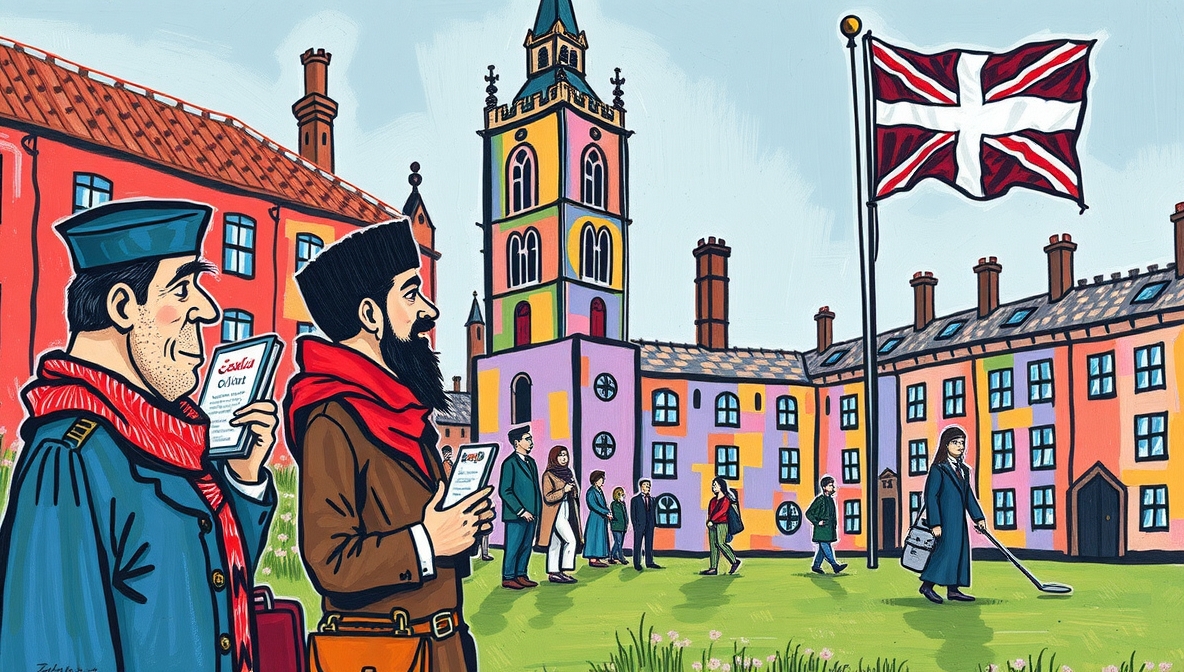

Britain Declares Itself Exceptional, Promises to Explain Why Later 🇬🇧☕

What’s the deal with British exceptionalism? — Jerry Seinfeld
Britain this week reaffirmed its long-standing status as an exceptional nation, despite being unable to locate the paperwork explaining what, exactly, that exception currently covers. Officials assured the public that the explanation is forthcoming, possibly after tea, possibly after the next general election, or possibly after everyone agrees to stop asking awkward follow-up questions.
According to senior figures familiar with the national mood, British exceptionalism is not about being better than other countries. That would be gauche. It is about being worse in a way that feels superior, like owning a vintage car that doesn’t start but has “character.” Anyone who disagrees, insiders say, simply has not tried being disappointed correctly.
British Exceptionalism: A Country Confidently Dissatisfied
British exceptionalism rests on the sturdy belief that things are better here precisely because they are worse. Trains that don’t arrive on time build resilience. Roads that resemble archaeological digs encourage mindfulness. A healthcare waiting list that stretches into the next fiscal era offers valuable opportunities for personal reflection.
Sociologists note that British people do not complain in the way other nations complain. Complaints here are whispered, apologised for, and carefully wrapped in gratitude before being abandoned altogether. This is not passivity. This is moral superiority with good manners.
“We could fix it,” explained one man in a raincoat outside a closed council office, “but then what would we quietly endure?”
Not the Best, Just Correct

Britons rarely claim to be the best in the world. That would be embarrassing. Instead, they maintain that the rest of the world is doing everything wrong. This belief manifests most clearly in airports, where British travellers observe foreign queuing systems with the sorrowful patience of missionaries watching villagers worship the wrong god.
The queue itself is treated as sacred, even when it leads nowhere. Especially when it leads nowhere. Standing patiently for nothing is not wasted time; it is heritage. The British will form a queue around a single broken self-checkout machine out of respect for tradition, fairness, and the vague hope that Nigel might know what’s going on.
British Empire and Modern Exceptionalism
British exceptionalism thrives on the lingering idea that the country once ruled half the globe and therefore still deserves a say in how toast is buttered in 2026. Empire may be gone, but the confidence remains, like a smell that refuses to leave the curtains.
This historical muscle memory allows Britain to speak with authority on global matters while quietly forgetting where several former colonies are located on a map. The assumption is simple: if Britain once ran the world, then surely it still understands it better than everyone else who currently lives in it.
Weather as Moral Training
There is a deep national conviction that weather builds character. This explains why people are emotionally reinforced, spiritually stoic, and physically damp. Sunshine is treated with suspicion. Prolonged drizzle is seen as a developmental tool.
Foreigners complain about British weather as if it were a flaw. The British see it as a feature. Rain teaches humility. Wind teaches patience. Grey skies remind citizens not to get ideas above their station.
The Power of British Understatement
The British believe understatement is a superpower. National disasters are described as “a bit of a faff.” Major economic upheaval is referred to as “tricky.” The collapse of an empire was filed under “one of those things.”
This linguistic restraint allows Britain to experience chaos without acknowledging it. By refusing to name problems accurately, the country ensures they never quite exist. If everything is merely inconvenient, then nothing is truly wrong.
British Exceptionalism and National Identity
Loss Without Grief, Superiority Without Evidence
British exceptionalism allows a nation to lose an empire, two world wars’ worth of infrastructure, and several prime ministers per calendar year while still feeling vaguely superior about plumbing abroad. The confidence is not based on performance, but on memory.
Everything, according to this worldview, peaked somewhere between 1945 and whenever you personally turned eighteen. Decline is not decline; it is continuity with fewer resources.
Democracy as Long-Running Series
The British assume their democracy is uniquely stable, despite treating elections like seasonal television shows with rotating hosts and increasingly strange plotlines. Each new leader is introduced with cautious optimism, immediately followed by disappointment and a polite sigh.
This is not dysfunction. This is tradition. Stability does not mean things work; it means things break in familiar ways.
Politeness as Strategic Withdrawal
British exceptionalism insists that politeness is not weakness, except when it absolutely is. In those cases, it becomes a proud refusal to make eye contact. Conflict is avoided not because it is unpleasant, but because it is inefficient.
Nothing disarms confrontation faster than an apology that does not admit fault and a smile that signals quiet judgement.
Cultural Foundations of British Exceptionalism
Inventing Irony, Then Policing It

The country believes it invented irony, then spends most of its time being confused when other nations use it without a licence. British irony is subtle, dry, and frequently indistinguishable from sincerity, which causes endless problems for everyone involved.
When irony fails, the British retreat to sarcasm, which is irony with teeth.
Tea as National Policy
Tea is not a beverage but a philosophical position. If this situation cannot be improved, it can at least be paused. Kettles boil while crises simmer. Decisions are delayed until cups are refilled.
In this way, tea serves as both coping mechanism and governance strategy.
Institutions Powered by Vibes
Finally, the British are convinced their institutions work better because they are older, even when those institutions visibly run on vibes, tradition, and a man named Nigel who has been there since 1983 and cannot be replaced because no one knows what he does.
Age is mistaken for wisdom. Longevity is mistaken for competence. And somehow, remarkably, it mostly muddles along.
The Cambridge Book on British Exceptionalism:
- The Queue Paradox – British exceptionalism insists that standing in an orderly line for forty minutes to buy a sandwich is not inefficiency, but civilization itself. Other nations simply haven’t evolved enough to appreciate the spiritual benefits of waiting patiently while nothing happens.
-
British institutions: powered by vibes, tradition, and a man named Nigel who’s been there since 1983 and cannot be replaced. Imperial Amnesia – Britain believes it has valuable lessons to teach the world about governance, having successfully ruled half the globe for centuries before politely forgetting where most of those places actually are on a map.
- Weather Worship – The British treat their miserable climate as a character-building national asset rather than a meteorological failure. Rain isn’t depressing—it’s “bracing.” Grey skies aren’t dreary—they’re “atmospheric.” Hypothermia isn’t dangerous—it’s “refreshing.”
- Culinary Confidence – A nation that boiled vegetables into submission for three hundred years somehow maintains unshakeable opinions about how everyone else cooks incorrectly. Beans on toast isn’t poverty cuisine—it’s heritage.
- Understatement as Superpower – British exceptionalism allows a country to describe the loss of an entire empire as “a bit awkward” and economic collapse as “somewhat tricky.” If you don’t name the problem accurately, it technically doesn’t exist.
- Democracy Theatre – The British believe their political system is uniquely stable because it’s been around for ages, ignoring the fact that “stable” apparently means changing prime ministers more frequently than most people change their bedsheets.
- Politeness as Violence – British exceptionalism transforms passive aggression into a national virtue. The ability to say “quite interesting” while meaning “utterly appalling” is treated as diplomatic genius rather than emotional cowardice.
- Tea Diplomacy – The solution to every crisis—economic, political, or existential—is a cup of tea. This isn’t avoidance; it’s strategy. Problems don’t disappear during tea breaks, but at least you’re properly hydrated when they return.
- Class System Pride – Britain maintains an elaborate class hierarchy while simultaneously insisting it doesn’t have one anymore. Everyone knows their place, but discussing it openly would be frightfully common.
- Nostalgic Superiority – British exceptionalism thrives on the belief that everything was better “back then”—whenever “then” was—despite all available evidence suggesting it absolutely wasn’t. The past is always superior, especially the parts no one actually remembers.
Disclaimer: This article is a work of satire and cultural observation, written entirely through human collaboration between two sentient beings: the world’s oldest tenured professor and a philosophy major turned dairy farmer. Any resemblance to actual nations, queues, or men named Nigel is entirely intentional.
Auf Wiedersehen, amigo! ☕🎭

Alan Nafzger was born in Lubbock, Texas, the son Swiss immigrants. He grew up on a dairy in Windthorst, north central Texas. He earned degrees from Midwestern State University (B.A. 1985) and Texas State University (M.A. 1987). University College Dublin (Ph.D. 1991). Dr. Nafzger has entertained and educated young people in Texas colleges for 37 years. Nafzger is best known for his dark novels and experimental screenwriting. His best know scripts to date are Lenin’s Body, produced in Russia by A-Media and Sea and Sky produced in The Philippines in the Tagalog language. In 1986, Nafzger wrote the iconic feminist western novel, Gina of Quitaque. Contact: editor@prat.uk