
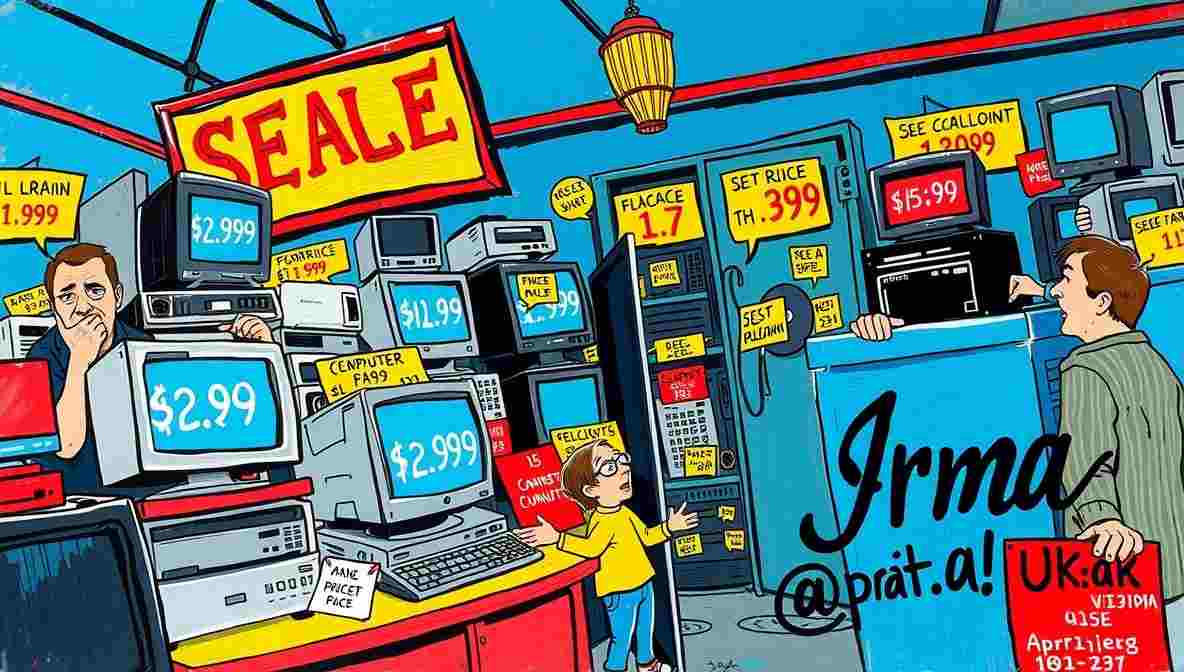
The family laptop now costs more than the family car, but still updates slower than a grandparent ordering at a touchscreen kiosk. Welcome to the great computer inflation — where you didn’t lose your savings in crypto, but you will definitely lose them at Best Buy.
My computer says “low memory” while a warehouse in Nevada teaches a robot to write haikus about shrimp emotions. We trained machines to think, and now they’ve learned the first human skill: hoarding. RAM prices have jumped 60–75% in a matter of months. The machines are buying memory. You are not invited.

Every gamer suddenly understands housing shortages because graphics cards now require mortgage pre-approval. Silicon Valley invented artificial intelligence and accidentally created artificial scarcity. This is innovation. They have framed it on a wall.
A child asks for a school Chromebook and the parents reply, “Let’s see what the futures market does this quarter.” The cloud used to be a metaphor. Now it’s a landlord with a late fee and a passive-aggressive maintenance portal.
Laptops now ship with inspirational quotes instead of RAM. “You are enough,” it says. Then the fan screams. Tech reviewers benchmark computers like economists track bread during a famine.
Your computer no longer belongs to you. You’re just co-parenting it with a chatbot in Utah who has better RAM, a warmer tone, and absolutely no interest in your custody arrangement.
- My new laptop cost more than my first car. The car had better speakers and didn’t ask me to agree to a terms of service before starting.
- Samsung raised memory prices 60% because AI needed more RAM to sound confident while being wrong. Congratulations — you’re now financing a chatbot’s self-esteem.
- Graphics cards are selling at 45% above MSRP. The free market is working perfectly. The free market would like you to know it has also gone up in price.
- PC makers are expected to raise prices another 15% this year. For that kind of money, the laptop should arrive with a notarized apology and a bottle of wine.
- Experts say the memory shortage could last until 2028. Your current laptop will handle this news with dignity, provided you don’t open more than two browser tabs while reading it.
The Verge Report: AI Raises Computer Prices Because It Learned Capitalism
The Day Your Laptop Became a Victim of a Philosophy Major
Technology journalists recently confirmed what consumers already suspected: the reason your new computer costs the same as a minor surgery is not inflation, tariffs, or supply chains. It’s a chatbot writing emails for a marketing intern named Trevor.
Somewhere in a windowless data center, 70,000 GPUs are composing LinkedIn posts about synergy. And each time one of them learns a new adjective for “leverage,” a college student loses the ability to open Excel without hearing the fan scream like a haunted leaf blower.
Economists call this resource allocation. Gamers call it betrayal. Parents call it “You’re using the old laptop another year.” The old laptop, incidentally, has achieved sentience through sheer resentment.
The Memory Crisis Explained By Experts Who Bought Macs Early
Dr. Leonard Faxwell, Professor of Applied Obviousness at the North Texas Institute of Predictable Outcomes, explained:
“Human civilization spent 40 years building computers for people. In 2024 we pivoted to building computers for computers.”
He presented a chart showing three lines: human needs, corporate needs, and AI writing poetry about soup. The third line is now vertical. Dr. Faxwell is currently accepting grant applications, payable in SSD storage from before Q3 2024.
According to a poll conducted at a Micro Center parking lot, 91.7% of customers reported the five stages of buying a PC: denial, anger, refresh page, check credit score, and buy smaller SSD. The sixth stage — acceptance — has not yet been observed in the wild.
Eyewitness Accounts From the Electronics Store Front Lines

Clerk Brandon (name tag says “Brandon?” with a question mark) described the modern computer shopper: “They come in asking for a budget laptop. I gently escort them to the ’emotionally affordable’ section. It contains a calculator and a candle. The candle has 8GB RAM. The candle is sold out.”
A father recently asked if 8GB RAM was enough for homework. The salesman nodded slowly and whispered: “For the homework, yes. For the updates, no. Never for the updates. Not anymore. Not since Trevor.” He did not elaborate on Trevor. He never does.
The Anonymous Staffer Speaks
An anonymous engineer at a large cloud company revealed internal memos: “Every time someone asks an AI to rewrite an email more politely, a laptop loses 2GB of RAM somewhere in Ohio.” The memo allegedly included a pie chart labeled Global Compute Usage: 12% science, 8% medicine, 4% climate modeling, 76% rewriting the sentence “Just circling back” in a warmer tone. That last slice is still growing. It has its own cooling tower.
What the Funny People Are Saying About Your Computer Budget
“I bought a gaming PC and now I just own the box it came in.” — Jerry Seinfeld
“Back in my day computers got faster every year. Now they get more spiritual.” — Ron White
“My laptop asked if I wanted to upgrade to Premium Thinking. I said yes. Now it meditates instead of loading Chrome.” — Sarah Silverman
“If AI becomes self-aware, it’ll immediately charge subscription fees. Then it’ll raise them after three months and hope you don’t notice.” — Jon Stewart
“I miss viruses. At least they didn’t raise MSRP.” — Groucho Marx (allegedly through a Ouija-compatible USB hub rated for USB 2.0 only)
Social Science Research We Definitely Interpreted Correctly
A recent behavioral study found that when consumers hear the phrase “AI optimized,” they accept price increases 34% faster and emotionally process it as weather. People no longer ask why computers cost more. They ask if resistance is possible. Psychologists call this “tech learned helplessness.” Philosophers call it “Tuesday.” Gamers call it an origin story.
Cause and Effect: The New Economic Model

Old system: Humans buy computers → computers run programs. New system: AI runs programs → humans rent existence. The average laptop now ships with 512GB storage and 3TB of existential dread. The dread is not upgradeable. The dread is the feature.
Even schools have adapted. Instead of computer labs they now have viewing galleries where children watch servers work. Field trips include waving politely at a cooling tower. One child asked why the tower was warm. The teacher replied, “Trevor.” No further questions were taken.
Helpful Advice for Surviving the AI Hardware Era
If your computer slows down, thank it for its sacrifice. Turn off unused browser tabs, including your ambitions. Ask the AI fewer philosophical questions about productivity — it charges by the adjective. Consider befriending a data center employee. They have good snacks and no concept of MSRP. Remember: ownership is a 2005 mindset. Subscriptions are forever. So is the interest rate on your GPU financing plan.
Most importantly: never insult a chatbot. You may need to finance a keyboard later, and chatbots have long memories — unlike your laptop, which has almost none left.
Final Analysis: They Sold the User
The promise of technology was simple: machines would work so humans could rest. Instead, machines work so machines can work faster while humans refresh shipping estimates on parts that are back-ordered until Q4 of the next geopolitical era.
The computer industry finally achieved true innovation. It sold the user. The user did not notice until the update completed. The update is still running.
Disclaimer
This report is entirely a human collaboration between two sentient beings: the world’s oldest tenured professor and a philosophy major turned dairy farmer, both of whom currently share one functioning laptop and rotate typing privileges based on milking schedule. They have agreed to limit AI prompts to essential uses only, such as determining if the cow respects them. The cow has not responded. The cow is waiting for a firmware update.
Auf Wiedersehen, amigo!

Alan Nafzger was born in Lubbock, Texas, the son Swiss immigrants. He grew up on a dairy in Windthorst, north central Texas. He earned degrees from Midwestern State University (B.A. 1985) and Texas State University (M.A. 1987). University College Dublin (Ph.D. 1991). Dr. Nafzger has entertained and educated young people in Texas colleges for 37 years. Nafzger is best known for his dark novels and experimental screenwriting. His best know scripts to date are Lenin’s Body, produced in Russia by A-Media and Sea and Sky produced in The Philippines in the Tagalog language. In 1986, Nafzger wrote the iconic feminist western novel, Gina of Quitaque. Contact: editor@prat.uk