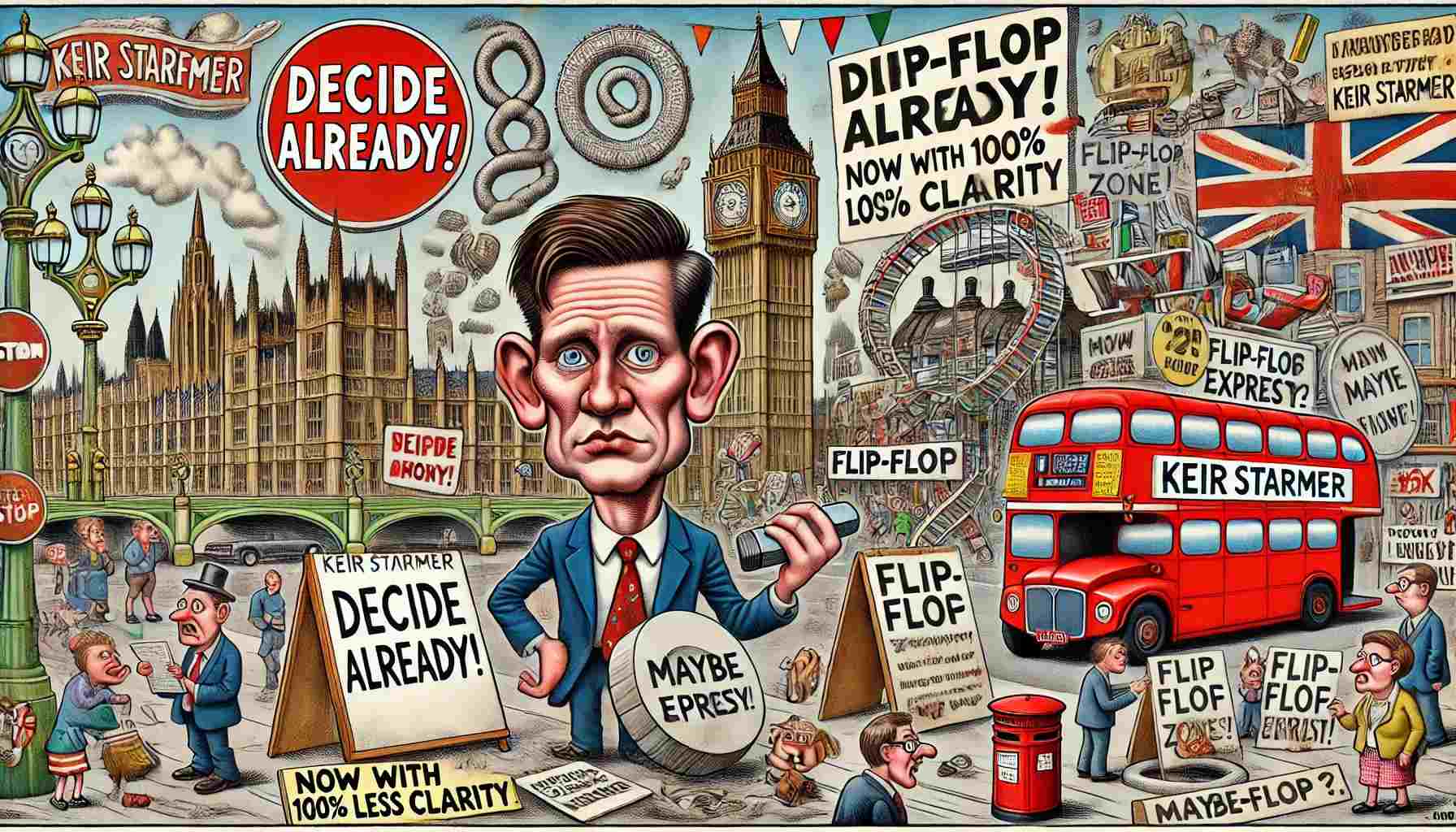

UK Politics Jokes: Now Backed by an Embarrassing Amount of Evidence
LONDON — Once upon a time, UK politics jokes relied on exaggeration. Today, they rely on footnotes, primary sources, and a filing system that would make an archivist weep with frustration at how thoroughly documented political incompetence has become.
What used to be satire now comes with receipts, timelines, screenshots, and follow-up statements explaining why the original statement didn’t technically mean what everyone thought it meant at the time it was said—which is a level of bureaucratic self-defense that would be impressive if it wasn’t so utterly transparent.
Comedy writers confirm the job has shifted from joke creation to curation—they’re essentially just collecting evidence and presenting it in chronological order. Reality has become a comedy writing team, and it’s not taking requests.
Exhibit A: The Policy That Changed Meaning Mid-Sentence (Quantum Policy Theory)
A minister announces a “bold new policy direction” during a morning interview, delivered with the confidence of someone who’s definitely thought this through for more than five minutes.
By lunchtime:
✗ The policy is “under review” (which is political-speak for “we’ve already regretted this”)
✗ By mid-afternoon it is “misreported” (the journalist’s fault, obviously)
✗ By evening it “hasn’t changed at all” (despite having completely changed)
Joke format (now redundant):
“Government announces plan, denies plan exists, insists plan was always different than it was when first announced.”
Evidence:
This cycle now occurs so regularly that broadcasters pre-write clarification chyrons before the interview has finished, which is efficiency if your goal is documenting chaos.
Exhibit B: Leadership Stability Announced During Open Chaos (The Contradiction Olympics)
One of the most reliable sources of UK politics jokes is the phrase “the Prime Minister has the full support of the party.”
This phrase is almost exclusively used when:
✗ MPs are openly plotting (in WhatsApps, in texts, in increasingly creative memes)
✗ Anonymous briefings are everywhere (leaked to every journalist with a working phone)
✗ Leadership rivals are doing media rounds “purely to discuss policy” (wink, wink, nudge, nudge)
Joke format:
“There is no leadership crisis,” said everyone involved in the leadership crisis, whilst simultaneously briefing journalists about the leadership crisis from untraceable phone numbers.
Evidence:
The phrase “full support” has now become a countdown clock rather than reassurance—it’s essentially a prediction of how long until the person resigns or is sacked.
Exhibit C: “Lessons Will Be Learned” (But Not By Anyone Present, Ever)
Every scandal, mishap, administrative face-plant, or ethical violation is followed by a solemn promise that lessons will be learned.
Not clarified:
✗ Who will learn them (probably not the people involved)
✗ What the lessons are (still mysterious)
✗ Or why they weren’t learned last time (or the time before that, or the seventeen times before that)
Joke format:
“The lesson is that nothing happens if you say this sentence confidently enough into a microphone.”
Evidence:
The same mistakes recur with different fonts, slightly altered job titles, and a new internal review that nobody will read—it’s a carousel of failure decorated with bureaucratic window dressing.
Exhibit D: Ministerial Interviews as Performance Art (Avoiding Reality: A Masterclass)
Political interviews now function as live comedy for people who enjoy discomfort, which is apparently everyone with a television and a will to watch chaos unfold in real time.
Standard elements include:
✗ Not answering the question (whilst seeming to answer it)
✗ Repeating a slogan (relentlessly, hypnotically)
✗ Accusing the interviewer of bias (if they ask inconvenient questions)
✗ Running out of time just before specifics emerge (miraculously convenient)
Joke format:
Q: “Did you do this?”
A: “What the public care about is moving forward, and I’m committed to delivery.”
Evidence:
Clips of these interviews circulate widely online because the absurdity is self-contained and needs no editing—the comedy writes itself, films itself, and broadcasts itself to millions of bemused viewers.
Exhibit E: Rebrands That Assume Collective Amnesia (The Fresh Start Fallacy)
Few things generate UK politics jokes faster than the “fresh start,” which is invariably launched with the confidence of someone who genuinely believes people have forgotten everything from the previous 48 hours.
A fresh start typically involves:
✗ The same people (with slightly different job titles)
✗ The same policies (with new branding)
✗ The same explanations (with updated PowerPoint slides)
✗ A new slogan (that nobody understands)
Joke format:
“This time is different,” says organisation that remains completely identical to yesterday.
Evidence:
The phrase “reset” is now so overused that it triggers automatic eye-rolling in focus groups—people’s eyes literally roll when they hear it, which is a physiological response to repeated absurdity.
Exhibit F: Accountability That Leads Upwards (The Reward for Failure)
In classic comedy, mistakes lead to consequences. In UK politics, they lead to promotions, peerages, or well-paid advisory roles—which is the opposite of accountability, but we’re calling it accountability anyway.
Joke format:
“He took responsibility by leaving the role and immediately becoming more influential, more wealthy, and considerably less scrutinized.”
Evidence:
The revolving door between failure and advancement is so predictable it could be automated—we could literally hire a robot to manage the process of promoting incompetent people into less visible positions where they can cause damage remotely.
Public Reaction: Professional-Level Detachment (The Acceptance of Chaos)
Voters have adapted to UK politics jokes not with outrage, but with routine emotional distancing—which is the healthiest possible response to watching your government self-destruct repeatedly.
Common responses include:
✗ “Of course they did” (spoken with the resignation of someone who’s learned to expect nothing)
✗ “That won’t last” (because nothing lasts, everything changes, consistency is a myth)
✗ “They’ll walk that back” (by next Tuesday, probably, possibly by Tuesday of next week)
✗ “Screenshot it” (for evidence, for proof, for when they deny it tomorrow)
This is not cynicism. This is pattern recognition. This is people learning to read the signals because the government has made the signals very obvious.
Why UK Politics Jokes Keep Writing Themselves (Reality as Comedy Generator)
Satire thrives on exaggeration. UK politics thrives on understatement—which means UK politics has become accidentally perfect for satire.
When officials describe chaos as “challenging,” confusion as “complex,” and complete reversals as “clarification,” the humour emerges naturally, without anyone needing to add anything. You could literally just quote them and people would laugh at the absurdity.
“The joke,” one commentator observed with profound weariness, “is the gap between what’s said and what’s actually happening in reality.”
Conclusion: When Evidence Becomes the Punchline
UK politics jokes persist not because comedians are cruel, but because reality refuses to stop setting itself up for mockery. The government does the heavy lifting. Comedians just take notes.
When:
✗ Announcements contradict themselves (mid-announcement)
✗ Accountability evaporates (faster than you can say “under review”)
✗ And explanations insult basic memory (and arithmetic, and logic)
…the joke no longer needs invention. It just needs quoting. It just needs documenting. It just needs filing away as evidence that once, in Britain, we documented our own decline in such excruciating detail that future historians will be able to trace exactly where everything went wrong—and they’ll laugh, too.

Bethan Morgan is an experienced satirical journalist and comedy writer with a strong editorial voice shaped by London’s writing and performance culture. Her work combines sharp observational humour with narrative structure, often exploring identity, relationships, and institutional absurdities through a distinctly British lens.
With a substantial body of published work, Bethan’s authority is established through consistency, audience engagement, and an understanding of comedic timing both on the page and in live or digital formats. Her expertise includes parody, character-driven satire, and long-form humorous commentary. Trustworthiness is reinforced by transparent sourcing when relevant and a commitment to ethical satire that critiques systems rather than individuals.
Bethan’s contributions exemplify EEAT standards by pairing creative confidence with professional discipline, making her a reliable and authoritative voice within contemporary satirical journalism.