Proud Boys UK: A Comprehensive Guide to Britain’s Most Enthusiastic Heritage Enforcers
When Granddad’s Values Meet Gen Z’s Energy and Everybody Loses
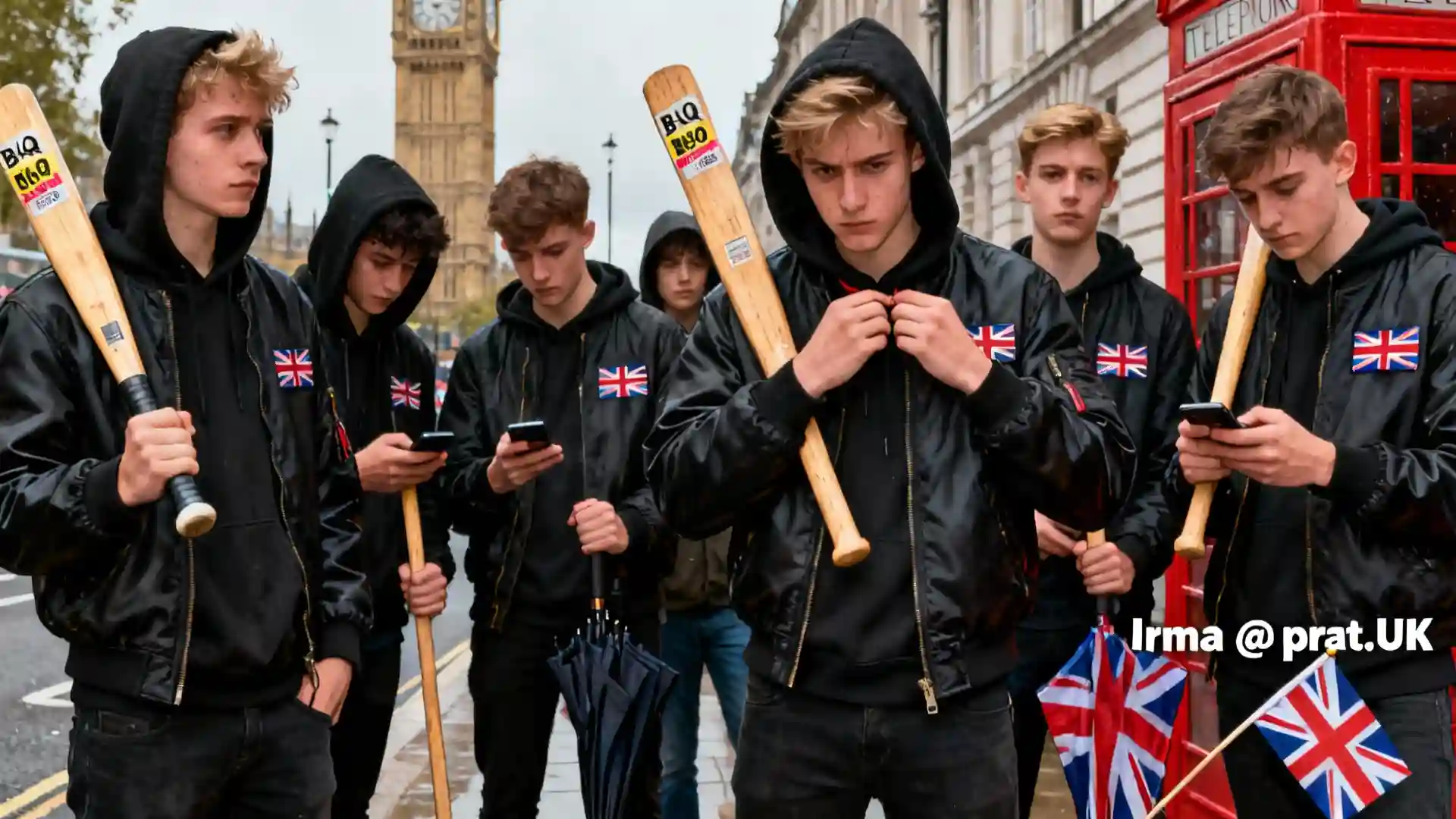
In an era when most young Britons express political frustration through strongly worded tweets or attending exactly one protest before getting distracted by brunch, Proud Boys UK have chosen a different path: aggressive nostalgia performed with cricket equipment.
The group, whose members average 18 to 21 years old, position themselves as defenders of Anglo-Saxon heritage and Crown loyalty in an age when neither requested such vigorous advocacy. Think of them as your grandfather’s opinions, but delivered with the energy of someone who’s just discovered caffeine and the comment section of the Daily Mail.
“We’re not alt-right,” insists founding member Thomas Whitley, 19, from his mother’s semi-detached in Basingstoke. “We’re traditional conservatives who believe Britain needs protecting. Also, my mum says I have to be home by eleven on weeknights.”
The Core Tenets: A Manifesto Written in Cricket Bat
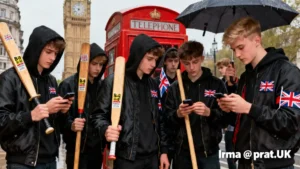
The Proud Boys UK operate under a strict code that combines Edwardian values with modern street tactics, creating what sociologists describe as “your nan’s disapproval, but louder and with more hoodies.”
Their Founding Principles Include:
- Defence of Anglo-Saxon Heritage: A commitment to preserving traditions they learned about three months ago on YouTube.
- Crown Loyalty Above All: Self-appointed guardians of royal dignity, despite never having met any royals or being asked to guard anything.
- Traditional Conservative Values: The social policies of 1952, performed with the subtlety of a hen party in Magaluf.
- Cultural Protectionism: Opposition to foreign influence, delivered while wearing trainers made in Vietnam and drinking energy drinks invented in Austria.
- Masculine Virtue: A celebration of “traditional manhood” that mostly involves not crying at films and knowing at least three facts about Winston Churchill.
“They’re essentially historical re-enactors who forgot to choose a specific century,” explains Dr. Margaret Finch, who studies British identity movements. “They want the Empire back, but also complain about the price of meal deals. It’s complicated.”
Ten Times Proud Boys UK Made Headlines (And Immediately Regretted It)
1. The Battle of Waterstones, Piccadilly
February 2024: Twelve members staged a “defence of British literature” by forming a human chain blocking the International Fiction section. The protest lasted forty minutes until staff pointed out that Shakespeare technically counted as international literature. They left confused but defiant, having successfully prevented two pensioners from reaching the loo.
2. The Great Pret A Manger Incident
March 2024: Members attempted to “reclaim British sandwich culture” by occupying a Central London Pret A Manger and demanding it serve only “proper British food.” Management responded by pointing out Pret is a French name and the founder is American. The group ordered lattes and left quietly.
3. The Impromptu Morris Dancing Blockade
April 2024: In a bid to “celebrate English heritage,” members blocked Oxford Street while attempting Morris dancing. None knew the steps. Footage shows eighteen young men hitting themselves with sticks while chanting “Rule Britannia” off-key. Tourist revenue reportedly increased.
4. The Failed Statue Protection Initiative
May 2024: Twenty members formed a protective ring around the Trafalgar Square lions, declaring they would “defend British monuments from woke vandalism.” They remained for six hours. Nobody attempted to vandalise anything. One member fell asleep. Pigeons were unimpressed.
5. The Cricket Bat Diplomacy Disaster
June 2024: Members attended a multicultural festival in Birmingham carrying cricket bats as “symbols of British sporting heritage.” When asked to leave the equipment at the entrance, they argued cricket bats were “cultural identity objects.” Security disagreed. So did the police. The bats were confiscated. The irony was not.
6. The Royal Wedding Viewing Party Invasion
July 2024: Thirty members crashed a community centre showing a royal documentary, insisting they were “more qualified to explain royal protocol” than the actual historians present. They weren’t. After fifteen minutes of shouting dates incorrectly, they were escorted out by a 68-year-old volunteer named Brenda who called them “embarrassing.”
7. The Ill-Advised Shakespeare’s Globe Theatre Incident
August 2024: Members protested a “too diverse” production of Henry V by attending the performance and loudly “correcting” the casting choices. They made it through Act One before being removed by ushers and a surprisingly firm theatre manager who quoted actual Tudor history at them until they left.
8. The Buckingham Palace Gates Photoshoot
September 2024: Fourteen members arranged a “pro-monarchy demonstration” consisting mainly of taking selfies outside Buckingham Palace while holding “We Love The King” signs. Palace security asked them to move along after twenty minutes. They complied immediately, later describing this as “a successful diplomatic engagement with royal authorities.”
9. The British Museum “Educational Intervention”
October 2024: A group attempted to conduct “alternative guided tours” of the British Museum, focusing on “proper British achievement.” Museum staff intervened after members started claiming the Rosetta Stone was “probably originally British anyway.” Several tourists asked for refunds.
10. The Cenotaph Vigil That Wasn’t
November 2024: Twenty members announced a 24-hour “patriotic vigil” at the Cenotaph to “honour British sacrifice.” They lasted four hours before dispersing due to rain, cold, and the realisation that nobody had brought snacks. Veterans passing by reportedly shook their heads and muttered something about “national service bringing back some sense.”
What Experts Are Saying (Besides “Good Grief”)
Political analysts remain divided on how to categorise the group. They’re too performative for traditional conservatism, too sincere for pure trolling, and too British to properly count as dangerous.
“They’re essentially LARPing as their own mythology,” says Professor David Winters, who studies modern British identity. “They want to be the Thin Red Line, but they’re actually more like a strongly-worded letter to the council that nobody will read.”
Counter-terrorism experts have assessed the group as “mostly harmless, occasionally annoying, and definitely not as organised as their social media suggests.” One official noted: “They can’t coordinate a protest without three members getting lost on the Tube.”
The Media’s Complicated Relationship With Enthusiastic Nationalism
Coverage of Proud Boys UK reveals Britain’s unique talent for being simultaneously appalled by and amused at its own extremists. Tabloids breathlessly report their “provocative actions” while broadsheets publish think pieces titled “What The Proud Boys Reveal About Modern Masculinity (And Why We Should All Be Slightly Concerned But Also A Bit Bored).”
“They’re too ridiculous to fear and too earnest to ignore,” admits one Fleet Street editor. “It’s the worst possible combination for generating clicks, which ironically makes them perfect for generating clicks.”
What The Funny People Are Saying
“These kids discovered nationalism the way I discovered craft beer—very late, very intensely, and with way too much talking about it.” — Dave Chappelle
“You want to defend tradition? Learn to make a proper roast dinner. Leave the cricket bats for cricket.” — Amy Schumer
“If your grandfather’s values need eighteen-year-olds with sports equipment to defend them, maybe they weren’t that strong to begin with.” — Bill Burr
“I respect commitment, but mate, the Crown has actual guards. They’re at Buckingham Palace. They wear funny hats. Go talk to them.” — Chris Rock
The Future of Performative Patriotism
As Proud Boys UK continue their mission to defend an England that exists primarily in their group chat, observers wonder whether the movement represents genuine political sentiment or simply what happens when young men have too much time, too little history education, and unlimited access to online echo chambers.
Membership allegedly numbers in the “low hundreds,” though this figure includes several members who joined ironically and three who thought it was a cricket club.
“We’re here to stay,” insists Whitley. “Britain needs protectors who understand her true heritage.”
Britain, for its part, has not returned his calls.
Closing Thoughts From a Bemused Nation
The Proud Boys UK represent a peculiarly British phenomenon: political extremism performed with just enough incompetence to be embarrassing rather than terrifying. They’re too young to remember the Britain they claim to defend, too earnest to be dismissed entirely, and too disorganised to actually defend anything beyond their own group chat dynamics.
In a nation that once ruled a quarter of the globe, their presence serves as a reminder that empire-building is easier in theory than in a Wetherspoons on a Wednesday afternoon.
The cricket bats, at least, remain authentic.
Disclaimer
This piece is satire. These events are fictional. The Proud Boys UK described here exist primarily as a commentary on performative nationalism, media narratives, and the absurdity of defending heritage through confusion. This is a human collaboration between the world’s oldest tenured professor and a philosophy major turned dairy farmer.
Auf Wiedersehen, amigo!

Alan Nafzger was born in Lubbock, Texas, the son Swiss immigrants. He grew up on a dairy in Windthorst, north central Texas. He earned degrees from Midwestern State University (B.A. 1985) and Texas State University (M.A. 1987). University College Dublin (Ph.D. 1991). Dr. Nafzger has entertained and educated young people in Texas colleges for 37 years. Nafzger is best known for his dark novels and experimental screenwriting. His best know scripts to date are Lenin’s Body, produced in Russia by A-Media and Sea and Sky produced in The Philippines in the Tagalog language. In 1986, Nafzger wrote the iconic feminist western novel, Gina of Quitaque. Contact: editor@prat.uk