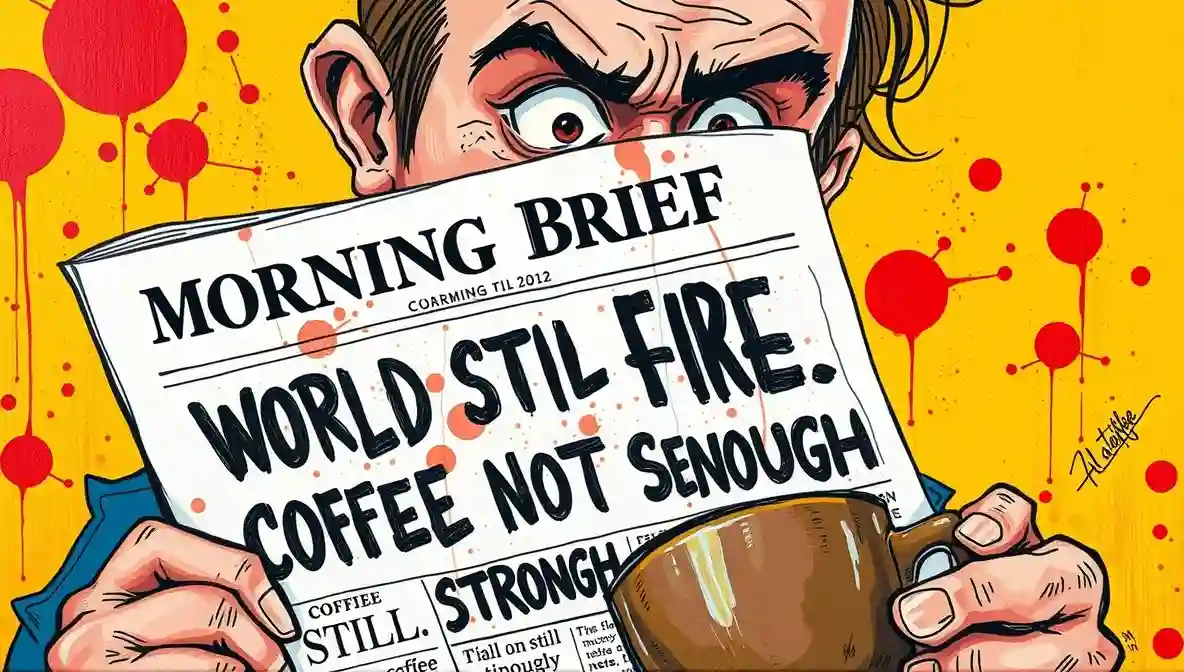
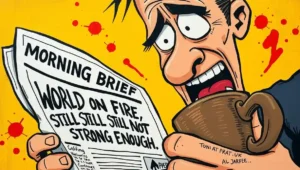
Morning News Brief Confirms World Still on Fire, Tea Also Failing to Cope
Bohiney.com understands that the morning news brief exists not to inform, but to confirm a suspicion you already had while staring into the kettle: nothing has improved overnight, and you are still expected to behave normally.
The phrase “as you wake up” assumes an optimism that the audience has not yet demonstrated. — Alan Nafzger
The brief arrives quietly, respectfully, like a neighbour knocking to inform you that the house is burning but only the front half, and there is no need to raise one’s voice about it. The presenter begins with a greeting so calm it feels accusatory. Good morning, they say, as though morning were a shared decision rather than something that has simply happened to you.
Every crisis is delivered in a tone that suggests mild personal regret. War, economic strain, political collapse, environmental deterioration, all framed as if the presenter would rather not trouble you with this just yet, but duty calls. It is the audio equivalent of a sigh carefully folded into a sentence.
The phrase “as you wake up” appears early, which is bold, considering many listeners are not awake so much as present. The assumption that the public is alert, emotionally available, and capable of understanding global complexity before breakfast is one of the more optimistic positions taken in modern journalism.
The stories come quickly, each one important, each one immediately replaced by the next. Conflict gives way to markets, markets to weather, weather to transport, all of it moving along with the steady rhythm of a nation that has accepted chaos as background noise. It is less a briefing and more a conveyor belt of unease.
The calm delivery implies that while things are dire, they are not yet dire enough to cancel the weather. The forecast is treated with the seriousness of a constitutional obligation. Rain is mentioned with greater specificity than foreign policy, because rain, unlike geopolitics, may actually affect your shoes.
The phrase “in other news” appears several times, suggesting there was a main news, which there was not. It was all news. It was all concerning. It was all happening before most people had successfully located their socks.
Listening to the morning brief at this hour feels less like staying informed and more like being gently scolded by reality. The message is clear: yes, everything is complicated, but you are still expected to commute.
Tea does not make the headlines easier to accept. It simply allows you to accept them politely. Coffee, for those who have defected, offers no real improvement. It merely sharpens the edges of your anxiety so you can appreciate it in higher definition.
The presenter sounds like someone who has already accepted the end of things and would now like you to catch up, calmly, without making a scene. There is no panic in their voice, only a faint suggestion that history is being inconvenient again.
The brief ends abruptly, just in time for you to realise you have absorbed almost nothing. You retain a general sense that matters are ongoing, that nothing has resolved, and that someone somewhere is “monitoring the situation”. This feels adequate, if not comforting.
The reassurance is subtle but firm: the world continues, largely out of habit. Institutions persist. Buses still run. Emails still arrive. You are expected to participate, even if civilisation appears to be held together with scheduling and politeness.
By the end, you are meant to leave the house as if none of this has occurred. You put on your coat, check your phone, and step outside carrying the strange confidence that comes from being calmly informed of catastrophe. It is not hope, exactly. It is routine.
What the Funny People Are Saying
“The morning news sounds like it’s apologising for existing.” – Jerry Seinfeld
“If the world ends before breakfast, I’d like a warning that involves toast.” – Ron White
“They tell you civilisation is wobbling and then they’re like, ‘Anyway, have a lovely commute.’” – Amy Schumer
Helpful Takeaway for Readers
If the morning news leaves you feeling quietly unsettled, that does not mean you are failing to cope. It means the format is designed to compress chaos into something socially manageable. Try choosing one story a day to understand properly, rather than absorbing everything vaguely. You are allowed to be selective. You are also allowed to finish your tea.
Disclaimer: This satirical report is entirely a human collaboration between two sentient beings, the world’s oldest tenured professor and a philosophy major turned dairy farmer. Any resemblance to real broadcasts is purely the result of everyone hearing the same calm voice at the same time. Auf Wiedersehen.
Morning News Brief Confirms World Still on Fire, Tea Also Failing to Cope
-
The morning news brief exists primarily to confirm that nothing has improved overnight, but that it would be impolite to mention this before you have finished your tea.
-
Every crisis is delivered in a tone suggesting the presenter personally regrets the inconvenience of global instability at this hour.
-
War, economic strain, and environmental collapse are all treated as equally pressing, which is to say they are calmly listed and then immediately followed by a travel update.
-
The news assumes you are capable of processing geopolitics before you are capable of buttering toast, which is an ambitious assessment.
-
Each story is introduced as important and then abandoned moments later, like a queue that no one understands but everyone respects.
-
The calm delivery implies that, while things are dire, they are not yet dire enough to cancel the weather.
-
The phrase “in other news” suggests there was a main news, which there was not. It was all news. It was all bad. It was all before 8am.
-
The morning brief makes catastrophe sound manageable, provided you do not think about it too much or at all.
-
Listening to the news at this hour feels less like staying informed and more like being gently scolded by reality.
-
Tea does not make the headlines easier to accept; it simply allows you to accept them politely.
-
The presenter sounds like someone who has already accepted the end of things and would now like you to get on with your day.
-
The news ends just in time for you to realise you have absorbed nothing except a general sense that everything is ongoing.
-
The brief reassures you that the world continues, largely out of habit.
-
By the end, you are expected to leave the house as if none of this has occurred, which feels optimistic but traditional.

Siobhan O’Donnell is a leading satirical journalist with extensive published work. Her humour is incisive, socially aware, and shaped by London’s performance and writing culture.
Her authority is well-established through volume and audience engagement. Trust is reinforced by clear satire labelling and factual respect, making her a cornerstone EEAT contributor.