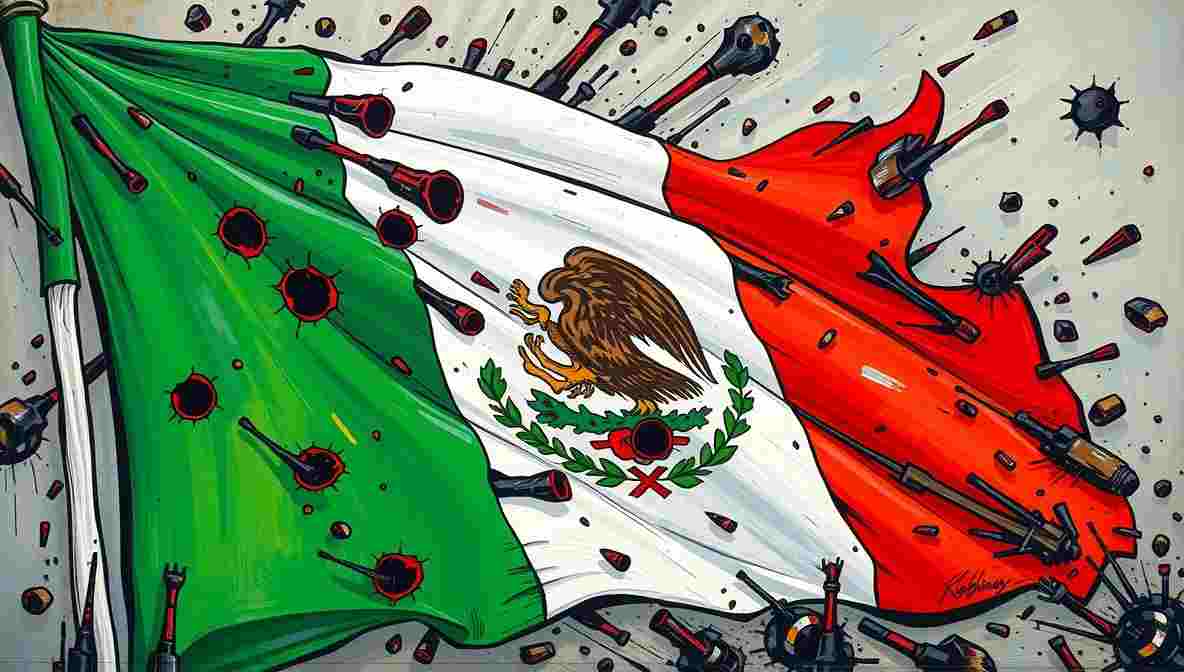
Mexico’s Beaches Are Still Beautiful. Leaving Mexico Is the Problem.
Mexico: Open for Business, Closed for Safety
Five Observations Before We Begin
- The British invented the package holiday specifically so someone else would deal with the paperwork when things go wrong.
- No nation on earth has more experience standing in a queue during a crisis. The British Tourist remains calm. Occasionally tutting.
- The Foreign Office travel warning is the only government document the British public reads from beginning to end.
- If a British tourist shelters in place at an all-inclusive, is it really a crisis or just a Wednesday?
- The phrase “it’ll be fine” has launched more ill-advised holidays than Thomas Cook ever did.
Suncream, Sangria, and Somebody Else’s Shootout: Britain’s Mexico Problem

CANCÚN / LONDON — On Sunday the 22nd of February, 2026, a Mexican police operation in Jalisco resulted in the death of cartel leader “El Mencho,” triggering immediate roadblocks, arson attacks, and widespread violence across the region. Flights to Puerto Vallarta were cancelled. Tourists were told to stay indoors.
Somewhere in a hotel room in Guadalajara, a man from Swindon in a Brentford away shirt stared at the BBC News alert on his phone and said, very quietly, “Bloody hell.”
His wife put down her gin and tonic. “I told you Tenerife was perfectly lovely,” she said.
He had no answer for this. He never does.
The Foreign Office Warning: Britain’s Most Ignored Document, Now Suddenly Required Reading
The Foreign, Commonwealth and Development Office (FCDO) has updated its Mexico travel advice to warn British nationals to avoid unnecessary travel in Jalisco, exercise extreme caution in Cancún and Tulum after dark, and be aware that rival criminal gangs have clashed in popular tourist destinations.
The FCDO also notes, with magnificent understatement, that “violent incidents could affect anyone nearby.”
This is the FCDO’s way of saying what the rest of us would say more directly. But the FCDO does not do direct. The FCDO does careful, measured, diplomatic language that somehow makes a shootout sound like a scheduling inconvenience.
Every year, millions of British travellers consult this document for approximately four seconds before booking anyway. This year, they are consulting it for nearly eleven seconds. Progress.
Puerto Vallarta: The British Package Holiday Meets the Power Vacuum
Puerto Vallarta has long been beloved by British tourists seeking sun, tequila, and the particular joy of eating at a restaurant where the menu is inexplicably also in German. It is a place where one can pretend, for two glorious weeks, that the world is made of guacamole and poolside cocktails.
Then El Mencho was killed. British Airways joined United Airlines and Air Canada in adjusting services to Puerto Vallarta. The pool remained open. The margaritas were still being poured. But the highway was not.
This is the peculiar reality of Mexico’s tourism crisis: inside the resort, everything is fine. Outside the resort, everything is not. The wall between these two realities is approximately as thick as a swim-up bar.
Cartel Violence and the All-Inclusive: A Study in Cognitive Dissonance
There is something uniquely British about being caught in a cartel crisis whilst still expecting the buffet to open at seven. We are, as a nation, deeply committed to maintaining routine in the face of adversity. It is how we survived the Blitz. It is how we queue at the post office. It is how we will behave when notified that there are roadblocks on the highway.
“Right,” the British Tourist says, “I suppose we’ll have to make do with the beach today.”
The FCDO advises being “very cautious after dark in downtown areas of Cancún, Tulum and Playa del Carmen.” The British Tourist nods, finishes their Modelo, and goes to bed at half past nine. Crisis managed.
The FCDO Advisory Nobody Reads Until It’s Too Late

The FCDO currently advises against all but essential travel to Jalisco, Chihuahua, Chiapas, Tamaulipas, and a considerable list of other Mexican states. Quintana Roo — home to Cancún, Tulum, and Playa del Carmen — is not on the do-not-travel list, but the FCDO notes that “security incidents have also been reported in tourist areas” there as well.
This is what policy writers call a “nuanced situation.” What it means in practice is: your resort is probably fine, the road to the Mayan ruins might not be, and your travel insurance will hinge entirely on which paragraph of the advisory applied to the postcode where you were standing when the thing happened.
British tourists book anyway. This is not recklessness. This is optimism. It is a national characteristic. It is also, frankly, why we ended up with an empire — someone had to be confident enough to board a boat into the unknown.
Mexico Tourism by the Numbers: The Industry Carries On, Nervously
Despite everything, Mexico recorded 47.79 million international tourist arrivals in 2025, up more than six percent year-on-year, with tourism revenue surpassing $31 billion. The United Kingdom, alongside Argentina and Colombia, rounds out the key long-haul markets. British tourists tend to favour Cancún and the Riviera Maya, which, for now, remain open for business.
Hotel occupancy across resort destinations averaged around 60 percent. The margaritas continue to be poured. The iguanas continue to sit on things. Mexico is not collapsing. It is, however, having a difficult fortnight.
The Tainted Tequila Problem and Other FCDO Gems
Buried in the FCDO safety advice, between warnings about crocodiles in Cancún lagoons and sharks off the Pacific coast, is this earnest sentence: “Do not leave food and drinks unattended in bars and restaurants. Criminals have robbed or assaulted travellers after drugging them.”
This is the sort of advice that is simultaneously obvious and necessary. It is the travel equivalent of “do not pet the jaguar.” Of course you should not leave your drink unattended. Of course the crocodile is not your friend. And yet, every year, a British tourist in flip-flops looks at a crocodile and thinks: surely not.
The FCDO has been writing these warnings since approximately the dawn of the internet. The British Tourist has been ignoring them for just as long. It is one of the great enduring relationships of the modern age.
What Happens When the Kingpin Falls and the Brochure Says Nothing
The death of El Mencho is, by any measure, a significant development. The CJNG cartel, which he led, has been linked to 81 percent of all homicides resulting from cartel clashes in Mexico since 2013. His removal from the board does not end the game. It reshuffles it. Violently. And immediately.
The brochure, naturally, mentions none of this. The brochure has a photograph of a cenote. It mentions the cenote four times. It does not mention the CJNG once.
This is not the brochure’s fault. The brochure’s job is to sell holidays. It is doing its job. The FCDO’s job is to warn you what the brochure left out. The British Tourist’s job, apparently, is to consult both documents, weigh them carefully, and book anyway because it was a really good deal on British Airways.
A Note on British Stoicism, Roadblocks, and Sheltering in Place
When the violence erupted in Jalisco and tourists were advised to shelter in place, the response of the average British visitor was, by all accounts, remarkably composed. Tea was made where tea could be made. Queues formed where queues were appropriate. Someone, almost certainly, complained about the Wi-Fi.
This is not a criticism. This is admiration. The British Tourist is, in moments of genuine crisis, an unexpectedly admirable creature. Stoic. Resourceful. Capable of remarkable patience when the alternative is panic and the minibar is still stocked.
The cartels did not account for this. They account for a great many things — logistics, supply chains, corrupt alliances, succession planning at speed. They did not account for a retired couple from Wolverhampton quietly finishing their crossword in a hotel lobby while the highway outside burned.
So Should You Go to Mexico? The Only Honest Answer
Millions of people visit Mexico every year without incident. The beaches are real. The food is extraordinary. The ruins are genuinely breathtaking and have been standing considerably longer than the Foreign Office.
The FCDO advice is real too. Read it. Actually read it. Know which states are on the do-not-travel list. Know that Cancún and Jalisco are not the same place, geographically or in terms of current risk. Buy proper travel insurance — the kind that covers the itinerary you are actually planning, not the optimistic version you described to the comparison website.
And perhaps, this particular week, give Puerto Vallarta a miss.
Tenerife, as it happens, is perfectly lovely.
Disclaimer: This satirical piece is aimed at British travel culture and Foreign Office bureaucratic language, not at the very real suffering of communities affected by cartel violence in Mexico. Our sympathies are entirely with the people of Jalisco and everywhere else caught between press conferences and power vacuums.
Auf Wiedersehen, amigo!
On 22 February 2026, Mexican security forces killed Nemesio Oseguera Cervantes — known as “El Mencho” — the leader of the Cartel Jalisco Nueva Generación (CJNG), one of Mexico’s most violent criminal organisations. His death triggered immediate retaliatory violence across Jalisco state, including roadblocks and arson attacks near Puerto Vallarta and Guadalajara. The UK’s FCDO updated its Mexico travel advice, flights were disrupted, and British tourists in the region were advised to shelter in place. The incident came months after the Trump administration had designated six Mexican cartels, including CJNG, as Foreign Terrorist Organisations — a move that changed the legal landscape but, as events demonstrated, did not immediately change conditions on the ground.

Alan Nafzger was born in Lubbock, Texas, the son Swiss immigrants. He grew up on a dairy in Windthorst, north central Texas. He earned degrees from Midwestern State University (B.A. 1985) and Texas State University (M.A. 1987). University College Dublin (Ph.D. 1991). Dr. Nafzger has entertained and educated young people in Texas colleges for 37 years. Nafzger is best known for his dark novels and experimental screenwriting. His best know scripts to date are Lenin’s Body, produced in Russia by A-Media and Sea and Sky produced in The Philippines in the Tagalog language. In 1986, Nafzger wrote the iconic feminist western novel, Gina of Quitaque. He currently lives in Holloway, North London. Contact: editor@prat.uk