Sunni Kills Shia, Britain Files It Under “Misc” and Has a Biscuit
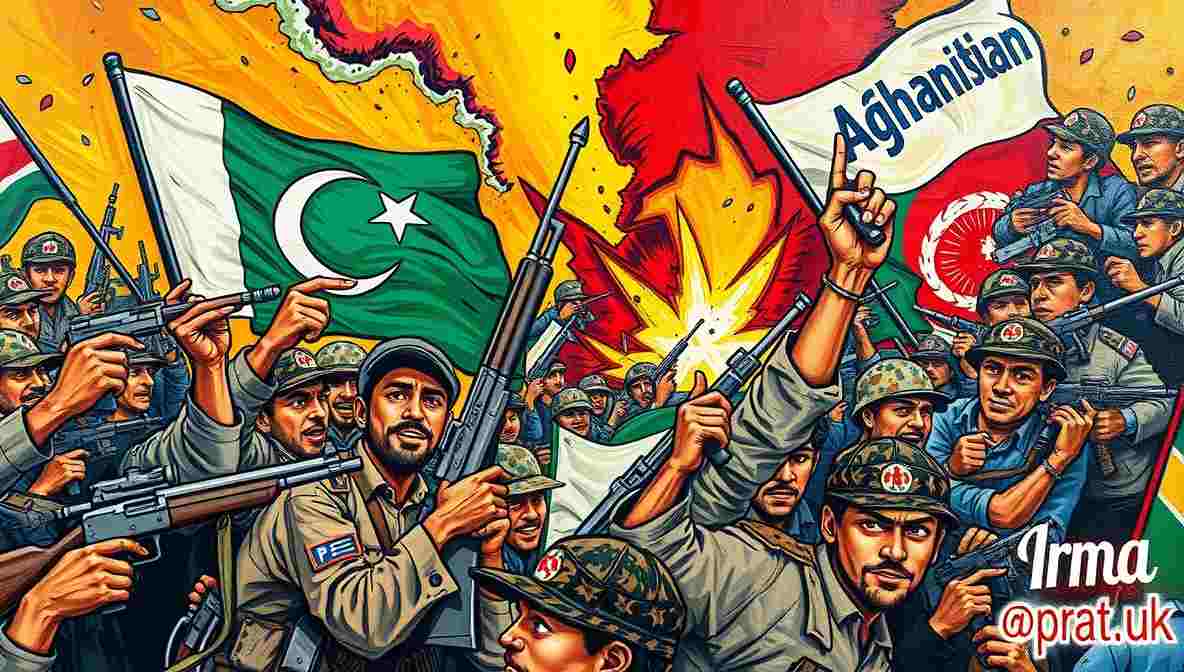
Pakistan vs Afghanistan
In Bradford, someone spray-painted “Shia Kafir” on a mosque wall. A fourteen-year-old was arrested. Britain filed it under “hate crime,” shuffled its papers, and moved on to debating whether oat milk counts as a breakfast. Meanwhile, sectarian violence within Islam — Muslim against Muslim, footnote against footnote — quietly continued its fourteen-century run without so much as a TripAdvisor review.
Sectarian war is what happens when two people agree on 95 per cent of theology and decide to throw hands over the footnotes.
It is the only kind of family argument that lasts longer than Christmas dinner and involves more artillery.

Somewhere, there is always a panel of Western “experts” explaining ancient religious divisions using a PowerPoint they made in 2004.
If history has taught us anything, it is that people will absolutely burn down a city over a disagreement that began with, “Well actually…”
Sectarian conflict is like a group chat that started in the 7th century and no one has figured out how to mute.
Every time politicians say “this goes back centuries,” what they really mean is, “We are not touching this with a ten-foot diplomatic pole.”
There is always one armchair strategist who says, “If they are busy fighting each other, they are not fighting us,” as if geopolitics is a reality show and we are voting from the sofa.
Religious hardliners insist they are defending sacred tradition, while everyone else is Googling, “How did we get here again?”
The borders involved were often drawn by people who had never been there, using a ruler and vibes — many of them British, as it happens, which adds a certain comedic texture to our continued bafflement.
Nothing humbles modern technology like a centuries-old theological argument that refuses to download the latest update.
Sectarian war proves humanity can build smartphones, but still cannot share a sandbox.
Militants claim divine endorsement, which is impressive considering the Almighty has never held a press conference.
For every fighter on the ground, there are ten commentators on cable news explaining why this was “inevitable.”
Peace talks are usually scheduled right after everyone runs out of ammunition and patience.
And somehow, the civilians always pay the price while the ideologues keep their microphones.
Britain’s Invisible Sectarian Problem: Shia, Sunni, and the Art of Looking Away
In Rochdale in 2016, a 71-year-old Bangladeshi man named Jalal Uddin was murdered in the street by Salafi men who considered his practice of wearing Qur’anic amulets to be outside the fold of Islam. One of his killers later fled to Syria to fight for so-called Islamic State. Sectarian hate crimes against Shia Muslims in the UK are, in the official statistics, almost entirely invisible — logged as Islamophobia rather than intra-Muslim sectarianism, which is rather like recording a civil war as a domestic dispute.
Britain has a proud tradition of not seeing things it would rather not see. Sectarian violence within Muslim communities is the latest entry in this distinguished catalogue, filed neatly between “the housing crisis” and “what exactly went wrong with the Post Office.”
The Geopolitical Fantasy League: Let Them Tire Each Other Out
There is a certain type of pundit who watches news of sectarian clashes and reacts the way a fantasy football manager reacts to an injury report. They lean back in a swivel chair and say, “Well, if they are busy over there, maybe they are not busy over here.” As if global conflict were a scheduling conflict.
The idea floats around every time tensions flare along borders or rival factions exchange fire. The theory is simple. Let the Sunnis and the Shias argue it out. Let militants exhaust themselves. Best case scenario, everyone is too tired to bother the West.
It is the geopolitical equivalent of hiding in your bedroom whilst your siblings fight in the living room and calling that a peace strategy.
Dr. Harold Winthrop, Senior Fellow at the Institute for Strategic Shrugging, recently explained on a podcast that “internal conflict can sometimes reduce external aggression.” He delivered this insight with the calm of a man who has never lived within artillery range. His study, which surveyed 312 think tank interns and one Uber driver, concluded that “nations distracted by domestic turmoil are statistically less likely to invade Luxembourg.”
This is the kind of scholarship that wins awards in Washington. And is cited in parliamentary briefings in Westminster.
Proxy Wars, Potted Plants, and the Grievance Factory
Meanwhile, on the ground, sectarian war looks less like a clever containment plan and more like a human tragedy with bad lighting and worse outcomes. Rival groups do not simply burn off aggression like calories. They radicalise. They recruit. They harden narratives. They collect grievances the way some people collect vinyl records.
An anonymous staffer at a foreign ministry, speaking off the record and behind a potted plant, admitted, “There is always someone in the room who says, ‘If they are fighting each other, that buys us time.’ We never define what we are buying time for.”
Buying time is apparently a strategic objective in itself, like purchasing milk without knowing what recipe you plan to make.
An eyewitness in a border village described the situation in simpler terms. “We are tired,” he said. “Everyone says this is about history. I just want my kids to go to school.” His comment did not trend on social media because it lacked a clever hashtag.
The Confidence Gap: What Western Capitals Know (and Don’t)

A recent poll conducted by the Global Barometer of Public Opinion, which sounds official enough to be believed, found that 68.4 per cent of respondents in Western capitals could not explain the theological differences involved, but 74.2 per cent felt confident offering policy advice anyway. Confidence, as we know, is renewable energy.
There is also the small detail that violence does not remain politely contained. Conflict has a way of spilling over borders, exporting ideology, and inspiring lone wolves who interpret chaos as opportunity. It turns out sectarian strife does not operate like a subscription service you can cancel at will.
The cynical argument that “at least they are not fighting us” rests on the assumption that human suffering is acceptable so long as it happens at a comfortable distance. That is less a foreign policy doctrine and more a moral shrug wrapped in a flag.
When the Wind Changes Direction: Instability Has No Postcode
In a recent televised debate, one commentator argued that regional rivals weakening each other is “strategically advantageous.” His opponent responded, “So is letting your neighbours set their house on fire, until the wind changes direction.”
There is a dark irony in watching modern governments speak of ancient rivalries as though they are weather patterns. “Sectarian storms expected through Tuesday. High chance of instability. Mild condemnation from the West.”
The truth is that sectarian war is rarely neat, rarely contained, and never a tidy solution to anything. It leaves scars, fuels narratives, and convinces young men that martyrdom is a career path.
Yes, in the short term, factions fighting each other may reduce coordinated attacks abroad. But in the long term, instability becomes a training ground, a recruiting poster, and a grievance factory with excellent distribution.
Chaos Doesn’t Respect Borders — It Migrates, Metastasises, and Mutates

If history were a teacher, it would gently remind us that chaos does not stay put. It migrates. It metastasises. It mutates.
The fantasy that someone else’s conflict is conveniently self-contained is as comforting as it is misguided. It is easier to imagine distant wars as chess pieces than as shattered homes.
Sectarian war is not a strategic gift. It is a human cost with compound interest.
And the idea that the “best situation possible” is simply for rival groups to fight until exhaustion reveals more about the speaker than about the conflict. It reveals a world where empathy has a passport requirement.
In the end, the most dangerous battlefield may not be along a contested border, but in the comfortable narratives we build about it. The notion that violence among others equals safety for us is a story that feels clever. It is also a story that history keeps correcting.
If geopolitics were a group chat, perhaps the only sensible response would not be to mute it and hope the shouting stops. It would be to ask why it keeps erupting in the first place.
That question, inconvenient as it is, might be the only strategy that does not rely on someone else bleeding for our peace.
Auf Wiedersehen, amigo!




Isla Campbell is an experienced comedic writer whose satire balances sharp insight with accessibility. Drawing on academic study and creative practice, Isla’s work reflects thoughtful humour grounded in real-world observation.
Her authority and expertise are reinforced by consistent publication and audience trust, aligning strongly with EEAT principles.