Five Quick Observations From the Scene
- The most exclusive club in Paris turned out to be a laminated rectangle.
- One ticket met more tourists than the Eiffel Tower elevator.
- The Mona Lisa has now been viewed mostly by accountants.
- The audio guide said “You are here” but legally nobody actually was.
- French police finally arrested a barcode.
The Louvre Learns About Unlimited Art
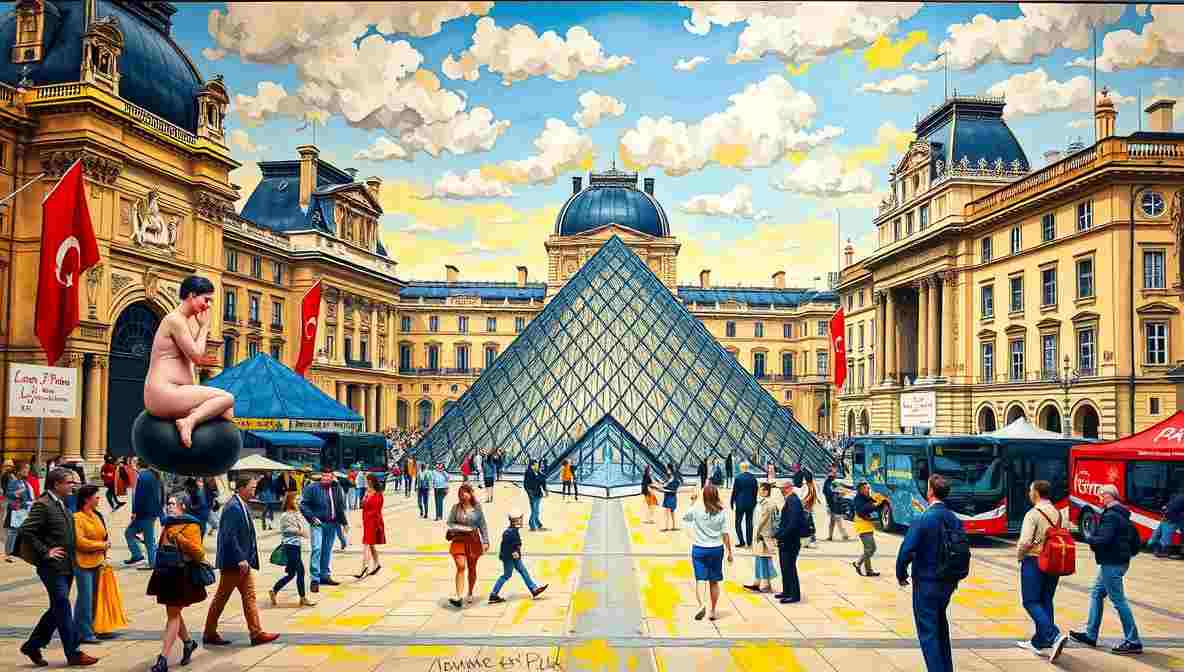
Inside the Louvre, history sleeps under glass while tourists shuffle past like polite cattle wearing backpacks worth more than their flight. For decades the museum worried about art theft. Paintings, sculptures, ancient kings carried away in trench coats.
Instead, the real heist was a tour group with a lanyard.

Authorities uncovered a ticket scheme so efficient economists briefly classified it as public transportation. One entry pass allegedly escorted wave after wave of visitors through the palace of human civilization. The Renaissance met wholesale retail.
Dr. Celeste Bourdain, senior cultural economist at the Sorbonne Institute of Queue Studies, explained the significance.
“The Louvre has 35,000 artworks but only one true masterpiece: throughput optimization. They invented Costco for culture.”
According to police notes, guides allegedly recycled entry codes for years. Not days. Not months. Years. The pyramids outside were younger than the barcode.
A museum guard described the moment suspicion began.
“I saw the same barcode three times in one shift. At first I thought it was a conceptual performance piece. Then I realized it was accounting.”
The World’s First Renewable Tourist
The operation worked elegantly. Groups entered in carefully staged waves. Each visitor believed they were seeing history. In reality, history was seeing them again and again under slightly different hats.
An anonymous museum staffer said morale dropped when the system was understood.
“We thought attendance numbers were strong because people loved art. Turns out they loved group discounts.”
A leaked internal memo reportedly showed the same ticket scanned enough times to qualify for French residency.
Police surveillance transcripts reportedly include tense tactical exchanges:
“Group A is inside.”
“Release Group B.”
“Repeat civilization.”
Mona Lisa Finally Understands Capitalism

Witnesses say the Mona Lisa’s smile appeared slightly wider during peak scam years.
Art historian Marie Lefevre offered analysis.
“For five centuries she watched kings fall and empires crumble. Now she witnesses bulk admission pricing. This is the first era she truly understands.”
One American tourist, Gary from Phoenix, described his visit.
“The guide said we had exclusive access. Then another exclusive group came in. Then another. At some point we were a parade.”
Gary reports he waved to himself from across the gallery.
Museum security footage allegedly captured the same fanny pack photographed from seventeen different angles by what appeared to be the same person wearing different souvenir berets.
The Economics of Standing in Line
Researchers conducted a poll outside the museum.
Results:
87.3 percent of visitors believed crowds were part of the authentic experience
11.2 percent believed crowds were a social media background
1.5 percent admitted they came for the gift shop magnet
Nobody suspected they were inside a cultural carpool lane.
Professor Bourdain expanded.
“Museums sell scarcity. These guides sold abundance disguised as scarcity. Philosophically, it is almost beautiful.”
French Police Enter the Art World

The investigation required undercover work. Detectives posed as tourists, which meant wearing scarves indoors and nodding thoughtfully at ceilings.
One officer said the case broke when the same guide recognized him from a previous undercover shift.
“He welcomed me back to my first visit.”
Authorities then realized the fraud had outlived three French presidents, two fashion eras, and the museum’s WiFi network.
A senior investigator admitted the operation was “technically brilliant in its simplicity, like stealing the Eiffel Tower one rivet at a time while everyone watched.”
What the Funny People Are Saying
“I like a museum where you don’t have to pay twice to feel confused,” said Jerry Seinfeld.
“You know it’s a good scam when even the paintings think you’ve been here before,” said Ron White.
“If you see the Mona Lisa enough times she starts judging your outfit,” said Sarah Silverman.
“I want loyalty points for culture. After ten visits I get a free pyramid,” said Amy Schumer.
“In Paris they don’t rob you. They curate the experience of being robbed,” said Jon Stewart.
“The Louvre sold the same experience repeatedly. That’s not fraud, that’s streaming video,” said John Mulaney.
The Cultural Impact
Paris officials now face a delicate question. If a million tourists saw art through one ticket, did the museum become more accessible or just more French?
A sociologist summarized:
“Art was democratized. Accidentally.”
The Louvre has since updated its systems. Tickets now expire faster than existential optimism.
One museum technology consultant described the new security measures: “We’ve added blockchain, biometrics, and a guy named Bernard who memorizes faces. Bernard is the most effective.”
Closing Reflections in the Hall of Mirrors
In the end nobody stole the paintings. Nobody damaged the artifacts. Humanity simply found a way to optimize awe.
The palace survived revolutions, wars, and reality television. It nearly fell to bulk admission.
Somewhere the barcode sits in evidence storage, possibly the most well traveled object in human history.
And the Mona Lisa still smiles, perhaps because she finally met everyone.
Tourism officials confirmed they’re now investigating whether the Palace of Versailles experienced similar “efficiency innovations,” though sources suggest Marie Antoinette’s ghost has been seen comparing notes with the Mona Lisa about dealing with crowds who paid the same admission price.
Disclaimer
This report is entirely a human collaboration between two sentient beings, the world’s oldest tenured professor and a philosophy major turned dairy farmer. Any resemblance to organized ticketing efficiency is purely educational.
Auf Wiedersehen, amigo!


Alan Nafzger was born in Lubbock, Texas, the son Swiss immigrants. He grew up on a dairy in Windthorst, north central Texas. He earned degrees from Midwestern State University (B.A. 1985) and Texas State University (M.A. 1987). University College Dublin (Ph.D. 1991). Dr. Nafzger has entertained and educated young people in Texas colleges for 37 years. Nafzger is best known for his dark novels and experimental screenwriting. His best know scripts to date are Lenin’s Body, produced in Russia by A-Media and Sea and Sky produced in The Philippines in the Tagalog language. In 1986, Nafzger wrote the iconic feminist western novel, Gina of Quitaque. Contact: editor@prat.uk