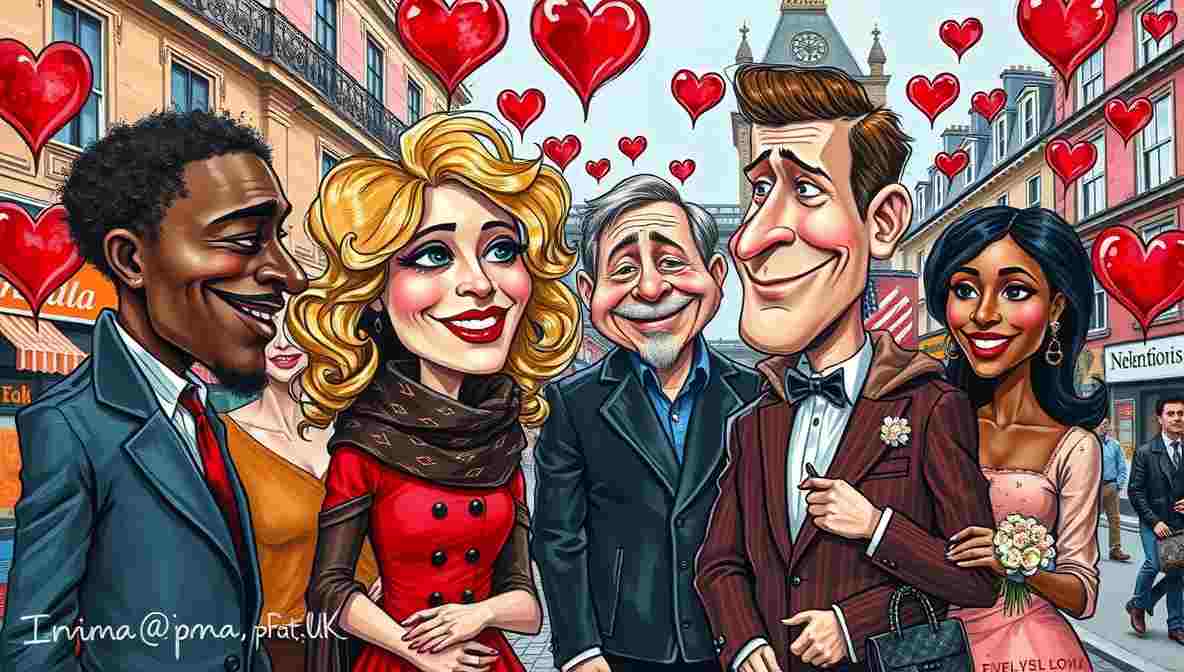
Valentine’s Day Not a Big Deal in Britain Because Emotional Availability Would Require Planning
Nation That Queues for Sport Refuses to Queue for Roses
Valentine’s Day arrives in Britain every February 14th like a distant relative nobody invited but everyone tolerates because refusing would involve a conversation about feelings. Across the United Kingdom, millions of adults will acknowledge the occasion by doing almost nothing, which in Britain counts as a declaration of deep and enduring passion.
While Americans spend billions on jewellery, helicopters, and elaborate proposals involving dolphins, the British approach to Valentine’s Day consists largely of a card purchased from a petrol station and a mumbled sentence that might contain the word love but could also be a request to pass the remote.
Why the British Find Valentine’s Day Emotionally Suspicious
Historians at the British Library have traced the nation’s reluctance to celebrate romantic holidays back to approximately 1066, when William the Conqueror arrived and everyone decided that showing feelings in public was best left to the French. Since then, the British have perfected the art of communicating affection through silence, tea preparation, and occasionally saying “not bad” when someone looks attractive.
Dr. Margaret Henslow, a cultural anthropologist at the University of Cambridge, explains the phenomenon with academic precision. The British do not reject love. They reject the American packaging. Asking a British person to hold a boom box outside a window is like asking them to eat soup with their hands. They understand the concept. They simply find the method distressing.
Survey data from the Office for National Statistics reveals that 61 percent of British adults describe Valentine’s Day as “a bit much.” A further 23 percent described it as “unnecessary fuss.” The remaining 16 percent were too embarrassed to finish the survey because the word romance appeared on page two.
British Valentine’s Day Traditions That Baffle the Rest of the World

The British Valentine’s Day experience differs from the American version in almost every measurable way. Where Americans book rooftop restaurants six weeks in advance, the average British couple will agree to go somewhere nice and then end up at Nando’s because the good place was full and nobody wants to make a scene. The chicken is reliable. The atmosphere is not romantic. This is considered acceptable.
Flowers are purchased but with restraint. A British man buying roses on Valentine’s Day will hold them at his side like a weapon he is slightly ashamed of. Eye contact with other men carrying flowers is avoided as though they are all members of a secret society that meets once a year to feel briefly vulnerable in a Tesco car park.
Gift giving follows a predictable pattern. Chocolates from Marks and Spencer are considered an expression of serious commitment. A card with actual handwritten words inside is the British equivalent of a marriage proposal. Anything involving a public display of affection, such as a singing telegram or a flash mob, would result in the recipient moving to Scotland and changing their name.
How British Weather Destroys Romance Before It Starts
Climate plays a role that cannot be overstated. February in Britain is a month characterised by horizontal rain, existential greyness, and a wind chill that makes standing outside a restaurant feel like a punishment rather than a date. The Met Office confirms that February is statistically one of the coldest and wettest months, which explains why the most romantic thing a British person can do on Valentine’s Day is suggest staying in.
Staying in, of course, is the unofficial national Valentine’s tradition. A takeaway curry, a blanket, and something on BBC iPlayer constitutes a perfect evening for millions of couples who have silently agreed that going outside in February is an act of hostility towards oneself.
What British Comedians Are Saying About Valentine’s Day
“Valentine’s Day in Britain is just a normal Tuesday where you feel slightly guilty about not doing something you were never going to do anyway,” said Peter Kay.

“My wife asked me what I was getting her for Valentine’s Day. I said increased emotional availability. She asked if I had kept the receipt,” said Lee Mack.
“The most romantic thing a British man has ever said to me is your parking is quite good. And I treasured it,” said Sarah Millican.
“Valentine’s Day is the one day of the year when British men are forced to pretend they have heard of feelings. Most of them are not convincing,” said Jimmy Carr.
“In America they do proposals on Valentine’s Day in stadiums. In Britain we propose during an advert break and hope nobody heard,” said Jack Whitehall.
“I bought my husband a Valentine’s card and he looked at me like I had reported him to the authorities,” said Miranda Hart.
“British romance is saying do you want the last biscuit and actually meaning it. That is our love language. Chocolate digestives are our roses,” said Michael McIntyre.
“Valentine’s Day is just capitalism wearing a nice shirt. In Britain we see through the shirt. We just cannot be bothered to complain about it,” said Frankie Boyle.
“The British idea of a grand romantic gesture is letting someone else choose what to watch on telly. That is vulnerability,” said Jo Brand.
“Americans celebrate Valentine’s Day like it is an Olympic event. We celebrate it like it is a minor dental appointment. Necessary. Uncomfortable. Over by half six,” said Ricky Gervais.
“My boyfriend got me a card that just said cheers. I wept. Not from sadness. From recognition,” said Katherine Ryan.
“I do not understand Valentine’s dinner reservations. You are paying double for the same pasta but now there is a candle on it. The candle is doing a lot of heavy lifting,” said Russell Howard.
The Economics of British Valentine’s Day Indifference
Financial data suggests the British spend considerably less per person on Valentine’s Day than their American counterparts. Research from Statista indicates that British Valentine’s spending averages around thirty pounds per person, compared to American averages that regularly exceed one hundred and fifty dollars. Economists attribute this not to poverty but to a national consensus that spending more than the price of a decent pub lunch on feelings would be irresponsible.
The British high street reflects this restraint. While American malls transform into pink cathedrals of commerce, British shops add a small display near the till featuring cards that say things like “to my other half” and chocolates shaped like hearts but priced like apologies. The effort is present. The enthusiasm is carefully rationed.
Why British Couples Prefer Staying In on Valentine’s Day
Relationship therapist Dr. Colin Finch believes the British approach may actually be healthier. Countries that commercialise romance create performance anxiety around love. The British model of quiet coexistence, shared tea, and the occasional compliment delivered with a straight face may produce more durable partnerships. He pauses. Or it may produce people who cannot identify their own emotions. The research is ongoing.
What remains clear is that Britain will continue to observe Valentine’s Day in its own fashion. Cards will be bought. Some will be signed. Restaurants will be visited, though mostly because someone’s mum suggested it. And across the nation, millions of couples will express their devotion in the most British way possible. By sitting next to each other in comfortable silence and agreeing that the heating is on too high.
Valentine’s Day originated as a Christian feast day honouring Saint Valentine before evolving into a global celebration of romantic love. In the United States, the holiday generates over twenty-five billion dollars in annual spending according to the National Retail Federation. In Britain, the occasion is observed with considerably less commercial fervour, though the Greeting Card Association reports it remains the second largest card-sending occasion after Christmas. Cultural commentators note that British reserve around public displays of affection has deep historical roots, with emotional restraint long considered a social virtue rather than a limitation.
This article is a work of satire and reflects a collaborative effort between the world’s oldest tenured professor and a philosophy major turned dairy farmer who once gave his wife a lambing torch for Valentine’s Day and still considers it romantic. No British emotions were harmed in the making of this piece because none were detected.
Auf Wiedersehen, amigo!

Alan Nafzger was born in Lubbock, Texas, the son Swiss immigrants. He grew up on a dairy in Windthorst, north central Texas. He earned degrees from Midwestern State University (B.A. 1985) and Texas State University (M.A. 1987). University College Dublin (Ph.D. 1991). Dr. Nafzger has entertained and educated young people in Texas colleges for 37 years. Nafzger is best known for his dark novels and experimental screenwriting. His best know scripts to date are Lenin’s Body, produced in Russia by A-Media and Sea and Sky produced in The Philippines in the Tagalog language. In 1986, Nafzger wrote the iconic feminist western novel, Gina of Quitaque. Contact: editor@prat.uk