London Fashion Week: Where Strutting Meets Swigging
London Fashion Week (LFW) — that biannual blend of haute couture, influencer ID badges, and the existential dread of someone realizing they paid £350 for socks — is upon the capital once more. Traditionally a showcase for the Big 4 of global fashion alongside New York, Milan, and Paris, LFW’s official mission is to celebrate British creativity and give buyers and press a sneak peak at what to tell everyone to pretend they get next season.
But if you listen closely between the tisk-tisk of critics whispering “intriguing silhouette” and “iconic palette,” you’ll hear something else: the clink of martini glasses and the roar of cab drivers outside Soho rooftops. Because London Fashion Week, for many, is less about fabric innovation and more about which speakeasy has the best Negroni — and a minimalist menu that costs more than a Bolt ticket to Heathrow. (The menu literally has three items on it, and one is “seasonal vegetables” which turns out to be a single roasted carrot for £18.)
The Catwalk-to-Cocktail Reality
The original idea — designers unveil collections on a glorified runway, everyone squints, nods, and emails their editor about how subdued looks are “in” — has, in practice, mutated into a sophisticated social sport. Post-show, the fashion set decamps to London’s “hottest nightcap playgrounds” where confetti cocktails and neon lighting become the runway of choice.
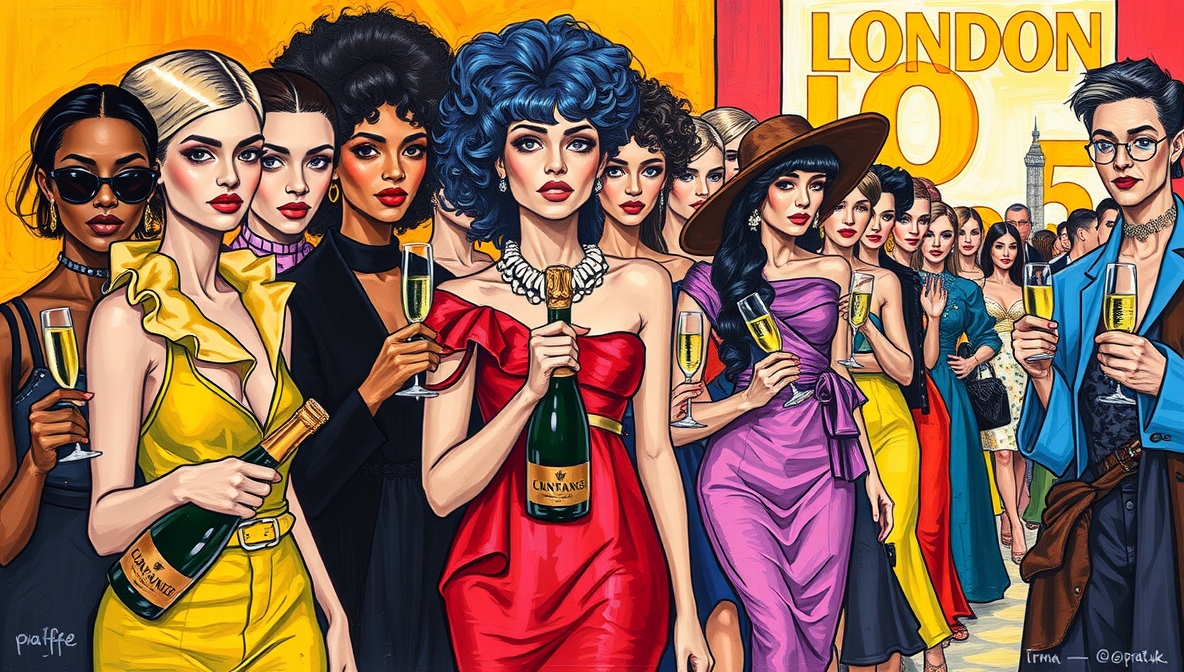
Champagne is the official LFW drink — preferably served with irony and a side of Instagram content. Stylish bars all over Mayfair and Soho believe that if they can convince a model to take a selfie by a floral wall, their Pimm’s concoction is suddenly an “iconic trend.” And of course, there will always be that one influencer doing a boomerang beside a bartender just because Minimalist Golden Ratio Garnishes are THE look of the season. (Bonus points if the garnish costs more than the actual drink.)
Stage 1: The Runway — Where Fashion Gets Photographed 8,000 Times
Here’s how fashion week typically goes: models in outfits that look like someone asked a creative director to “make something that feels like post-modern existential crisis but cosy” silently parade past buyers while photographers snap their 8,000th photo of what is technically a pleated coat. Somewhere behind the scenes, producers are reminding everyone there’s a livestream that people will watch at 2 a.m. in Japan.
Meanwhile, street style photographers — the paparazzi of outerwear — snap pics of attendees wearing outfits so abstract that the only thing people can agree on is shape. It is equal parts confusion and awe. Then the critics write about how the ambiguity redefines seasonal dressing even though three months later everyone’s still wearing hoodies and trainers. (The hoodies, however, will be described as “elevated basics with architectural intention.”)
Stage 2: The Aftershow — Where the Real Fashion Happens
Soon as the last model shuffles offstage, it’s cocktail o’clock. Bars with names like The Velvet Clover or The Barcode Lounge roll out the red carpets, or at least very narrow ones suitable for stilettos. Behind every velvet rope is a branded drink that costs roughly what a month’s rent is in Peckham — but it sparkles under the LED lights.
One bartender told me, on condition of anonymity — understandably, because fashion people get very sensitive about vibes — that during LFW “the drinks are more intense than the outfits.” He’s not wrong. A Deconstructed Espresso Martini might come out presented on a tiny slate, but by 11:30 p.m. you’re glad you ordered the double. (The single would have evaporated before you could even get a photo for your Stories.)
Expert Opinion: The Industry Perspective
Fashion week experts — which are people who get invited to talk about trends — remind us that these events are crucial for the industry. They connect designers with buyers, celebrate innovation, and generate global buzz. But let’s be honest: the only buzz some attendees are hunting is literal via that 8-ingredient cocktail with edible glitter that keeps glitter in your teeth for days. (Some call it “commitment to the aesthetic.”)
Public Opinion: What the People Really Think
In a completely official and not at all fabricated Twitter poll of “People Who Wear Sunglasses Inside Bars During Fashion Week”:
- 72% said they came for the clothes, stayed for the drinks
- 18% said they just like the free Wi-Fi
- 10% said they didn’t know there were actual shows because they were too busy queueing outside bar pop-ups
(The remaining 0% were too busy adjusting their sunglasses to participate in the poll.)
Cause and Effect of Champagne Culture
Here’s the irony: the more exclusive the show, the bigger the afterparty scene. The catwalks have become a loss leader — a way to reel you in with artistic intent and then upsell you on a lofty signature cocktail served in a glass that makes a better TikTok than most outfits on the runway.
This duality has created what one London cab driver described — while waiting outside a Soho bar for ten minutes — as “a fashion cult that forgot it was meant to be about clothes and now judges everyone on how small their martini glass is.” Depending on the route you take home, you might get three variations of this sentiment from ridehail drivers; it’s the city’s unofficial LFW commentary circuit. (Black cab drivers: the true fashion critics of London.)
A Toast to It All
So here it is: LFW remains a cornerstone of British fashion. It showcases creativity, industry muscle, and the staggering commitment of stylists who can wear unexpected footgear without limping. But behind the sheen of sequins and the minimalist capsule collections lies the truth… fashion week became the most glamorous excuse ever to rebrand club hopping as cultural participation.
In other words, London Fashion Week is exactly what London would invent: a mash-up of serious artistry and cheeky party culture that makes the rest of us wonder if owning an all-black outfit qualifies us as “in the scene.” (Spoiler: It doesn’t, but wearing it with confidence and pretending you know what “directional” means might get you past the door.)
Auf Wiedersehen, amigo!

Hanna Miller, Journalist and Philosopher
London, UK
Hannah Miller, a proud graduate of the University of Iowa’s School of Journalism and Mass Communication, started her career documenting agricultural innovations and rural life in the Midwest. Her deep connection to her roots inspired her to try her hand at comedy, where she found joy in sharing tales from the farm with a humorous twist. Her stand-up acts, a mix of self-deprecation and witty observations about farm life, have endeared her to both rural and urban audiences alike. She is a four-year resident to London and the UK.