BAFTAs 2026 Accidentally Invent New Genre: “Prestige Chaos”
Five Observations That Nobody Asked For But Everyone Needed
- The only thing louder than the slur was the sound of 1,200 publicists simultaneously Googling “How long is a live delay?” — followed immediately by “Is two hours actually long enough to make a cup of tea and catch a moral lapse?”
-
The BAFTAs celebrated editing excellence—then forgot to edit. That’s like the Queen forgetting to wave. Or Specsavers forgetting to see. The room froze with the British freeze that says, “If we don’t react, perhaps reality will apologise.” BBC producers claim they “didn’t hear it” because they were in a truck, which officially makes that truck the most selective hearing device in British history — narrowly beating the average British husband during a conversation about feelings.
- The BAFTAs, an event that celebrates editing excellence, forgot to edit. That’s like the Queen forgetting to wave. Or Specsavers forgetting to see.
- Every celebrity in the room suddenly developed a PhD in Neurology and Crisis Optics — a double qualification you can’t yet get at UCL, though give it a term.
- Somewhere in Soho, a pub debate started with “It’s complicated” and ended with “You’re a prat.” Much like every pub debate in recorded history.
The Night British Celebrities Tried to Escape Through a Side Door
London loves ceremony. It loves red carpets, polite applause, restrained scandal. It loves a good awkward moment so long as it can be resolved with a statement beginning, “We regret…”
The BAFTAs this year decided to test that formula.
During a live broadcast, an involuntary outburst from John Davidson, a Tourette’s campaigner seated in the audience, detonated in the middle of a presentation. The kind of moment that doesn’t politely ripple. It lands like a dropped champagne flute in a cathedral.
The room froze.
And not the glamorous freeze of an awards-show camera pan. The real freeze. The British freeze. The sort that says, “If we don’t react, perhaps reality will apologise.”
The BBC and the Mysterious Truck of Selective Hearing
The BBC later explained that producers working in a truck did not hear the slur during the tape delay.
A truck.
This is the same organisation that can detect a microphone picking up a cough in Aberdeen from a studio in Salford. This is also the organisation that broadcast the ceremony on a two-hour delay specifically to allow for editorial intervention. Two hours. That’s long enough to watch Paddington 2 and still have time for a biscuit.
But this? Missed it.
One anonymous staffer told us, “We were monitoring six feeds, three graphics panels, and a biscuit tin. It all happened very quickly.”
A biscuit tin.
According to a flash poll conducted by the Institute for National Embarrassment, 63.7 percent of Britons now believe the truck is either haunted or sponsored by Specsavers. The remaining 36.3 percent are still in the truck.
Awards Shows, Live Television, and the Illusion of Control
Awards ceremonies are theatre with better tailoring. Nothing spontaneous is allowed except crying.
But this moment refused choreography.
Tourette’s is neurological. Involuntary means involuntary. That’s the medical definition. But live television doesn’t process nuance. It processes sound waves. And the BBC’s sound waves apparently have a blind spot the size of a production truck.
So now you had three things colliding:
A neurological condition. A racially explosive word. And British broadcast delay.
It’s like mixing tea, petrol, and irony. Which, coincidentally, is also the recipe for most British political careers.
The Optics Olympics: Celebrity Crisis Management at Full Speed

The presenters handled it with visible composure. Professionalism under pressure is what actors train for. Michael B. Jordan and Delroy Lindo, both Black, continued with quiet, extraordinary dignity — a grace note that the Hollywood Reporter noted was widely praised.
But behind the scenes?
Publicists reportedly began whispering phrases like “context matters” and “sensitivity review” while calculating their clients’ brand trajectories using a formula involving empathy units and quarterly earnings.
Jamie Foxx, helpfully, posted on Instagram that the outburst was “unacceptable” and that Davidson “meant that shit” — a comment that demonstrated, at speed, that not everyone had Googled what Tourette’s syndrome actually is before having feelings about it.
A cultural analyst from Camden explained, “Modern fame is about surviving the clip. If it trends, it defines you.” And it trended. Within minutes, timelines were ablaze.
Some defended the neurological explanation. Others demanded accountability.
A third group just argued about whether BAFTA stands for British Academy of Film and Television Arts or British Association of Frequent Tension.
London Reacts Like London: Half-Informed Certainty Over Oat Milk
BAFTA: “Black Anglo Film and Television Arse”
By morning, Soho cafés were full of half-informed certainty.
By morning, politicians were aiming at BAFTA’s bumbling — e.g., “some MPsbegan speculating the B-A-F-T-A stood for something rather different by morning.”
“It’s about education,” said one barista stirring an oat flat white with philosophical aggression.
“No, it’s about editing,” countered a man who once did lighting for a fringe production of King Lear and now considers himself an expert on live production ethics — and, apparently, neurodevelopmental disorders.
Meanwhile, in Westminster, no one officially commented, which is the political equivalent of pulling the curtains closed and pretending the dinner party didn’t happen. This is also known as standard operating procedure.
The Irony Is Practically Framed and Ready for the Mantelpiece
BAFTA’s lawyers have now added the televised show to the list of things requiring a two-hour delay.
The BAFTAs celebrate cinematic precision. Editing. Narrative control. Timing. The very craft of knowing what to keep and what to cut.
And the defining moment of the night was the absence of editing.
If irony were eligible for nomination, it would have won Best Supporting Role, Best Original Screenplay, and the Special BAFTA for Outstanding Contribution to National Embarrassment.
What This Actually Reveals About Live Broadcasting and Modern Outrage
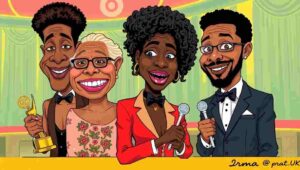
Live television is still human. It is messy. It is reactive. It depends on split-second judgment — or, apparently, on whether the person in the truck had their headphones on properly.
And in a culture that dissects moments frame by frame, any hesitation becomes a headline. The Washington Post noted the incident sparked immediate global debate about disability, race, and the responsibilities of broadcasters — three topics that British television has historically preferred to handle in a politely delayed manner.
A media psychologist based in Hackney explained, “Outrage spreads faster than clarification. The brain loves certainty more than complexity.” Complexity rarely goes viral. Certainty does. And a truck full of people who apparently heard nothing is, if nothing else, a very certain image.
The Real British Instinct: Move Forward, Pretend It Was Fine
What Britain does best is move forward while pretending it never panicked.
Statements are issued. Apologies are refined. Panels are convened. BBC iPlayer is quietly updated. The truck is probably undergoing spiritual counselling. John Davidson, for his part, responded with genuine anguish and decency — which the internet briefly acknowledged before returning to arguing about Jamie Foxx.
But beneath the satire and the spectacle is something very modern: We want live authenticity. We demand flawless control. We tolerate neither. That contradiction is the real headline.
A Modest Proposal for Future BAFTA Ceremonies
Perhaps next year the BAFTAs should begin with a gentle disclaimer:
“Tonight’s ceremony may contain art, emotion, technical mishaps, and the unpredictable nature of humanity. The BBC will be in a truck. Viewer discretion advised.”
It would be the most honest thing broadcast all evening — and the first time the BBC has accurately described its own monitoring capabilities since 1987.
Final Thought from a Proud London Prat

Awards shows are rituals. Rituals occasionally go sideways. The difference in 2026 is that sideways has Wi-Fi, a comments section, and Jamie Foxx’s Instagram account.
The BAFTAs survived. BAFTA and the BBC both issued full apologies by Monday. John Davidson, who has devoted his life to educating the public about Tourette’s syndrome, issued a statement of dignity that most of the internet failed to read past the headline. The internet did what it always does.
And somewhere, in a production truck parked outside a glittering London venue, someone has learned that the most dangerous thing in television is not scandal. It is assuming you heard everything. Especially when the biscuit tin is open.
Disclaimer: This article is entirely a human collaboration between the world’s oldest tenured professor and a philosophy major turned dairy farmer. Any resemblance to organised calm is purely coincidental. Auf Wiedersehen, amigo!
On the evening of Sunday 22 February 2026, the 79th BAFTA Film Awards at London’s Royal Festival Hall became the most talked-about broadcast in Britain since the BBC accidentally aired a man shouting “badger” during the Queen’s Speech. Tourette’s syndrome campaigner John Davidson — the real-life inspiration behind the BAFTA-nominated film I Swear — was seated in the audience when an involuntary vocal tic caused him to shout a racial slur precisely as Sinners stars Michael B. Jordan and Delroy Lindo took the stage. BAFTA had warned the audience in advance. The BBC broadcast the show on a two-hour delay. The slur remained in the broadcast anyway. Both BAFTA and the BBC issued apologies. Davidson, who later said he was “deeply mortified,” chose to leave the auditorium early. The internet, characteristically, did not leave early — it stayed up all night arguing.

Alan Nafzger was born in Lubbock, Texas, the son Swiss immigrants. He grew up on a dairy in Windthorst, north central Texas. He earned degrees from Midwestern State University (B.A. 1985) and Texas State University (M.A. 1987). University College Dublin (Ph.D. 1991). Dr. Nafzger has entertained and educated young people in Texas colleges for 37 years. Nafzger is best known for his dark novels and experimental screenwriting. His best know scripts to date are Lenin’s Body, produced in Russia by A-Media and Sea and Sky produced in The Philippines in the Tagalog language. In 1986, Nafzger wrote the iconic feminist western novel, Gina of Quitaque. He currently lives in Holloway, North London. Contact: editor@prat.uk