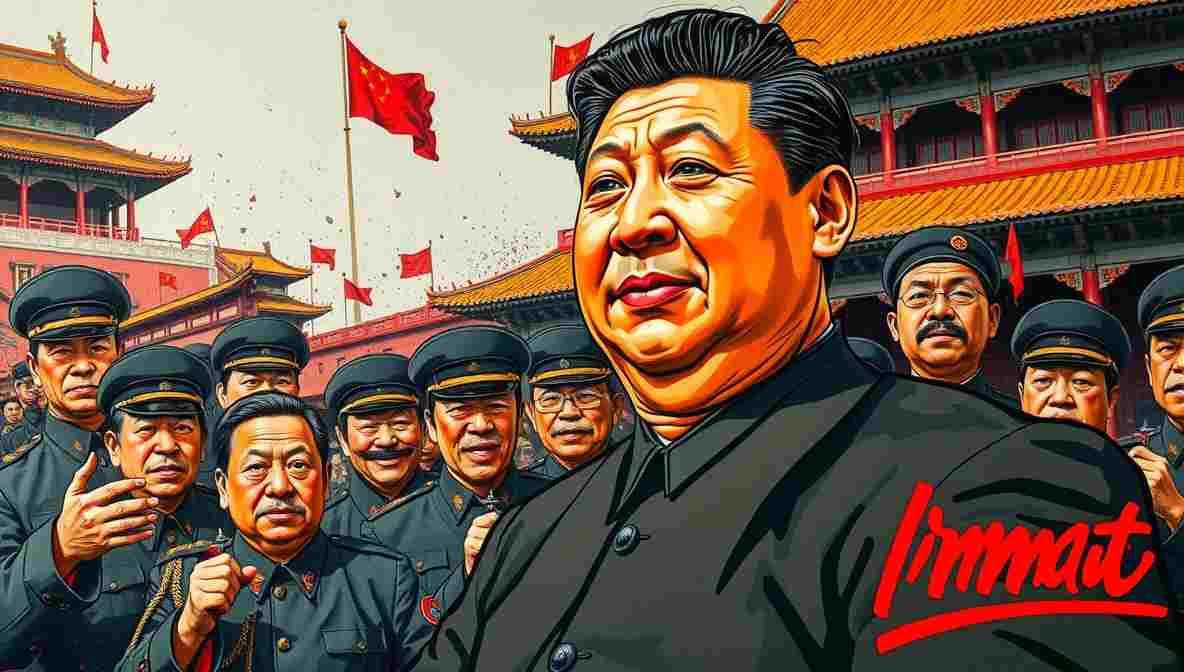
Xi Purges Generals, Accidentally Purges the Instructions Manual Too
Beijing woke up this week to discover that the world’s largest military had been placed on a brief administrative hold whilst management “sorted a few things out.” President Xi Jinping, a man who believes loyalty is the highest military rank, reportedly looked at his top brass and decided the only thing more dangerous than enemies abroad is employees who might finish a sentence without permission.
So he fired them. Or investigated them. Or relocated them to a scenic government basement with very thick doors. Details remain classified, but the effect is clear: the People’s Liberation Army is now led by a promising new generation of officers whose main qualification is nodding with enthusiasm and never finishing the phrase “with all due respect.”
The purge, according to regional analysts and one extremely nervous map, comes at an awkward moment. Xi has spent years talking about modernising the military and preparing for potential action regarding Taiwan. Unfortunately, the modernisation plan appears to have included deleting the save file. You know, like when you’re playing a video game and accidentally overwrite your progress right before the boss battle. Except the boss is geopolitics and the game is real life.
Command Structure Now Runs on Positive Vibes and Mandatory Enthusiasm
A senior defence scholar at the Institute for Strategic Uncertainty, Professor Lionel Bafford, explained the situation calmly whilst clutching a stress ball shaped like the South China Sea.
“Removing your entire senior command during a period of military buildup is bold,” Bafford said. “It’s like replacing your airline pilots mid-flight because they looked at you funny. It shows confidence. Possibly the wrong kind, but still.”
Eyewitnesses inside Beijing describe an atmosphere of intense productivity mixed with the subtle terror of a workplace where the suggestion box has been replaced with a trapdoor. One mid-level officer, who spoke on condition of being described only as “definitely not standing near a listening device,” said morale is “very high” and “legally required.”
“We are fully committed to readiness,” the officer said, blinking in Morse code. “We have new slogans, new posters, and a new understanding that asking follow-up questions is a hobby best enjoyed in retirement.”
The new workplace culture reportedly includes inspirational quotes like “Doubt is just loyalty taking a tea break” and “Critical thinking: for external enemies only.”
Taiwan Invasion Timeline Now Depends on Who Has the Password
Xi has long set milestones for military readiness, including the widely discussed 2027 target for having the capability to take Taiwan by force. That plan now faces a minor scheduling issue: half the people who knew where the folders were have been escorted out.
An anonymous staffer close to the Central Military Commission described the current situation as “a very motivated group of people trying to assemble IKEA furniture without the manual, the tools, or the bloke who used to pretend he understood Swedish diagrams.”
Still, official statements remain upbeat. State media recently declared the armed forces “stronger, purer, and more ideologically moisturised than ever.” The phrase “ideologically moisturised” has since been added to several training manuals and at least one line of luxury skincare.
New Generals Excited to Lead, Once Someone Explains What the Buttons Do
The new crop of commanders are reportedly loyal, disciplined, and slightly unclear on which branch of the military they currently run. One recently promoted officer was overheard asking if aircraft carriers come with parking sensors. Another allegedly inquired whether submarines need to signal before changing lanes.
A regional fisherman off the coast of Fujian said he has noticed “a lot more ships doing slow, thoughtful circles.”
“They look very determined,” he said. “Like when my cousin borrowed my boat after watching one online tutorial.”
A recent internal survey, leaked by someone who definitely enjoys danger, found that 82.4 percent of junior officers feel “inspired by the Chairman’s vision,” whilst 79.8 percent also admitted they are “not entirely sure who signs off on missile launches now.” The margin of error is plus or minus one career.
Absolute Control Achieved, Instructions Sold Separately
Xi’s supporters argue that consolidating control ensures unity of purpose. Critics argue it also ensures that if something goes wrong, everyone will be very unified in not mentioning it.
Dr. Maribel Quong, a political risk consultant who has made a career out of saying “this is fine” whilst everything smolders, put it this way:
“Authoritarian systems are very efficient at making decisions quickly. They’re less efficient at hearing the phrase ‘Sir, that’s a terrible idea.’ What you get is speed, confidence, and the strategic depth of a motivational poster.”
Meanwhile, Taiwan is watching events unfold with the cautious expression of a neighbour observing someone aggressively reorganising their garage at 2 a.m. whilst muttering about “teaching those paint tins a lesson.”
Military Modernisation Paused for Team-Building Exercises and Loyalty Seminars
Sources say the PLA is currently undergoing what officials call a “patriotic recalibration phase.” This includes loyalty seminars, history lessons, and a new exercise where officers practise saying “Excellent idea, Chairman” in twelve different emotional tones.
One defence attaché in the region summarised the situation diplomatically: “They’re very focused on internal cohesion right now. Less so on, you know, external geography.”
Still, Chinese state television recently aired footage of troops training vigorously, saluting energetically, and assembling equipment with the careful intensity of people who suspect the equipment might be judging them.
What the Funny People Are Saying
“Purging your generals right before you need them is like sacking your entire pit crew the morning of the Grand Prix.” – Jimmy Carr
“I’ve seen better succession planning at a kebab shop at closing time.” – Frankie Boyle
“Nothing says ‘ready for conflict’ like a command structaure held together by blind loyalty and a positive attitude.” – David Mitchell
“This is what happens when you confuse autocracy with a management seminar.” – Katherine Ryan
“If they invaded tomorrow, half the fleet would probably end up in the wrong ocean asking for directions.” – James Acaster
Cause and Effect, Now With Fewer Causes
Strategists worldwide are recalculating. On one hand, Xi now has tighter personal control over the military than ever. On the other, the chain of command currently resembles a group chat where everyone is waiting for someone else to say “go.”
A retired regional diplomat offered a simple analogy: “It’s like replacing your entire coaching staff right before the championship game, then telling the new coaches the playbook is classified from them.”
For Taiwan, the situation is both reassuring and unsettling. Reassuring because chaos is rarely the best launch platform. Unsettling because history shows that uncertainty can be just as dangerous as precision, especially when paired with a leader who believes destiny is just a strongly worded calendar reminder.
Helpful Advice for Global Superpowers Considering a Mid-Project Purge
Experts suggest the following best practices: maybe keep one general who knows where the spare parts are, label your invasion folders clearly, and avoid restructuring the entire command hierarchy during high-stakes geopolitical standoffs.
Growth mindset matters. Even empires can learn. Ideally before pressing any large red buttons labelled “symbolic demonstration.”
Disclaimer
This satirical analysis is a work of humour and imagination, created as a collaboration between two sentient beings: the world’s oldest tenured professor and a philosophy major turned dairy farmer. Any resemblance to real strategic planning competence is purely coincidental.
Auf Wiedersehen, amigo!

Alan Nafzger was born in Lubbock, Texas, the son Swiss immigrants. He grew up on a dairy in Windthorst, north central Texas. He earned degrees from Midwestern State University (B.A. 1985) and Texas State University (M.A. 1987). University College Dublin (Ph.D. 1991). Dr. Nafzger has entertained and educated young people in Texas colleges for 37 years. Nafzger is best known for his dark novels and experimental screenwriting. His best know scripts to date are Lenin’s Body, produced in Russia by A-Media and Sea and Sky produced in The Philippines in the Tagalog language. In 1986, Nafzger wrote the iconic feminist western novel, Gina of Quitaque. Contact: editor@prat.uk