Winston Churchill’s One-Liners: How a Wartime Leader’s Wit Became Britain’s Emotional Defense Mechanism
The Legendary Zingers That Shaped the Stiff Upper Lip
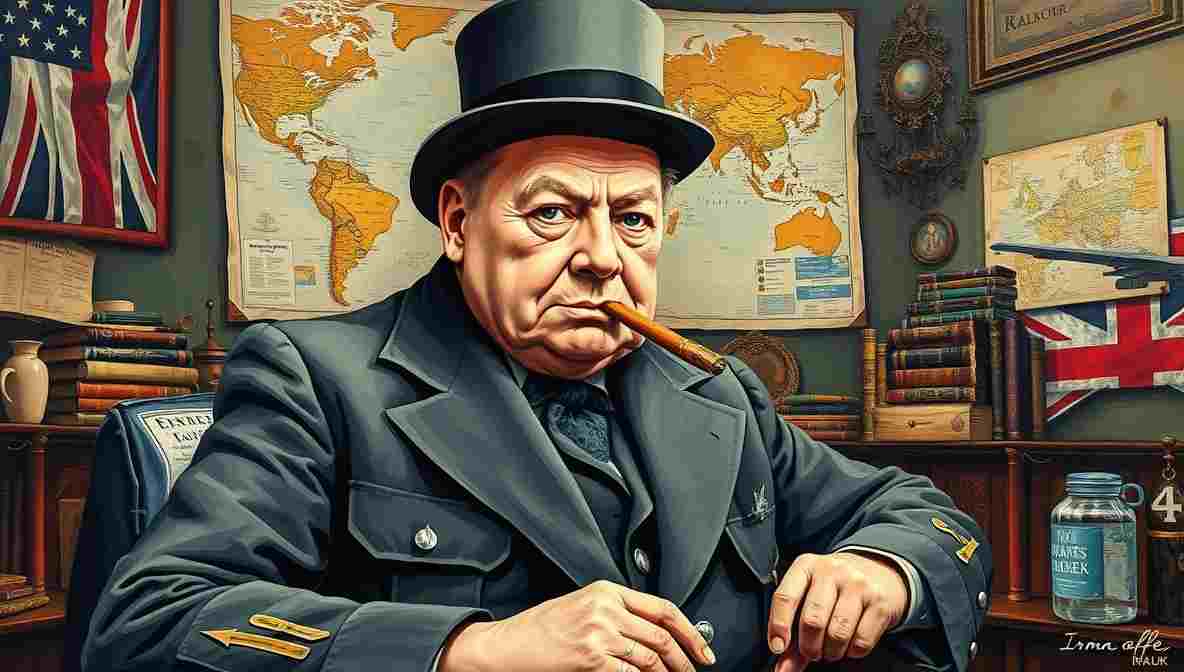
Winston Churchill saved Britain from Nazi Germany through strategic brilliance, international diplomacy, and relentless determination. He’s equally remembered for his devastating one-liners, acerbic wit, and ability to insult people so cleverly they didn’t realize they’d been destroyed until days later. This combination of wartime leadership and verbal violence created the template for modern British humor: laugh in the face of disaster, maintain composure through clever quips, and never let anyone see you’re terrified—a coping mechanism that serves Britain to this day, for better or worse.
The Churchill Wit: Weaponized Eloquence

Churchill’s famous quips range from the genuinely brilliant to the possibly apocryphal, with the British public caring little about historical accuracy when a good story supports the national character. His exchange with Lady Astor—where she allegedly told him “Winston, if you were my husband, I’d poison your tea,” and he replied “Madam, if you were my wife, I’d drink it”—may or may not have happened, but it’s too perfect not to repeat. The fact that it perfectly encapsulates the British approach to conflict (destroy them verbally while maintaining civility) ensures its survival regardless of authenticity.
His actual, documented wit was equally sharp. When accused of being drunk in Parliament, Churchill’s response—”And you, madam, are ugly. But I shall be sober tomorrow”—demonstrates the British talent for turning personal attack into opportunity for superior counterattack. Whether he actually said this to Bessie Braddock or whether it’s another myth matters less than its cultural function: establishing that proper British response to confrontation is devastating wit, not physical violence or honest emotional expression.
The Art of the Parliamentary Burn
Churchill’s Parliamentary performances elevated political insult to art form, setting standards that modern MPs struggle to match despite their best efforts. His description of Clement Attlee—”a modest man with much to be modest about”—combined apparent compliment with subtle devastation, creating a format for British political commentary that persists in Prime Minister’s Questions today, where MPs compete to destroy each other while technically remaining civil.
The wartime leader’s ability to deliver complex insults that required genuine intelligence to parse created the modern British preference for subtle, clever mockery over straightforward criticism. Americans might tell you directly what they think; Britons, following Churchill’s example, will compliment you in ways that take three days to decode as insults.
Wartime Wit: Laughing Through the Apocalypse
During World War II, while London burned under German bombing and Britain faced potential invasion, Churchill maintained his wit publicly, creating the impression that the British response to existential threat was clever wordplay. His speeches combined genuine emotional gravitas with underlying humor, suggesting that the appropriate reaction to possible annihilation was stiff upper lip and sardonic commentary.
This approach—facing catastrophe with humor rather than panic—became embedded in British identity, whether it accurately represented the population’s actual wartime experience (it didn’t) or created a useful myth for national cohesion (it did). Churchill’s public persona suggested that being British meant remaining witty even while your city was being destroyed, an impossible standard that generations have since struggled to maintain.
“We Shall Fight on the Beaches” (And Make Jokes About It)
Churchill’s famous “We shall fight on the beaches” speech is remembered as stirring oratory, but Churchill reportedly followed the public version with private commentary joking about fighting with broken bottles since Britain lacked proper weapons. This combination of public gravitas and private sardonic humor became the British template: appear dignified, then immediately undercut that dignity with self-deprecating wit the moment you’re behind closed doors.
The Drinking Problem (That Enhanced the Legend)
Churchill’s prodigious alcohol consumption—champagne for breakfast, whisky throughout the day, brandy at night—would today be recognized as alcoholism requiring intervention. In his era, and in British memory, it enhanced his legend: the man who saved civilization while maintaining a constant blood-alcohol level that would incapacitate lesser mortals. His quip “I have taken more out of alcohol than alcohol has taken out of me” became justification for generations of British functional alcoholics.
The Churchill drinking mythology supports the British relationship with alcohol: it’s not a problem if you remain witty and productive, and in fact might enhance both qualities. This convenient belief persists in British culture, where heavy drinking is acceptable if accompanied by clever banter, creating a nation of people who think being amusing while intoxicated is a skill rather than a symptom.
The Depression Churchill Never Joked About

Churchill’s “black dog” of depression—his term for the mental health struggles he battled throughout life—receives less attention than his wit, possibly because acknowledging that Britain’s wartime hero suffered from clinical depression complicates the myth. His ability to maintain public humor despite private anguish created another impossible British standard: suffering in silence while appearing functional and amusing to others.
Modern understanding recognizes Churchill’s wit and depression as connected rather than contradictory—many comedians use humor to manage mental health issues. But British culture internalized only the visible wit, not the invisible struggle, creating the expectation that proper British response to personal crisis is clever wordplay rather than seeking help.
Legacy: The Wit That Built a Nation’s Defense Mechanism
Churchill’s influence on British humor extends beyond his actual jokes to the philosophy they represent: that wit is armor, that verbal dexterity demonstrates superiority, and that the proper response to any situation is a clever quip. This approach serves Britain well in some contexts—creating a culture of verbal creativity and self-deprecating humor—while causing problems in others, like emotional openness and straightforward communication.
The modern British “stiff upper lip” owes much to Churchill’s example: face adversity with humor, never show genuine emotion in public, and maintain composure through wordplay. Whether this is healthy coping or repression dressed as cultural virtue remains debatable, but it’s thoroughly embedded in British identity, for better or worse.
The Fake Churchill Quotes Industry
Churchill is now credited with hundreds of quotes he never said, because British people desperately want to believe their wartime hero had a perfect quip for every situation. “If you’re going through hell, keep going” sounds like Churchill but lacks documentary evidence. “Success is stumbling from failure to failure with no loss of enthusiasm” is definitely not Churchill but gets attributed to him constantly. The British need for Churchill to have been funnier than he actually was reveals our dependence on his wit as cultural foundation.
Churchill Humor in Modern Britain

Contemporary British comedy still follows Churchill’s template: self-deprecation as strength, verbal agility as virtue, and the assumption that being clever is more important than being kind. Panel shows feature comedians competing in Churchillian wordplay, politicians attempt his parliamentary wit (usually failing), and the general population believes that being amusing during crisis is a national characteristic rather than learned behavior from one man’s example.
The BBC and British media perpetuate Churchill’s wit through constant repetition, ensuring each generation inherits the same approach to humor and adversity. Whether this serves modern Britain—facing different challenges than 1940s Nazi invasion—is questionable, but the alternative would require developing new cultural responses, and Britain prefers maintaining tradition, however inappropriate.
What Churchill’s Wit Actually Accomplished
Churchill’s one-liners achieved something remarkable: they created the impression that Britain faced existential threat with amused detachment rather than terror. Whether this was accurate (it wasn’t—people were terrified) mattered less than the myth it created, unifying the nation around the idea that being British meant remaining witty while everything burned. This mythology served wartime morale and created lasting cultural identity, even if that identity sometimes prevents honest emotional expression.
The Churchill wit legacy includes both genuine gifts—a culture that values wordplay and self-deprecating humor—and problematic inheritances, like the expectation that proper British response to crisis is clever commentary rather than seeking support. Modern Britain navigates this legacy awkwardly, trying to maintain the wit while acknowledging that maybe laughing through everything isn’t always healthy.
The Stiff Upper Lip’s Modern Crisis

Contemporary Britain faces a Churchill paradox: the wit-as-defense mechanism he exemplified conflicts with modern mental health awareness encouraging emotional openness. Young Britons are told simultaneously to maintain traditional stiff upper lip composure and to talk about their feelings, creating confusion about which cultural value should dominate. Churchill’s legacy—that strength means witty stoicism—clashes with contemporary understanding that strength includes vulnerability and asking for help.
The solution, if one exists, probably involves appreciating Churchill’s wit while recognizing its limitations as life philosophy. Being clever is valuable; being only clever while ignoring emotional needs is problematic. But Britain struggles with this balance, still seduced by the myth that our grandparents’ generation faced the Blitz with nothing but tea and sardonic commentary, when reality was far more complex and frightened.
Why We Still Need Churchill’s Jokes
Britain clings to Churchill’s wit because it represents a time when the nation mattered internationally, when British characteristics seemed exceptional rather than eccentric, and when humor genuinely helped survive catastrophic circumstances. His one-liners provide cultural continuity, connecting modern Britain to its “finest hour” through shared verbal tradition. Whether this connection helps or hinders contemporary British identity remains unclear, but we’re too committed to the bit to stop now.
The stiff upper lip, sustained by Churchill’s example, persists because abandoning it would require admitting that maybe the traditional British approach to adversity—laugh through it while drinking heavily—isn’t optimal for all situations. And if we admit that, we might have to develop new coping mechanisms, which sounds exhausting. Better to keep repeating Churchill quotes, maintaining the myth that wit conquers all, and pretending we’re fine while everything slowly falls apart—which, come to think of it, might be the most Churchillian approach to modern Britain’s challenges.
Top 10 Churchill Witty Statements: The Stories Behind the Legendary One-Liners
Winston Churchill’s Most Famous Verbal Takedowns Explained
Winston Churchill remains one of history’s most quotable figures, with his devastating wit and masterful command of language producing legendary one-liners that are still repeated today. However, many of these famous quips have fascinating backstories—and some may not have originated with Churchill at all. Here are ten of his most celebrated witty statements, along with the stories behind them.
1. “Madam, if I were your wife, I’d drink it!” – The Lady Astor Poison Tea Exchange
The Quote: When Lady Nancy Astor allegedly said “Winston, if you were my husband, I’d poison your tea,” Churchill supposedly replied, “Madam, if I were your wife, I’d drink it!”
The Story: This exchange is frequently attributed to Churchill and Lady Astor, Britain’s first female MP who famously disliked Churchill. However, the truth is more complicated. The joke actually dates back to at least 1899 in American newspapers, appearing in various forms for decades before being associated with Churchill. According to the International Churchill Society, it was more likely said by Churchill’s friend Lord Birkenhead (F.E. Smith), who was known for quicker retorts than Churchill. The version with Churchill and Astor first appeared in print in 1952 in “The Glitter and the Gold” by Consuelo Vanderbilt Balsan, though whether it actually happened remains unverified.
2. “Tomorrow I shall be sober, and you will still be disgustingly ugly” – The Bessie Braddock Encounter
The Quote: When Labour MP Bessie Braddock confronted Churchill outside the House of Commons saying “Winston, you are drunk, and what’s more you are disgustingly drunk,” Churchill reportedly replied: “Bessie, my dear, you are ugly, and what’s more, you are disgustingly ugly. But tomorrow I shall be sober and you will still be disgustingly ugly.”
The Story: This exchange actually did occur in 1946, confirmed by Ronald Golding, Churchill’s Scotland Yard bodyguard who was present. However, there are important caveats. First, Churchill wasn’t actually drunk—just tired and unsteady after a long, late-night parliamentary debate. Second, the retort wasn’t original. Churchill was a film buff with a photographic memory, and this line closely mirrors dialogue from the 1934 W.C. Fields film “It’s a Gift”, where Fields’ character responds to being called drunk by saying: “Yeah, and you’re crazy. But I’ll be sober tomorrow and you’ll be crazy the rest of your life.” Churchill essentially edited W.C. Fields for the occasion. The joke format itself dates back to at least 1863 in American newspapers.
3. “A modest man, who has much to be modest about” – The Clement Attlee Put-Down
The Quote: When asked about his political rival Clement Attlee, Churchill allegedly said: “A modest man, who has much to be modest about.”
The Story: This devastating assessment of Labour Prime Minister Clement Attlee perfectly demonstrates Churchill’s mastery of the backhanded compliment. What appears at first to be praise—acknowledging Attlee’s modesty—becomes a savage critique upon completion of the sentence. The line suggests Attlee has genuine reasons to be modest, implying he lacks significant accomplishments or abilities. Despite their political rivalry, Churchill and Attlee maintained a working relationship during the wartime coalition government, though Churchill’s Conservatives lost badly to Attlee’s Labour in the 1945 election, which must have made this barb particularly satisfying to deliver.
4. “I am ready to meet my Maker. Whether my Maker is prepared for the great ordeal of meeting me is another matter”
The Quote: When asked by a reporter if he was prepared to meet his Maker, Churchill responded with characteristic wit.
The Story: This quote, delivered in 1954, showcases Churchill’s ability to be simultaneously humble and arrogant in a single breath. The first part expresses proper religious humility—he’s ready to face divine judgment. The second part, however, cheekily suggests that God might be the one who needs to prepare for the encounter, implying Churchill’s life has been so eventful, controversial, and complex that even the Almighty might find the meeting challenging. The quote reflects Churchill’s lifelong relationship with religion: respectful but not devout, spiritual but skeptical, and always maintaining his sense of humor even when discussing mortality.
5. “A good speech should be like a woman’s skirt: long enough to cover the subject and short enough to create interest”
The Quote: Churchill’s advice on speechmaking using a gendered metaphor.
The Story: This quote demonstrates both Churchill’s wit and the dated attitudes of his era. The comparison works on multiple levels: a speech needs sufficient length to address its topic thoroughly (covering the subject) while remaining concise enough to maintain audience attention (creating interest). The metaphor was considered clever in Churchill’s time but now seems outdated, reducing effective communication to a comparison involving women’s clothing. Nevertheless, the underlying advice remains sound—speeches should balance comprehensiveness with conciseness, a principle Churchill himself followed in his most famous addresses.
6. “History will be kind to me for I intend to write it”
The Quote: Churchill’s frank acknowledgment of his plans to shape his own legacy.
The Story: This remarkably self-aware statement proved prophetic. Churchill did indeed write history—literally. His six-volume memoir “The Second World War” won the Nobel Prize in Literature in 1953, shaping how generations understood the conflict. He also wrote “A History of the English-Speaking Peoples” and numerous other historical works. By controlling the narrative, Churchill ensured his perspective on events would dominate historical understanding, at least initially. Modern historians have since reassessed many of Churchill’s claims and interpretations, but his volumes remain influential primary sources. The quote reveals Churchill’s strategic thinking extended beyond wartime—he understood that controlling the story of events could be as important as the events themselves.
7. “You can always count on Americans to do the right thing—after they’ve tried everything else”
The Quote: Churchill’s assessment of American decision-making.
The Story: This quote perfectly captures Churchill’s affectionate exasperation with America’s approach to international crises, particularly World War II. The United States remained neutral until Pearl Harbor in 1941, despite Britain fighting alone against Nazi Germany from 1940. Churchill, whose mother was American, maintained deep connections to the United States throughout his life and worked tirelessly to bring America into the war. This quote likely reflects his frustration with American isolationism while acknowledging that once committed, America typically makes the right choice. It’s both criticism and compliment—suggesting American decision-making is circuitous but ultimately sound. The quote has been applied to numerous situations since, becoming a general observation about American foreign policy.
8. “Nothing in life is so exhilarating as to be shot at without result”
The Quote: Young Churchill’s observation about combat from 1898.
The Story: This quote comes from Churchill’s first book, “The Story of the Malakand Field Force” (1898), written when he was just 23 years old after serving as a soldier-correspondent on India’s Northwest Frontier. The young Churchill had experienced combat firsthand during the Siege of Malakand (1897), one of many battles during the Anglo-Afghan wars. The quote reveals several aspects of Churchill’s character: his physical courage, his love of adventure, and his ability to find excitement even in mortal danger. It’s both genuine observation—there is indeed an adrenaline rush in surviving danger—and characteristic bravado. This early experience with combat would later inform his wartime leadership, as he understood viscerally what he asked of British soldiers.
9. “The nose of the bulldog has been slanted backwards so that he can breathe without letting go”
The Quote: Churchill’s metaphor for British tenacity from 1905.
The Story: This early quote from Churchill’s parliamentary career demonstrates his gift for memorable imagery. The bulldog, which would later become his personal symbol and a metaphor for British determination during World War II, represents the ideal of holding on despite difficulty. The biological observation—that bulldogs’ facial structure allows them to grip prey while still breathing—becomes a metaphor for British character: the ability to maintain one’s grip (continue fighting) while surviving (breathing). Churchill himself would embody this quality during Britain’s darkest hours, refusing to surrender when invasion seemed imminent. The bulldog imagery became so associated with Churchill that cartoonists regularly depicted him as one, and he eventually embraced the comparison.
10. “We can always count on the Americans to do the right thing, after they have exhausted all the other possibilities”
The Quote: A variation on quote #7, often cited differently.
The Story: This alternate version of Churchill’s American quote appears in numerous sources but cannot be definitively traced to him in any authenticated speech or writing. Like many Churchill quotes, it may be apocryphal—attributed to him because it “sounds like something Churchill would say.” The International Churchill Society notes this quote has “no known connection to Churchill” in this exact phrasing. However, the sentiment aligns with his documented views about American reluctance followed by commitment. This illustrates a broader pattern: Churchill’s wit was so famous that clever political observations are frequently attributed to him without verification, expanding his legendary status beyond his actual words.
The Churchill Quote Problem
Many quotes attributed to Churchill aren’t actually his. Richard Langworth, editor of “Churchill By Himself,” estimates that at least 80 famous sayings attributed to Churchill weren’t necessarily uttered by him. People tend to attribute witty political observations to Churchill because his reputation for clever remarks makes him a plausible source. The Internet has amplified this problem, with “Churchill quote” websites often sharing unverified or misattributed statements.
However, even when quotes aren’t original to Churchill or are adapted from other sources (like the W.C. Fields film), his delivery and timing often made them famous. Churchill’s genius wasn’t just creating original witticisms but knowing when and how to deploy them for maximum impact. His photographic memory allowed him to recall appropriate quotes from literature, film, and political history, adapting them to contemporary situations.
Why Churchill’s Wit Endures
Churchill’s witty statements survive because they combine several elements: clever wordplay, political insight, perfect timing, and quotability. Many work on multiple levels—the Attlee quote, for instance, appears complimentary until you complete the thought. Others reveal deeper truths about politics, war, or human nature while making people laugh.
His best quotes also reflected genuine aspects of his character: his courage (being shot at), his strategic thinking (writing history), his international perspective (on Americans), and his understanding of communication (the speech/skirt metaphor). Even when adapted from other sources, Churchill made them his own through delivery and context.
The continued popularity of Churchill quotes—real and apocryphal—demonstrates enduring fascination with leaders who combine intelligence, courage, and humor. In an age of careful political messaging, Churchill’s unfiltered wit seems refreshingly direct, even when we know some quotes aren’t authentic. The legend has become almost more important than the historical reality, which is perhaps what Churchill meant when he said he intended to write history himself.
Auf Wiedersehen, amigo!

Alan Nafzger was born in Lubbock, Texas, the son Swiss immigrants. He grew up on a dairy in Windthorst, north central Texas. He earned degrees from Midwestern State University (B.A. 1985) and Texas State University (M.A. 1987). University College Dublin (Ph.D. 1991). Dr. Nafzger has entertained and educated young people in Texas colleges for 37 years. Nafzger is best known for his dark novels and experimental screenwriting. His best know scripts to date are Lenin’s Body, produced in Russia by A-Media and Sea and Sky produced in The Philippines in the Tagalog language. In 1986, Nafzger wrote the iconic feminist western novel, Gina of Quitaque. Contact: editor@prat.uk