London Futball Becomes City’s Primary Source of Weather Complaints
London used to complain about the weather because it was there. Rain existed. Wind happened. Grey was a lifestyle choice. Then Futball arrived and said, no, no, this is about us now.
In modern London Futball, weather is no longer atmospheric. It is tactical. Rain is not rain. Rain is a defensive liability. Wind is not wind. Wind is a biased third official. Sun glare is not physics. Sun glare is corruption.
A missed sitter is never a missed sitter. It is a “slick surface issue.” A defender slipping is not poor balance, it is an “unexpected moisture event.” Fans who cannot name five cloud types will suddenly speak with the confidence of senior meteorologists. “That drizzle wasn’t forecast.” “You can tell the wind shifted after the warm-up.” “This pitch hasn’t dried properly since 2019.”
London Futball fans now check the weather app before checking the lineup. Some check it during the match. Others blame the weather retroactively, scrolling back through hourly precipitation like detectives proving motive.
“The barometric pressure at kickoff was 1013 millibars,” explained one supporter clutching a phone like evidence. “That’s practically a meteorological conspiracy.”
When London Futball teams win, the conditions were “perfect for the way we play.” When they lose, the weather becomes a scandal. Questions are raised. Investigations are implied. Someone mutters that northern clubs “get away with this sort of thing.”
Climate change is discussed seriously, but only insofar as it affects away fixtures in February.
London Futball has turned weather into evidence.
London Futball Fans Proudly Declare Rival Club “Finished,” Check Table Daily Just In Case
Nothing in London Futball is more satisfying than declaring a rival club finished. Not beaten. Not struggling. Finished. As in done. Over. Gone. A historical footnote with a badge.
This declaration is usually triggered by one loss, one transfer rumor, or one photograph of a manager looking mildly concerned. The rival is finished financially, tactically, culturally, spiritually, and in terms of “pull.”
Fans deliver the verdict with joy. They say it in pubs with smiles that suggest closure. They post it online with confidence bordering on relief. “They’re finished.” “That’s it for them.” “End of an era.”
Then, quietly, they check the table. Daily. Sometimes hourly. Not because they are worried. Just curious. Just monitoring the ruins.
If the rival climbs one place, it is dismissed as “false position.” If they win, it is “papering over cracks.” If they draw, it is “exactly what you’d expect from a finished club.”
“They won 4-0, but I saw their defensive shape,” said one Arsenal fan about Spurs. “Absolutely finished. I’ll check again tomorrow to confirm.”
The rival is always finished until they aren’t, at which point the narrative adjusts. Suddenly the rival has “resources.” Suddenly they are “dangerous.” Suddenly they have “nothing to lose,” which is apparently very threatening.
London Futball fans do not retract statements. They revise timelines.
The rival remains finished. They just keep inconveniently playing Futball.
The Psychology of Rivalry
Sports psychologists studying football rivalry behavior have identified what they call “Schrödinger’s Rival”—the ability to hold two contradictory beliefs simultaneously: that your rival is both catastrophically doomed and dangerously threatening, depending on which narrative serves you better at any given moment.
London Futball Matches Now Considered Community Theatre With More Swearing
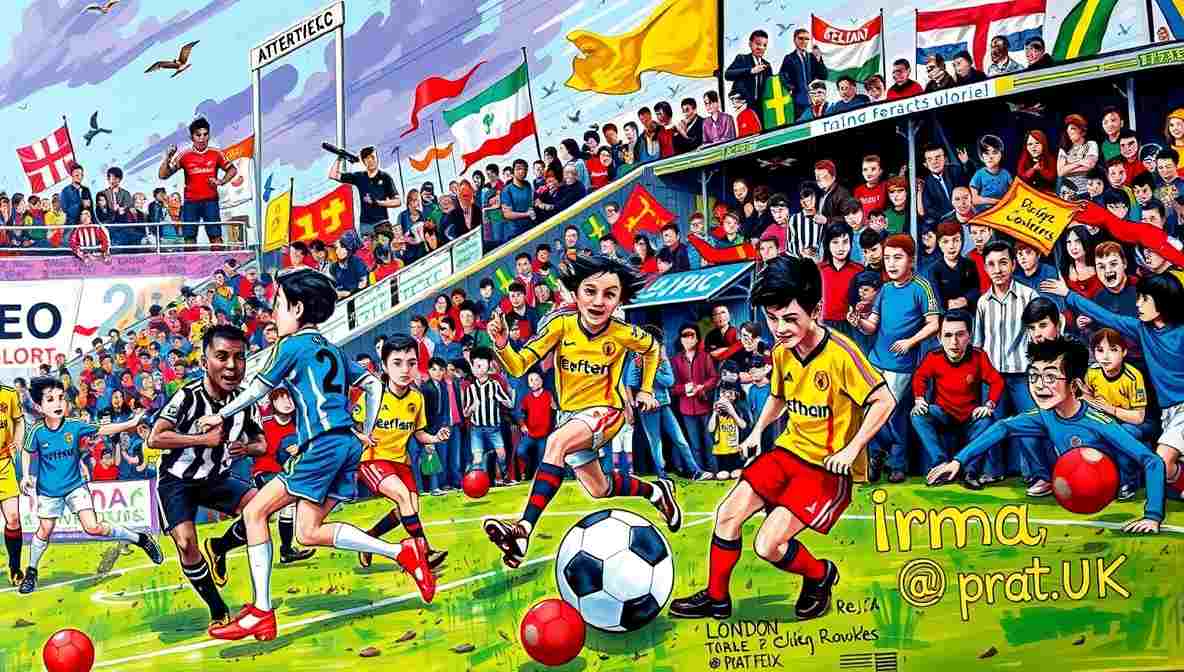
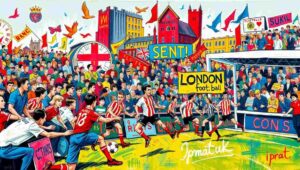
A London Futball match is no longer just a sporting event. It is community theatre. Immersive. Loud. Unscripted. Slightly confusing. Performed weekly with rotating leads and a recurring sense of disappointment.
Everyone has a role. The hopeful optimist. The tactical expert who learned formations from social media diagrams. The man who boos everything, including throw-ins. The child asking questions no adult can answer honestly.
The pitch is the stage. The players are actors who forgot their lines. The manager is a director whose vision is explained exclusively in hindsight. The referee is a villain introduced early to ensure audience unity.
Dialogue is improvised. Swearing is not optional. Silence is frowned upon. Chants rise and fall like experimental monologues, sometimes poetic, sometimes aggressive, sometimes just rhythmically committed to one syllable.
“I heard a chant that was just the word ‘massive’ repeated for ninety seconds,” reported one West Ham supporter. “It was either brilliant or concerning. Possibly both.”
There is drama. A near miss produces a collective gasp that feels rehearsed. A bad pass triggers groans with perfect timing. A substitution causes a reaction usually reserved for plot twists.
At halftime, the audience debates the meaning of the first act. “We were the better side.” “No, we weren’t.” “It’s there for us.” “We’re lucky it’s only one.”
The final whistle ends the performance but not the discussion. Reviews are delivered immediately. Harshly. Passionately. Everyone agrees it mattered deeply, even if no one is quite sure why.
London Futball is theatre where everyone believes they could do it better and keeps buying tickets anyway.
London Futball Fans Unite Briefly to Boo VAR, Then Return to Hating Each Other
Nothing unites London Futball fans like VAR. For a brief, shining moment, tribal hatred dissolves. Scarves lower. Voices merge. The enemy is no longer the rival club. It is the screen.
VAR decisions take just long enough to create hope and just short enough to destroy it. Fans boo the delay. They boo the decision. They boo the concept. They boo the idea that clarity was ever promised.
In that moment, fans agree on everything. VAR is ruining the game. VAR is inconsistent. VAR is too slow. VAR is too fast. VAR is wrong even when it is correct.
Opposing supporters who spent the entire match insulting each other now stand shoulder to shoulder, united in disbelief. Strangers nod. Someone says, “Game’s gone.” Another replies, “Absolutely.”
“For thirty glorious seconds, I forgot I hated everyone around me,” admitted one Chelsea fan. “Then they gave the penalty, and I remembered why football matters.”
Then the decision is finalized.
Unity dissolves instantly. The chant resumes. Old grudges reappear. The rival fans are once again unbearable. VAR is still terrible, but less important than hating each other correctly.
The moment passes. It always does.
London Futball unity is powerful, fleeting, and conditional on a shared sense of injustice.
The Comedian’s Take on Unity
James Acaster said, “Football fans will unite against anything except each other, which is ironic because they’re essentially the same person wearing different colored scarves.”
Romesh Ranganathan observed, “VAR has done what no government could do—it made Londoners agree on something for five whole seconds.”
Katherine Ryan noted, “Men say they want unity in football, but then VAR gives them a common enemy and they still find a way to argue about it differently.”
London Futball Experts Confirm “Next Year” Remains Strongest Team in the League
According to London Futball experts, “Next Year” is once again the most promising side in the league. It has depth. It has potential. It has a clear plan that is just about to click.
Next Year plays exciting Futball. Next Year signs the right players. Next Year fixes the defense. Next Year benefits from a full preseason, fewer injuries, and lessons learned.
Every season ends the same way. Disappointment is reframed as preparation. Failure becomes groundwork. Loss becomes learning.
Fans talk about Next Year with warmth. With belief. With charts. They say things like, “If we add two players and keep everyone fit, we’re right there.” Right where remains undefined.
“Next Year has never lost a match,” explained one Tottenham supporter while reviewing transfer rumors. “Perfect record. Unbeaten since 1882.”
Next Year never concedes late goals. Next Year never wastes chances. Next Year does not panic in October.
London Futball survives on Next Year. It is the most consistent performer in the city. It never loses. It never disappoints. It never actually arrives.
And yet, every August, London Futball fans welcome it back like an old friend.
Hope kicks off again.
The Philosophy of Perpetual Hope
Behavioral economists studying fan loyalty patterns have discovered that “Next Year Syndrome” is not delusion but adaptation—the human brain’s remarkable ability to reset expectations annually, like a biological season ticket.
David Mitchell said, “Supporting a football team is the triumph of hope over experience, repeated weekly until you die.”
Sara Pascoe observed, “Men invest in ‘Next Year’ like it’s a pension scheme. Spoiler: it pays out the same as actual pension schemes—disappointment in your sixties.”
Nish Kumar remarked, “Arsenal fans have been talking about ‘Next Year’ since 2004. It’s less a football strategy and more a lifestyle philosophy.”
Ed Gamble noted, “Next Year is the only player who never gets injured, never loses form, and is always available on a free transfer.”
Russell Howard said, “Believing in Next Year is like believing in Father Christmas, except Father Christmas occasionally delivers.”
Rob Beckett quipped, “Next Year is the best signing every club makes. Costs nothing, promises everything, delivers the same as this year.”
Disclaimer
This article is satire. Any resemblance to actual clubs, supporters, managers, weather patterns, or psychological coping mechanisms is not coincidental but deeply structural. This piece is the result of a fully human collaboration between the world’s oldest tenured professor and a philosophy major turned dairy farmer, both of whom support London football teams and check the weather app before checking the lineup.
Auf Wiedersehen, amigo!

Alan Nafzger was born in Lubbock, Texas, the son Swiss immigrants. He grew up on a dairy in Windthorst, north central Texas. He earned degrees from Midwestern State University (B.A. 1985) and Texas State University (M.A. 1987). University College Dublin (Ph.D. 1991). Dr. Nafzger has entertained and educated young people in Texas colleges for 37 years. Nafzger is best known for his dark novels and experimental screenwriting. His best know scripts to date are Lenin’s Body, produced in Russia by A-Media and Sea and Sky produced in The Philippines in the Tagalog language. In 1986, Nafzger wrote the iconic feminist western novel, Gina of Quitaque. Contact: editor@prat.uk