
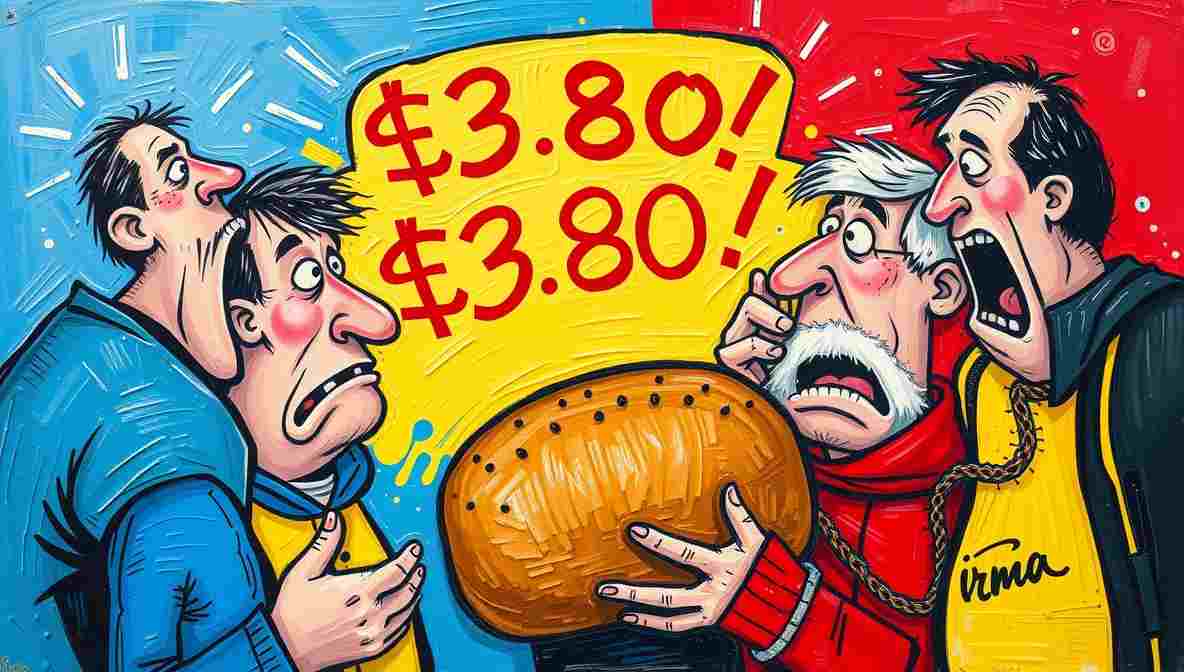
UK Food Inflation: Nation Shocked to Discover £3.80 Is Now “A Modest Loaf”
Britain awoke this week to the news that food inflation remains “stubbornly high,” a phrase economists use to mean “we’ve absolutely lost control but would prefer not to cry on television.” Shoppers across the country responded in the traditional British manner: staring silently at a supermarket shelf while doing mental arithmetic normally reserved for bridge tournaments and hostage negotiations.
Once upon a time, food shopping was a dull necessity. You went in for milk, bread, and a vague sense of purpose, and you left with milk, bread, and £12 less than you expected. Now it is a high-stakes financial experience involving spreadsheets, loyalty apps, and the moral question of whether cheese is still a basic human right.
The Weekly Shop: Now a Luxury Experience™

According to official figures, the cost of everyday food items has risen again, though the phrase “everyday” is doing heroic levels of work here. Milk is now priced as if it were gently hand-milked by monks at dawn. Bread costs more if it has ever heard the word “artisan.” Eggs fluctuate in price so wildly they are now considered a commodity market.
Supermarkets insist they are “doing everything they can” to keep prices down, which is why they have helpfully introduced:
-
Smaller packs for the same price
-
Identical packs for more money
-
New “value” ranges that still cost more than the entire shop did in 2019
A family-sized lasagne now feeds a family of one mildly optimistic adult, or two children if neither of them is particularly hungry and one of them is imaginary.
Shrinkflation: Because Math Is Optional
Perhaps the most impressive innovation of the food inflation era is shrinkflation, the practice of quietly reducing product size while keeping the price the same. Or, in more advanced cases, raising the price while making the product smaller, lighter, and emotionally distant.
A “sharing bag” of crisps now contains roughly seven crisps and a sense of betrayal. A chocolate bar has slimmed down so much it now qualifies as a chocolate pamphlet. Cereal boxes are mostly air, which at least prepares you for the feeling of emptiness at the checkout.
Manufacturers assure us this is all perfectly reasonable and that consumers “won’t notice.” This is bold, given that British people are still emotionally damaged by the introduction of decimal currency and can spot a missing gram from across the room.
Supermarket Loyalty Cards: A Game You Must Play to Survive

In response to rising prices, supermarkets have introduced loyalty schemes so complex they resemble offshore tax arrangements. Without a card, your shopping costs the GDP of a small Baltic state. With a card, you can enjoy “exclusive savings,” which is marketing language for “the price it should have been anyway.”
Shoppers now scan apps, collect points, activate offers, and sacrifice a small amount of personal data just to buy pasta without taking out a loan. At this stage, it would be simpler to have a loyalty card for being poor, which automatically applies discounts when you look tired and whisper “£2.50 for butter” under your breath.
Government Response: Calm Reassurance and Vibes
The government has responded to food inflation with its trademark blend of calm reassurance and absolutely nothing concrete. Ministers have reminded the public that inflation is a “global issue,” which is comforting in the same way being told everyone is on fire would be.
Officials have urged shoppers to “make smart choices,” a phrase that suggests the public has been irresponsibly buying foie gras instead of choosing between heating and eating. They have also praised supermarkets for “working hard,” which is true in the sense that someone is definitely working very hard to reprice bananas every Tuesday.
Meanwhile, wages remain theoretically linked to inflation in the same way a kite is linked to the ground: technically attached, but absolutely not keeping up.
Middle-Class Panic: Switching to Own-Brand Everything
The true scale of the crisis became clear when middle-class shoppers began quietly switching to own-brand products while insisting it was “actually just as good.” Olive oil has been replaced with “olive-flavoured cooking liquid.” Parmesan has become “hard Italian-style topping.” Hummus is now beige spread.
Dinner parties have evolved too. Guests no longer compliment the food; they compliment the value. “This is lovely,” they say, nodding approvingly. “Was it on offer?”
Wine is discussed not by region but by discount percentage. “I got this for under a tenner,” someone whispers, as though confessing to a minor crime.
Food as a Concept, Not a Guarantee

Charities warn that food insecurity is rising, which is a grim way of saying that more people are discovering hunger is no longer something that happens elsewhere. Food banks are busier than ever, and not just with people you’d expect, but with teachers, nurses, and people who were previously only familiar with budgeting in an abstract, theoretical way.
The idea that food should be affordable has quietly shifted into the idea that food should be managed. Meals are planned like military operations. Leftovers are respected. Freezers are treated as sacred spaces.
A roast chicken now does at least four meals and possibly a soup, a curry, and an existential lesson about gratitude.
Looking Ahead: Hope, Apparently
Experts predict food inflation will eventually ease, which is economist-speak for “please stop shouting.” Until then, Britons will continue adapting in small, stoic ways: buying less, wasting nothing, and staring into fridges hoping inspiration will strike before payday.
The nation remains resilient, resourceful, and quietly furious—qualities that have always defined British cuisine, if not always its flavour.
And if nothing else, food inflation has reminded us of one vital truth: when bread costs £3.80, it had better be the best loaf of your bloody life.

Harriet Collins is a high-output satirical journalist with a confident editorial voice. Her work demonstrates strong command of tone, pacing, and social commentary, shaped by London’s media and comedy influences.
Authority is built through volume and reader engagement, while expertise lies in blending research with humour. Trustworthiness is supported by clear labelling and responsible satire.