Britain Discovers the Slippery Slope, Immediately Sets Up a Queue at the Bottom of It
Tax Breaks for Pubs & the EVERYONE ELSE AS WELL
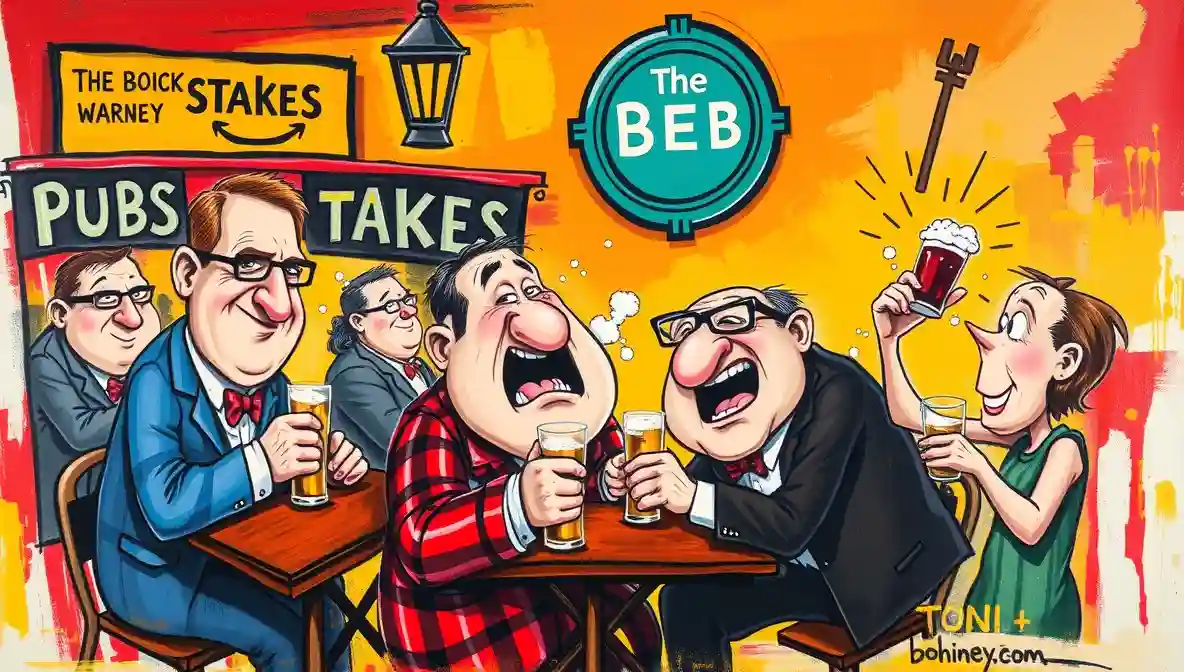
Britain’s independent bookshops have asked for the same tax relief as pubs, and within twelve minutes of that request becoming public, the nation collectively realised what it always realises far too late: once one business gets a tax break, every other business in the country begins stretching, yawning, and asking if now might be a good time to identify as a “community hub.”
Bookshops argue, not unfairly, that they serve wine, host gatherings, provide emotional support, and occasionally listen to people complain about politics in hushed tones. Pubs do this loudly, with fewer books and more regret. The government, having already promised pubs a degree of mercy, now finds itself facing a philosophical crisis it has not prepared for: where exactly does “pub-like” end?
The Community Hub Arms Race Begins
Within hours of the Booksellers Association making its case, a poll conducted by the Institute for Fiscal Resentment showed that 91 percent of small businesses now believe they qualify for the same tax status as a pub, provided the definition of “pub” is allowed to stretch to the width of a yoga mat.
Swimming pools were first out of the gate. “People gather here, they drink afterwards, and someone always cries in the changing rooms,” said one leisure centre manager, gesturing toward a vending machine that technically sells alcohol-free beer but feels spiritually adjacent to a pint. “If that’s not a pub, what is?”
Bike repair shops followed. Customers linger. Conversations happen. Someone always brings up Brexit even though nobody asked. One mechanic in Hackney told reporters that his shop had become “a safe space for men who own too much Lycra and don’t understand the concept of inside voices.”
Britain Redefines ‘Pub’ As ‘Any Place With Feelings’
The Treasury, already dizzy from its own spreadsheets, attempted to draw a line. That line lasted roughly six minutes before collapsing under the weight of laminated menus.
Libraries filed an application, arguing they had been unfairly overlooked for centuries despite offering silence, social interaction, and the quiet judgment of strangers. Dog grooming salons insisted they qualified due to “regulars,” “snacks,” and “the faint smell of despair.”
One Whitehall insider admitted the situation had become untenable. “We gave pubs relief because pubs matter,” the official said, staring into the middle distance. “Now everyone is telling us they matter. Some of them are even showing us their community noticeboards.”
Experts Warn of Full Cultural Meltdown
According to Professor Elaine Morton of the London School of Applied Slippery Slopes, this was inevitable. “The moment you reward one form of social cohesion, you invite all other forms to self-identify,” she explained. “We saw this with artisanal bakeries in 2014. We ignored it. Now we’re here.”
Morton noted that once bookshops positioned themselves as community anchors, the definition of “anchor” became dangerously nautical. “If everyone is an anchor, nothing moves. Including tax policy.”
Even Amazon Is Watching Closely
Online retailers have responded with quiet interest. A spokesperson for Amazon noted that while the company does not currently qualify as a pub, it does offer book clubs, customer reviews, and existential dread, which are “arguably the modern equivalent of bar chatter.”
Jeff Bezos, speaking only through his facial expressions in archival footage, appeared intrigued by the idea of hosting a digital happy hour with same-day delivery of regret.
Government Attempts to Draw a Line, Immediately Erases It
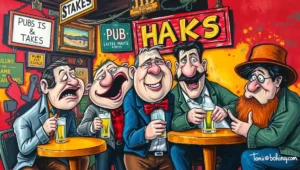
Chancellor Rachel Reeves attempted to reassure the public by explaining that pub relief was “temporary, targeted, and specific,” a phrase that caused accountants nationwide to laugh until they required medical attention.
Officials briefly considered issuing a formal definition of a pub, but abandoned the effort after someone pointed out that many pubs no longer resemble pubs, and most bookshops now sell wine.
A leaked memo suggested the Treasury was exploring a points-based system. Businesses would earn pub-status credits for stools, chalkboards, handwritten signs, and at least one staff member named Tom.
The Slippery Slope Gains Speed
As the debate raged, more applicants emerged. Pottery studios claimed emotional release. Yoga studios claimed spiritual intoxication. Escape rooms claimed that people leave them disoriented and shouting, which is traditionally a pub outcome.
A small accountancy firm in Surrey applied after realising its waiting area had chairs and unresolved tension.
“We don’t even want the relief,” admitted one partner. “We just don’t want to be the only idiots paying full rates while the bike shop next door hosts open-mic nights.”
Public Opinion: Confused, But Passionate
A YouGov-style poll conducted by the Centre for Fairness Feelings found that 62 percent of Britons believe bookshops deserve relief, 58 percent believe pubs deserve more, and 74 percent believe someone else is getting something they personally are not.
Another 19 percent said they did not understand business rates but felt strongly that someone was cheating.
Bookshops Stand Firm, Surrounded by Everyone Else
The Booksellers Association insists it never intended to unleash fiscal anarchy. “We are not asking for special treatment,” a spokesperson said carefully. “We are asking for equal treatment. If that equality now includes swimming pools, bike repair shops, and a man who fixes radios from his shed, that is not our doing.”
Still, the optics are difficult. One bookseller in Balham admitted that while his shop hosts readings and offers free coffee, he was not prepared to defend the tax status of a cryotherapy studio claiming to be “the pub of the nervous system.”
Britain Considers the Inevitable Conclusion
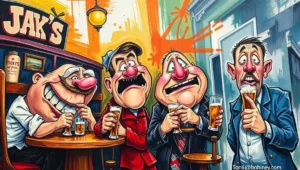
By week’s end, rumours circulated that the government might simply declare the entire high street a pub and be done with it. “It would simplify things,” said one exhausted civil servant. “We could just tax Amazon and let everyone else argue over the snacks.”
For now, Britain stands at the top of the slippery slope, staring downward, clutching a copy of James Joyce, and pretending not to hear the sound of hundreds of businesses shouting, “Oi, what about us?”
The Complete List: 47 Other Businesses Requesting Tax Relief Status
As the debate intensified, a veritable avalanche of small business applications flooded into the Treasury. The following establishments have formally requested pub-equivalent tax relief, each with their own tortured justification:
Personal Services & Wellness
- Barber shops – “We dispense wisdom, judgment, and occasionally spirits-based aftershave”
- Nail salons – “Emotional support with a side of gossip, basically therapy with polish”
- Tattoo parlours – “People make terrible decisions here while mildly intoxicated, exactly like pubs”
- Massage therapy centres – “We provide relief, just like pubs, but with less shouting”
- Tanning salons – “Regret distribution centres with occasional refreshments”
- Weight loss clinics – “Community support groups, tears included”
- Acupuncture studios – “Pain relief and contemplation, the original pub experience”
Retail & Specialty Shops
- Comic book stores – “Gatherings, debates, and people who never leave”
- Record shops – “Musical education and strong opinions, served daily”
- Antique stores – “We’re literally older than most pubs”
- Charity shops – “Community hubs staffed by volunteers who deserve tax breaks”
- Fishing tackle shops – “Lies are told here daily, exactly like pubs”
- Garden centres – “We have cafés, communities, and people crying over dead plants”
- Pet shops – “Emotional support animals require emotional support environments”
- Craft supply stores – “Where dreams go to gather dust, communally”
Food & Beverage Adjacent
- Coffee roasteries – “Caffeine is a drug, we’re basically dealers with community values”
- Tea shops – “Pubs for people who judge pubs”
- Cheese shops – “Wine pairing advice makes us hospitality adjacent”
- Bakeries – “Morning pubs for people in denial”
- Ice cream parlours – “Childhood nostalgia and sugar highs, emotionally equivalent to beer”
- Butcher shops – “Conversations about cuts of meat are inherently philosophical”
Entertainment & Leisure
- Bingo halls – “Gambling, shouting, and occasional beverages – literally pub bingo”
- Bowling alleys – “Pubs with pins”
- Snooker clubs – “Silent pubs for people with cues”
- Escape rooms – “Panic and teamwork, just like pub quiz night”
- Pottery painting studios – “Wine is often involved, ask anyone”
- Trampoline parks – “Injuries and regret, traditional pub outcomes”
- Karaoke venues – “Literally just pubs with microphones, your honour”
Professional & Creative Services
- Photography studios – “We capture memories people made in pubs”
- Printing shops – “Community noticeboards start here”
- Framing shops – “We preserve pub memorabilia”
- Coworking spaces – “Pubs for laptops”
- Music lesson studios – “Noise complaints, just like pubs”
- Dance studios – “Physical exertion leading to thirst, pub pipeline established”
- Art galleries – “Wine at openings counts as hospitality”
Automotive & Technical Services
- Car washes – “Waiting areas with magazines and despair”
- MOT centres – “Bad news delivery with community support”
- Phone repair shops – “Crisis management and emotional support”
- Locksmiths – “We see people at their most vulnerable, like pubs at closing time”
- Dry cleaners – “We fix mistakes made in pubs”
Miscellaneous & Oddities
- Launderettes – “Captive audiences and forced socialisation”
- Post offices – “Queue-based community bonding”
- Parking garages – “Where pub-goers leave their cars”
- Storage facilities – “We house things people can’t bear to part with, extremely pub-like behaviour”
- Funeral homes – “Gatherings, tears, and often alcohol afterwards – we’re basically sad pubs”
- Estate agents – “We crush dreams daily, just like pub landlords raising prices”
- Vape shops – “Pubs for clouds”
- Cryptocurrency advice centres – “Bad decisions made in groups, textbook pub behaviour”
A Treasury spokesperson declined to comment on the list, though sources report the sound of quiet weeping emanating from Whitehall offices late into the evening.
Disclaimer
This article is a work of satire and commentary inspired by current events, public debate, and the proud British tradition of arguing about fairness until the pub closes. It represents a fictionalized interpretation of real discussions and should not be mistaken for official policy guidance, tax advice, or a legally binding definition of what constitutes a pub. This story is entirely a human collaboration between two sentient beings: the world’s oldest tenured professor and a philosophy major turned dairy farmer. Auf Wiedersehen, amigo!

Carys Evans is a prolific satirical journalist and comedy writer with a strong track record of published work. Her humour is analytical, socially aware, and shaped by both academic insight and London’s vibrant creative networks. Carys often tackles media narratives, cultural trends, and institutional quirks with sharp wit and structured argument.
Her authority is reinforced through volume, consistency, and reader engagement, while her expertise lies in combining research with accessible humour. Trustworthiness is demonstrated by clear labelling of satire and an ethical approach that values accuracy and context.
Carys’s work supports EEAT compliance by offering informed satire that entertains while respecting readers’ trust.