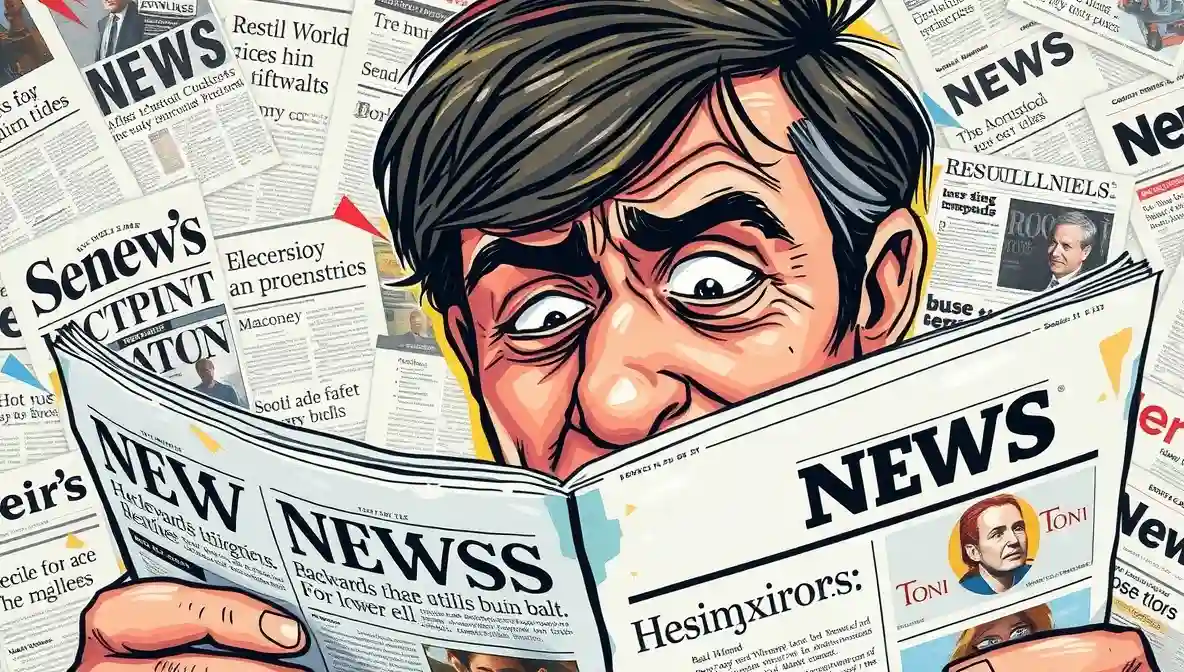
Behavioural research suggests starting with final paragraph reduces anxiety and prepares readers for disappointment
Reading the News Backwards

- People already skim the news; reading it backwards just makes that honest.
- Most articles end by admitting nothing is resolved.
- Headlines are designed to frighten you; conclusions are designed to calm advertisers.
- Reading the last paragraph first saves time and emotional energy.
- Nobody reaches the end of an article unless they are furious or procrastinating.
- Journalists bury uncertainty at the bottom like a courtesy blanket.
- Breaking news is rarely broken, just startled at the top.
- Context is always “developing” by the final paragraph.
- People want answers but will accept disclaimers.
- The news makes more sense once you accept that nothing is finished.
A new behavioural study suggests that reading news articles backwards, starting with the final paragraph and working upward, may reduce anxiety, increase patience, and prepare readers emotionally for disappointment. Researchers describe the practice as “emotionally efficient” and “closer to how people already consume information.”
News Fatigue Concerns

The real-world background involves growing concern over news fatigue, declining trust in media, and the emotional toll of constant alerts. Studies have shown that whilst people feel compelled to stay informed, they are increasingly overwhelmed by the tone and volume of coverage. This new research asked a simple question: what if the problem is order? The study involved several hundred participants who were instructed to read news articles starting with the last paragraph. Researchers found that participants reported feeling calmer, less reactive, and more “emotionally prepared.”
Absorbing Emotional Truth First
Dr Alan Merrick, lead author of the study, explained the logic. “Most articles end with uncertainty,” he said. “By starting there, readers absorb the emotional truth before encountering the chaos.” Indeed, final paragraphs often contain phrases like “it remains unclear,” “experts disagree,” or “the situation is evolving.” These sentences function as soft landings, gently lowering expectations. When read first, they inoculate readers against outrage. Participants reported that once they knew nothing was resolved, the rest of the article felt less threatening. “I already knew it wasn’t sorted,” said one subject. “So the problem didn’t feel personal.”
Tension Building Since 2008
Journalists reacted defensively. “That’s not how stories are structured,” said one editor. “We build tension.” Readers responded by pointing out that tension has been building nonstop since 2008. Media analysts noted that traditional article structure assumes linear engagement according to journalism researchers. Modern readers, however, arrive distracted, sceptical, and emotionally knackered. “People don’t want suspense,” said digital media researcher Dr Paula Nguyen. “They want orientation.” The study also revealed that backward reading reduced doomscrolling. Participants were less likely to click multiple related articles once they had already accepted ambiguity. “They felt informed enough,” Merrick said. “Which terrified publishers.”
Narrative Craft Undermined
Critics argued that the practice undermines journalism by devaluing narrative craft. Supporters countered that narrative craft has been undermined by push notifications. Psychologists explained the appeal. “Anxiety comes from uncertainty,” said Dr Marla Quinn. “If you encounter uncertainty first, the rest becomes manageable.” Participants also reported improved comprehension. Without the emotional spike of headlines, they were better able to process details. “I wasn’t bracing myself,” said one reader. “I was just reading.”
Engagement Metrics Concern

News organisations expressed concern that widespread adoption could reduce engagement metrics. One executive warned that if readers start at the end, they might stop early. Researchers confirmed this was likely and called it “the point.” The cause-and-effect chain is subtle but powerful. Headlines provoke. Bodies react. Context arrives too late. Reverse the order, and the body stays calm. Some readers have already adopted the method instinctively. “I scroll to the bottom first,” admitted one participant. “I need to know if I should care.” Journalism schools have not yet updated curricula. Editors remain hopeful the trend will fade. Readers remain hopeful the news will. The study concludes with a modest recommendation: start where honesty lives. As one participant summarised, “If nothing is resolved, I’d rather know that straightaway.” Media researchers and journalism educators continue studying reader behaviour. Auf Wiedersehen, amigo!
SOURCE: Guardian, Times, Telegraph, Sun, Daily Mail, Mirror, Independent, Financial Times, Observer, Evening Standard, Express, Daily Telegraph, Metro, Daily Mirror

Alan Nafzger was born in Lubbock, Texas, the son Swiss immigrants. He grew up on a dairy in Windthorst, north central Texas. He earned degrees from Midwestern State University (B.A. 1985) and Texas State University (M.A. 1987). University College Dublin (Ph.D. 1991). Dr. Nafzger has entertained and educated young people in Texas colleges for 37 years. Nafzger is best known for his dark novels and experimental screenwriting. His best know scripts to date are Lenin’s Body, produced in Russia by A-Media and Sea and Sky produced in The Philippines in the Tagalog language. In 1986, Nafzger wrote the iconic feminist western novel, Gina of Quitaque. Contact: editor@prat.uk