
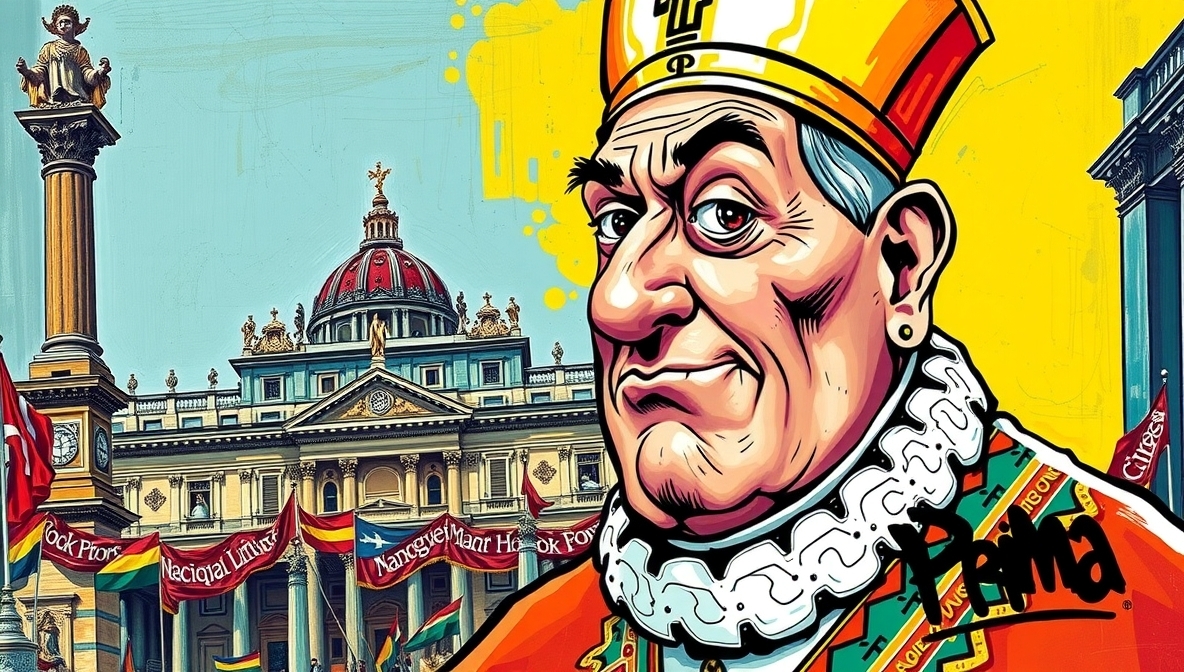
How Pope Alexander VI Turned Vatican Politics Into the Ultimate Family Business
In Renaissance Rome, getting ahead in the Catholic Church didn’t require theological brilliance or spiritual devotion—you just needed to sleep with the right cardinal. Pope Alexander VI, born Rodrigo Borgia, transformed papal politics into a masterclass in nepotism so brazen that it would make modern corporate dynasties blush. While history remembers him for debauchery and corruption, the real scandal wasn’t who warmed the papal bed, but how their relatives ended up running half of Christendom.
The Farnese Fast Track to Cardinal Status
When Giulia Farnese caught the eye of 58-year-old Cardinal Rodrigo Borgia in 1489, she was a 15-year-old newlywed. Her marriage to the “squint-eyed” Orsino Orsini proved no obstacle—in fact, Orsini’s mother actively encouraged the affair, hoping it would benefit her family’s standing. The gamble paid off spectacularly. Within four years of the affair beginning, Giulia’s brother Alessandro Farnese was elevated to the College of Cardinals at age 25, earning him the nickname “Cardinal Petticoat” and less polite variations involving female anatomy.
“I’ve seen corporate ladder-climbing,” said British comedian David Mitchell, “but this is more like a corporate fireman’s pole straight to the executive suite—assuming the fireman’s pole required your sister to date the CEO.”
When Your Sister’s Bedroom Skills Become Your Career Plan
Alessandro’s appointment wasn’t subtle. Court gossip attributed his rapid advancement entirely to his sister’s relationship with Alexander VI, and Alessandro himself was mockingly called the “Borgia brother-in-law” while Giulia earned the sarcastic title “Bride of Christ.” The Venetian nobleman Soriano recorded that Alessandro was derisively known as “Cardinal Pussy”—apparently Renaissance Italians didn’t believe in euphemisms when discussing nepotism.
The arrangement worked beautifully for everyone involved. Giulia received prominence at the papal court and bore Alexander a daughter. Her actual husband got a castle as consolation prize. And Alessandro? He collected benefices, bishoprics, and eventually became Vice-Chancellor of the Catholic Church—the second-most powerful position in the Vatican.
“It’s the ultimate friends-with-benefits program,” noted comedian James Acaster, “except the benefits include controlling half of Italy’s spiritual and temporal authority.”
The Borgia Blueprint for Dynastic Power

Alexander VI didn’t invent papal nepotism—he simply perfected it to an art form that would make the Medici jealous. With his previous mistress Vannozza dei Cattanei, Alexander had fathered at least seven children between 1462 and the early 1490s. Unlike most Renaissance clergymen who quietly acknowledged their bastards, Alexander openly claimed his illegitimate offspring and used the papacy’s resources to establish them as Italian nobility.
Turning Church Property Into Family Real Estate
Alexander’s son Cesare was made a cardinal. Another son, Juan, became Duke of Gandia. The Pope then carved out fiefdoms from the Papal States and the Kingdom of Naples, creating personal kingdoms for his children. This land-grab strategy infuriated King Ferdinand I of Naples, who correctly recognized it as the Pope stealing from Church holdings to establish a Borgia dynasty.
“Imagine if the Archbishop of Canterbury started giving his kids pieces of Westminster Abbey,” said comedian Sara Pascoe. “That’s basically what happened, except with more poisoning and considerably better architecture.”
The Pope’s daughter Lucrezia became a political pawn, married off three times to forge advantageous alliances. Cardinal Ascanio Sforza observed that “many long to marry into the pope’s family via his daughter and he lets many think they have a chance.” Lucrezia’s marriages served as diplomatic tools—when one alliance became inconvenient, Alexander simply annulled the marriage and arranged another.
The Mistress-to-Pope Pipeline That Shaped Counter-Reformation Politics
The ultimate irony of Alexander VI’s scandalous nepotism? It accidentally created one of the Catholic Church’s most significant reform popes. When Alessandro Farnese finally ascended to the papacy as Pope Paul III in 1534, he convened the Council of Trent—the cornerstone of the Counter-Reformation that addressed clerical corruption and Protestant critiques.
From Libertine Cardinal to Reform Pope
Alessandro’s journey from “Cardinal Petticoat” to serious church reformer followed a predictable arc of Renaissance hypocrisy. As a young cardinal, he kept his own mistress, Silvia Ruffini, and fathered four children with her between 1500 and 1510. He didn’t take priestly vows until 1519, when he was 51 years old. But once installed as Pope Paul III, he suddenly remembered that the Church had rules about such things.
“Nothing says ‘I’m ready for spiritual leadership’ quite like spending three decades as a dissolute playboy first,” said comedian Frankie Boyle. “It’s like hiring a former casino owner to run the financial regulator—oh wait, we’ve done that too.”
Paul III’s pontificate was marked by spectacular contradictions. He initiated genuine church reforms while practicing nepotism that would have embarrassed his benefactor Alexander VI. Within two months of becoming pope, he made his own 14-year-old grandson Alessandro a cardinal, then appointed another teenage grandson Guido Ascanio Sforza to the same rank. He carved out the Duchy of Parma and Piacenza from Papal States territory and gave it to his illegitimate son Pier Luigi, establishing a Farnese dynasty that would rule for nearly two centuries.
The Strategic Marriage Market of Papal Families
Alexander VI’s manipulation of marriage alliances demonstrated how Renaissance popes treated family members as strategic assets rather than people. When his daughter Lucrezia wasn’t being strategically married off, she was allegedly managing papal affairs in her father’s absence—supposedly even attending meetings on his behalf. Critics later claimed this access gave her opportunities to poison Borgia rivals, though such accusations were likely exaggerated by enemies of the family.
“It’s like if the President’s daughter started chairing Cabinet meetings,” said comedian John Oliver, “except with considerably more medieval intrigue and substantially fewer ethics regulations.”
When Your Mistress’s Ex Becomes Pope Too
The incestuous nature of Vatican politics reached peak absurdity when Alexander VI’s mistress Vannozza dei Cattanei was revealed to have previously been involved with Cardinal Giuliano della Rovere—who later became Pope Julius II, Alexander’s successor. This made dei Cattanei the mistress of two popes, a distinction that speaks volumes about how Renaissance church politics operated more like an aristocratic dating pool than a spiritual institution.
The Borgia family’s corruption extended beyond sexual scandals to systematic selling of church offices (simony), confiscation of rival families’ property, and alleged murders of political opponents. The Orsini and Colonna families—Rome’s other great noble houses—were systematically subjugated through a combination of imprisonment, property seizure, and strategic violence.
The Legacy of Mistress-Driven Geopolitics
The Borgia-Farnese connection demonstrates how Renaissance papal politics created multigenerational consequences. Alessandro Farnese’s cardinal appointment—secured through his sister’s relationship with Alexander VI—led directly to his 1534 papal election. As Paul III, he wielded enormous influence during the Protestant Reformation’s critical period, shaping Catholic responses that would define the Church for centuries.
“It’s the butterfly effect,” observed comedian Nish Kumar, “except instead of a butterfly flapping its wings in Brazil, it’s a teenage girl sleeping with a cardinal in Rome, and instead of a hurricane in Texas, you get the entire Counter-Reformation.”
The Family Business Model of the Medieval Church
While Alexander VI’s nepotism was spectacular, he wasn’t unique. His uncle Pope Callixtus III had appointed Rodrigo (future Alexander VI) as a cardinal at 25, setting the precedent. The practice was so common that it barely raised eyebrows—what made Alexander notorious was the sheer scale and shamelessness of it. He appointed at least ten relatives to the College of Cardinals and used his daughter as a diplomatic asset through strategic marriages.
The 1492 papal conclave that elected Alexander VI was reportedly one of the most expensive in history, with Borgia deploying “four mule loads of silver” in bribes to secure votes. His rival, Cardinal della Rovere, was backed by the King of France with 200,000 gold ducats. The message was clear: spiritual authority could be purchased like any other commodity in Renaissance Rome.
When Corruption Accidentally Produces Reform
Perhaps the greatest irony in this saga of mistresses, nepotism, and political manipulation is that it ultimately contributed to church reform. Alessandro Farnese, who owed his entire career to his sister’s affair with a corrupt pope, eventually broke from his dissolute lifestyle, took genuine holy orders, and became a serious church administrator. His papal reign included establishing the Inquisition, condemning slavery, and convening the Council of Trent—reforms that addressed many of the abuses his own family had exploited for generations.
“It’s like if Bernie Madoff’s nephew became head of the SEC and actually did his job,” said comedian Hannah Gadsby. “Technically possible, but it doesn’t erase how he got there in the first place.”
The Price of Selling the Papacy
The Borgia papacy represented everything critics of the Catholic Church despised: simony, nepotism, sexual impropriety, political violence, and treating the Church as a family business. Yet from this moral swamp emerged institutional changes that would define Catholicism for the modern era. The Council of Trent’s reforms, the establishment of the Jesuits, and the Counter-Reformation’s theological clarifications all emerged during or shortly after this period of spectacular corruption.
The context for understanding this paradox: Renaissance Rome operated under different rules than the modern world. Nepotism wasn’t scandalous—it was expected. Cardinals having mistresses was unremarkable. What made the Borgias notorious wasn’t that they broke rules, but that they broke them so enthusiastically and on such a grand scale that even jaded Renaissance Italians were impressed.
The Enduring Question of Merit Versus Connection
The Borgia-Farnese saga raises uncomfortable questions about how power structures perpetuate themselves. Alessandro Farnese was reportedly intelligent, educated, and capable—but would he have become Pope Paul III without his sister’s relationship with Alexander VI? Would he have received a cardinal’s appointment at 25 based purely on merit? The historical record suggests not.
“Every corporate executive whose dad knew the CEO can relate to this,” said comedian Michelle Wolf, “except Alessandro’s dad didn’t know the CEO—his sister knew the CEO in a very different way entirely.”
The legacy of Renaissance papal corruption ultimately proved that institutional rot can coexist with genuine reform, that the morally compromised can still advance important causes, and that family connections will always matter more than merit when power is concentrated in small, self-selecting groups. Whether in 15th-century Rome or modern corporate boardrooms, some truths remain constant: it’s not what you know, it’s who your relatives know. Or in Giulia Farnese’s case, who your relatives know.
Auf Wiedersehen, amigo!

Alan Nafzger was born in Lubbock, Texas, the son Swiss immigrants. He grew up on a dairy in Windthorst, north central Texas. He earned degrees from Midwestern State University (B.A. 1985) and Texas State University (M.A. 1987). University College Dublin (Ph.D. 1991). Dr. Nafzger has entertained and educated young people in Texas colleges for 37 years. Nafzger is best known for his dark novels and experimental screenwriting. His best know scripts to date are Lenin’s Body, produced in Russia by A-Media and Sea and Sky produced in The Philippines in the Tagalog language. In 1986, Nafzger wrote the iconic feminist western novel, Gina of Quitaque. Contact: editor@prat.uk