Playing London Casino Games In Vain: A Study in Elegant Financial Disappearance 🎰💷
Five Quick Observations Before the Money Is Gone
- People enter London casinos with confidence and exit with stories they tell like war memoirs.
- Every gambler believes they are one spin away from becoming a personality change.
- Math is respected, admired, and then completely ignored.
- Hope is the most expensive commodity on the casino floor.
- Everyone leaves convinced the casino was lucky, not good.
Confidence Is the First Chip to Disappear

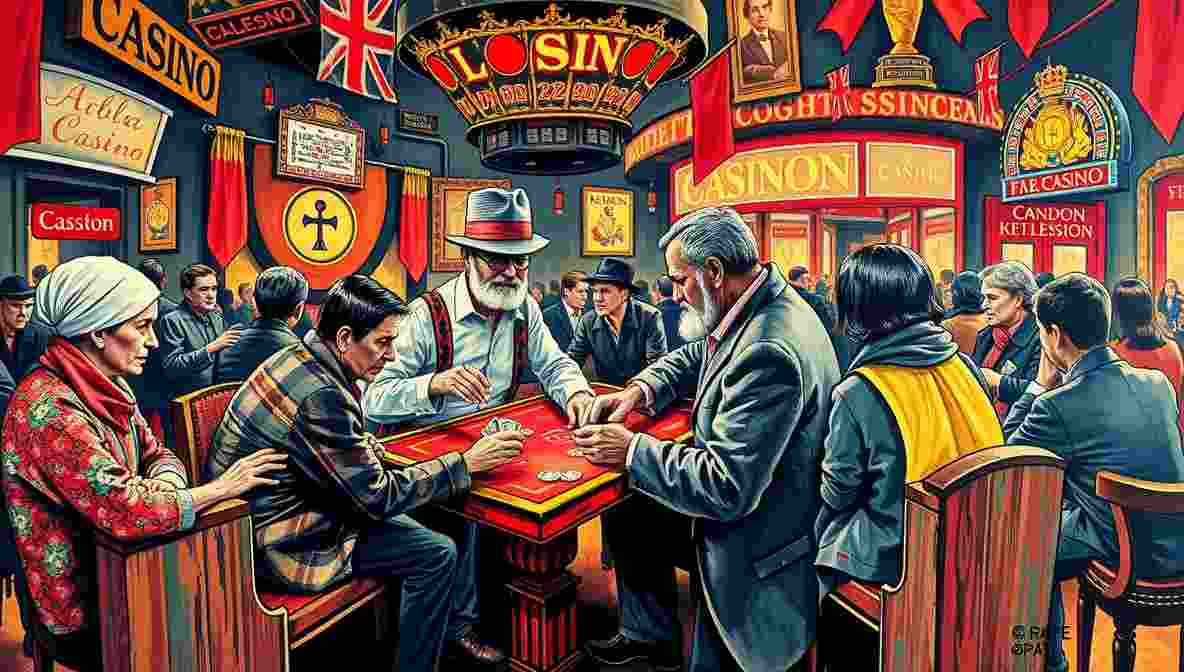
The London casino experience begins with posture. Not luck. Posture. Shoulders back, chin up, wallet brave. People walk in like diplomats arriving at a summit, convinced this will be a measured exchange of capital and dignity. Five minutes later, dignity is negotiating a quiet exit through the gift shop.
There is something uniquely British about losing money with confidence. In other countries, gambling looks frantic. In London, it looks polite. A man can lose three hundred pounds at a blackjack table and still thank the dealer for the privilege. The money vanishes quietly, like it had other plans and didn’t want to cause a scene.
Psychologists call this optimism bias. Casino regulars call it “having a feeling.” Studies show that confidence increases right before a loss, which explains why casinos are filled with people who look absolutely certain they are wrong. London casinos don’t exploit confidence; they let it self-destruct naturally.
This is not reckless spending. This is ceremonial disposal of funds.
Glamour Promised, Regret Delivered
Casino advertising suggests you will be surrounded by glamour, champagne, and attractive strangers who find probability irresistible. The reality is more educational. Glamour is replaced by lighting designed to flatter nobody and chairs that suggest you’ll be here longer than planned.
People dress as if luck respects outfits. There is always someone wearing a blazer clearly purchased for this moment, paired with shoes that say, “I didn’t plan on walking home thinking about this.”
The regret arrives early. It shows up right after the first loss, standing quietly beside you like a concerned accountant who has given up trying to help. Yet everyone pushes forward, because glamour, once promised, must be earned retroactively.
Marketing experts explain that aspirational environments increase spending. Casino experts explain nothing and keep refilling the glasses.
“In Vain” Is Not a Phrase, It Is a Budget Category
The phrase “in vain” sounds poetic until you see it itemized on a bank statement. In London casinos, money doesn’t disappear accidentally. It is sacrificed with intention. Each bet is a small speech that begins with, “This will fix everything.”
Economists define sunk cost fallacy as the inability to stop investing in something because you’ve already invested so much. Gamblers define it as “getting close.” London casinos are temples built entirely around this misunderstanding.
People continue not because they expect to win, but because stopping would mean admitting the money didn’t go anywhere useful. Losing “in vain” is preferable to losing “for nothing,” which is why people will lose twice as much to justify the first loss.
The casino doesn’t rush you. It knows time is an ally. Sooner or later, “in vain” feels like a plan.
Slot Machines Are Emotional Freelancers

Slot machines do not steal money. They freelance. They accept short-term contracts funded entirely by hope. Each spin feels like a negotiation, even though the machine has already decided not to care.
The lights flash just enough to suggest effort. The sounds celebrate outcomes that mean absolutely nothing. A near miss feels like encouragement when it is mathematically identical to a total failure. London casinos excel at this illusion because they understand restraint. Too much noise would feel American. Here, disappointment is tasteful.
Behavioral scientists note that intermittent rewards are more addictive than consistent ones. Slot machines are essentially emotional consultants billing by the second. They do not promise success. They promise suspense, which costs more.
People insist they are “up earlier,” as if slot machines maintain emotional ledgers.
Roulette and the Physics of Optimism
Roulette wheels spin with the authority of fate. People stare as if concentration might bend physics. Someone always announces they feel red coming. This is not intuition. This is loneliness seeking validation.
The roulette table is a live demonstration of cause-and-effect denial. The ball does not remember previous spins. Humans insist it should. The phrase “it has to land on black eventually” is spoken with religious conviction, despite centuries of evidence suggesting otherwise.
Physicists explain randomness clearly. Gamblers explain it emotionally. London casinos side with the physicists quietly while letting the gamblers finish their speeches.
Every spin is treated like a conversation with destiny. Destiny never replies.
Chips Feel Heavier Than Cash for a Reason
Casino chips weigh nothing, yet they feel heavier than money. This is psychological design. Chips remove the emotional sting of cash. Losing chips feels like misplacing tokens. Losing cash feels like adulthood.
London casinos use chips like emotional insulation. Once money becomes plastic, people gamble with posture instead of caution. The clack of chips is soothing, rhythmic, and vaguely encouraging.
Anthropologists would note that chips function like ritual objects. They separate the gambler from reality just long enough to feel brave. The moment chips are exchanged back for cash, the weight returns, usually accompanied by silence.
Nobody ever says, “I lost chips.” They say, “I was down.”
Systems Exist Only to Collapse
Every gambler has a system. The system is always explained with diagrams, hand gestures, and phrases like “statistically speaking.” Systems work beautifully until they don’t, which happens immediately.
London casinos are filled with people running complex algorithms against simple facts. Probability does not negotiate. Systems are not strategies. They are coping mechanisms dressed as intelligence.
The moment someone says, “Trust me,” the system has already failed. The casino listens patiently. It has heard this speech before.
Mathematicians explain that past outcomes do not influence future ones. Gamblers explain that math hasn’t seen what they’re about to do.
Advanced Math, No Subtraction
Casinos are the only places where people perform advanced calculations while actively avoiding subtraction. Players know exactly how much they could win and refuse to calculate how much they have lost.
This selective arithmetic is not ignorance. It is optimism with boundaries. London gamblers can calculate odds down to decimal points but cannot locate yesterday’s balance.
Psychologists call this motivated reasoning. Casinos call it loyalty.
People leave convinced they were “almost ahead,” which is not a financial category recognized anywhere else.
“I’m Due” Is a Personality Trait
“I’m due” is said with confidence unmatched by any profession. Doctors hedge. Engineers hedge. Gamblers announce destiny owes them money.
The belief that luck keeps score is deeply human. London casinos monetize this belief gently. They do not correct it. They encourage pauses long enough for the idea to grow stronger.
Research shows humans are pattern-seeking creatures. Casinos provide patterns that look meaningful and are not. Being “due” feels fair, even though fairness does not apply.
Luck does not have memory. Gamblers insist it has manners.
Chasing Losses Is a Debate With Gravity
Watching someone chase losses is watching an argument with physics. Each bet is louder than the last, as if volume might convince reality to change its mind.
London gamblers chase losses quietly, with resolve and disappointment wrapped in politeness. There is no shouting. There is just determination wearing regret.
Financial advisors warn against emotional investing. Casinos provide the environment for exactly that. The more someone loses, the more important it feels to continue.
Gravity remains unmoved.
Free Drinks Are Emotional Padding
The drinks are free, which is generous, because they need to be. Alcohol does not improve odds. It improves narratives. After a few drinks, losses feel temporary and decisions feel inspired.
London casinos serve drinks with discretion. Not enough to cause chaos. Just enough to soften judgment. It is not bribery. It is ambiance.
People insist they play better relaxed. Data disagrees. The casino does not interrupt.
Paying for Suspense
Casinos prove humans will pay for suspense even when the ending is predictable. The thrill is not winning. It is almost winning. Almost is expensive.
London casinos offer suspense with dignity. The atmosphere suggests importance. Losing feels like participation in something larger than your bank account.
Entertainment economists note people pay more for experiences than outcomes. Casinos offer an experience where the outcome is optional.
Subscriptions to Disappointment

Money is not lost all at once. It is donated gradually, like a subscription service you forget to cancel. Each bet feels small. The total never does.
London casinos excel at slow loss. There are no alarms. No urgency. Just time and comfort.
People say they lost track, as if the money wandered off.
The One Winner Everyone Notices
There is always someone who wins big. Casinos do not hide them. They are proof of possibility. They are also statistical camouflage.
For every winner, dozens leave quietly. Humans notice the exception. Casinos rely on this.
London winners celebrate modestly. They know too much joy attracts attention.
Leaving Feels Like Honor
Leaving a casino feels noble. Even when broke, people exit with posture. It feels like retreat, not defeat.
The machines do not react. They are ready for the next person.
Disclaimer
This article is satire. Any resemblance to actual losses, personal bank statements, or moments of quiet reflection outside a London casino is entirely intentional. This story is a human collaboration between two sentient beings: the world’s oldest tenured professor and a philosophy major turned dairy farmer, both of whom agree that probability is undefeated, dignity is optional, and the house always waits patiently.
Auf Wiedersehen.
END NOTES
-
Gambling Survey for Great Britain (official stats on gambling behaviour and attitudes) — provides robust evidence on how people gamble and the risks involved. Gambling Survey for Great Britain statistics and research (UK Gambling Commission)
-
2024 Gambling Survey for Great Britain report — recent data showing gambling participation, positive/negative experiences, and proportion scoring high on problem gambling indices. 2024 Gambling Survey for Great Britain published (UKGC)
-
GambleAware analysis of casino play patterns in Great Britain — shows the distribution of heavy player losses in casino-style games like slots and the scale of net losses. Analysis of play among British online gamblers (GambleAware)
-
Relative risk of gambling products in Great Britain — details research finding casino games (after EGMs) pose high risk for gambling harm. Relative risk of gambling products within Great Britain (GambleAware)
-
Exploring relationship between gambling activities and problem-gambling scores — UK report showing casino participation is significantly associated with high scores on the Problem Gambling Severity Index (PGSI). Exploring the relationship between gambling activities and PGSI scores (UKGC)
-
Gambling-related harms quantitative evidence review (UK) — government analysis of prevalence and harms associated with gambling in England. Gambling‑related harms evidence review summary (UK Govt)
-
Study on house-edge information and subjective odds — research showing how house-edge and return-to-player info affects understanding of losses, demonstrating long-term disadvantage. House‑edge vs return‑to‑player warning labels study (ResearchGate)
-
Near-miss effect in gambling psychology — explanation of how near misses (common in slot and casino play) can mislead players and encourage continued betting. The near‑miss effect in gambling (Wikipedia)
-
Between-session chasing of losses vs wins — behavioural science study showing how gamblers return to play after losses (loss chasing), a factor in repeated and often unproductive gambling sessions. Chasing losses behaviour in gambling sessions (PMC)
-
UK Gambling Commission estimate on problem gamblers — news report summarising official UKGC estimates that roughly 1.4 million adults in Britain are classified as problem gamblers, many driven by risky games including casino play. 1.4m Brits have a gambling problem (Guardian summary)

Alan Nafzger was born in Lubbock, Texas, the son Swiss immigrants. He grew up on a dairy in Windthorst, north central Texas. He earned degrees from Midwestern State University (B.A. 1985) and Texas State University (M.A. 1987). University College Dublin (Ph.D. 1991). Dr. Nafzger has entertained and educated young people in Texas colleges for 37 years. Nafzger is best known for his dark novels and experimental screenwriting. His best know scripts to date are Lenin’s Body, produced in Russia by A-Media and Sea and Sky produced in The Philippines in the Tagalog language. In 1986, Nafzger wrote the iconic feminist western novel, Gina of Quitaque. Contact: editor@prat.uk