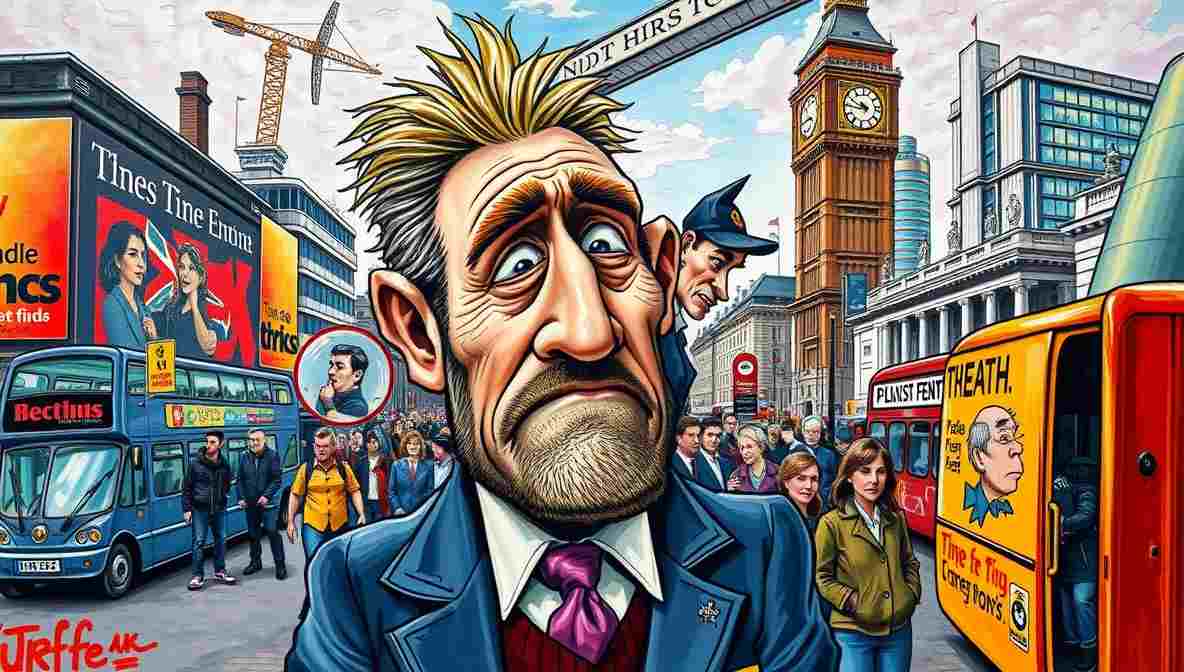
London Headlines Explained: The News That Never Actually Changes
London does not so much generate news as recycle it with confidence. The city wakes each morning, checks what was confusing, expensive, broken, or mildly alarming yesterday, and reissues it with the word “new” somewhere near the top.
What follows is not a parody of London headlines, but an interpretive guide—because after a while, the city stops reporting events and starts reporting vibes.
Transport Disruption: London’s Most Reliable Service
“London Faces Transport Disruption” appears so frequently it should be preloaded into news websites, ready to go before the problem has even occurred. Transport disruption in London is not an emergency; it is the default setting.
The cause is usually “a signal failure,” a phrase that sounds technical but actually means something somewhere stopped believing in itself. Occasionally, the disruption is blamed on weather, even when that weather is “autumn.” One suspects the signals are powered by optimism, which runs out around 8:47 AM daily.
Londoners respond by checking three apps, ignoring all of them, and boarding the wrong train anyway. No one is surprised. No one is refunded. The disruption ends sometime after everyone has arrived late, which BBC London reports as “normal service resumed.”
Property Prices Reach Heights Previously Reserved for Hot Air Balloons
This headline is delivered annually with the solemnity of a royal announcement. Property prices have reached a new high, again, shocking experts who predicted exactly this last year while professionally forgetting they said the same thing in 2015.
The article will include a photo of a flat that appears to be one room, one emotion, and one existential compromise. The estate agent describes it as “ideal for professionals,” meaning someone with no hobbies, no furniture wider than a yoga mat, and a high tolerance for regret.
London property journalism exists to reassure homeowners they are geniuses and renters that character is built through suffering. The photos always show impossibly tidy spaces, suggesting the current tenant either doesn’t own things or has achieved enlightenment.
Mayoral Plans: Bold, New, and Suspiciously Familiar
Every London mayor unveils bold plans in the same way: carefully, cautiously, and with several escape clauses hidden in the appendices.
The plan is ambitious. The timeline is vague. The funding is “under review,” which is bureaucratic code for “we haven’t asked yet.” A consultation period is announced, during which Londoners will shout at each other online while nothing physically happens beyond the creation of a PDF.
The plan will later be delayed, revised, renamed, and quietly absorbed into another initiative with a logo that looks like a child’s drawing of optimism. Previous examples include “Vision 2020” (it didn’t happen) and “Future London” (still pending).
Tourist Invasion: The Annual Migration Pattern
This headline is seasonal, much like hay fever and despair.
Tourists arrive with suitcases, enthusiasm, and an unshakeable belief that Oxford Street is “iconic” rather than “a crowded monument to capitalism’s most boring impulses.” Londoners respond by rerouting their lives around entire neighbourhoods, treating Zone 1 like a nature preserve they observe from a distance.
The article frames tourism as an economic necessity while avoiding the human cost: commuters stuck behind families walking six abreast, stopping suddenly to photograph Pret as though they’ve discovered a rare species. The queues for the Tower of London snake around buildings like a very slow, very expensive conga line.
Knife Crime Debate: The Argument That Never Ends
This headline appears whenever something serious happens, which is often. The “debate” involves politicians expressing concern, commentators arguing past each other, and social media producing the worst possible takes within minutes.
The article itself offers statistics without context, quotes without solutions, and a sense that this has all happened before—which it has. Someone will inevitably blame music videos. Someone else will blame austerity. Both may be right. Nothing changes.
The debate sparks. It does not resolve. The headline returns, punctual as the Northern Line isn’t.
London Nightlife: Dying While Keeping Everyone Awake
London nightlife is always on the brink, according to headlines. Every year, another venue closes, another is saved by a last-minute campaign, and another becomes luxury flats with a jazz-themed name like “The Blue Note Residences.”
The article mourns culture while noting noise complaints from people who moved next to a club and were shocked to discover sound. These residents apparently purchased property based solely on daytime viewing and were horrified to learn that nightlife happens at night.
London nightlife is both dying and impossible to sleep through, depending on which side of the wall you live on. It’s Schrödinger’s entertainment district.
Weather Warnings: When Tuesday Becomes Breaking News
London journalism treats weather like a personal betrayal.
A yellow warning is issued for rain, which Londoners experience as Tuesday. Umbrellas are forgotten, coats are misjudged, and everyone complains as if this was unforeseeable despite living on an island in the North Atlantic.
The Met Office warning implies danger. The reality is damp inconvenience and emotional overreaction. Somewhere, a commuter is photographing a puddle with the caption “London can’t cope.”
New Trends and the Manufactured Division Industry
Londoners are divided over everything, which is impressive given how rarely they speak to one another.
The “division” usually consists of one person liking something and another finding it annoying. This is elevated into a cultural rift through careful quoting of three people on Twitter, one of whom may be a bot.
The trend itself disappears within weeks, replaced by a new thing to argue about. The division remains, spiritually, like a philosophical inheritance passed down through generations of disgruntled commuters.
Historic Areas and the Heritage Demolition Dance
London’s history is routinely discovered moments before demolition.
An area is described as “historic,” “beloved,” and “full of character.” A developer promises to “respect the heritage” while releasing images of glass buildings that resemble expensive toasters designed by someone who’s never eaten bread.
The history is preserved via naming rights. A Victorian warehouse becomes “The Old Warehouse Luxury Apartments,” where the only Victorian element is the price. The soul is value-engineered out, replaced by communal roof terraces no one uses because it’s always raining (see: Weather Warning).
Cost of Living Crisis: The Permanent Temporary Emergency
The cost of living crisis is reported as though it has just arrived on the Eurostar, rather than been quietly living here for years, paying exorbitant rent and complaining about Tube fares.
Articles feature Londoners “cutting back,” which ranges from skipping holidays to skipping meals, depending on postcode. Experts explain inflation using graphs. Readers nod grimly while calculating whether they can afford both heating and eating this month.
Nothing changes except the price of everything, which rises with the confidence of property values and mayoral ambitions.
Fashion Week Returns: The Annual Clothes Confusion
Fashion Week temporarily turns parts of London into a performance art piece where the audience isn’t sure if they’re being pranked.
Headlines celebrate creativity while readers squint at photos wondering if trousers are optional now or if they missed a memo. Normal clothes are suspended. Black returns afterward, undefeated and unchallenged, like a reigning champion who never left.
Fashion Week promises bold futures. Retail delivers beige, on sale, three months later.
Protests and the Disruption Within Disruption
The protest is framed as a disruption rather than an expression, despite London traffic being permanently disrupted anyway by roadworks, signal failures, and the existential weight of living in an expensive city.
Drivers complain about being delayed by activism, unaware they would have been delayed by roadworks regardless. The protest route could be replaced with a three-hour podcast and the traffic impact would be identical.
The article includes phrases like “chaos” and “gridlock,” even when everyone eventually gets home, annoyed but unchanged. Democracy, apparently, should be quieter and less inconvenient.
Crime Statistics and the Geography of Fear
This headline avoids naming boroughs until the reader is emotionally invested, like a thriller with terrible pacing.
Maps appear. Fear spreads unevenly. Commenters announce they “knew it,” despite having no prior knowledge. Others insist it’s worse somewhere else, beginning the traditional British sport of competitive misery.
Context is sacrificed for clicks. Anxiety does the rest. Someone’s cousin’s friend definitely saw something once, which becomes evidence in the court of local Facebook groups.
Hidden Gems and the Paradox of Discovery
The moment something is described as hidden, it is over.
The article reveals cafés, parks, or markets previously enjoyed by locals who will now complain quietly while waiting in newly formed queues. The gem becomes a queue. The queue becomes content. The content becomes another article about London’s “authentic” spots, completing the circle of destruction.
London continues to hunt for authenticity while aggressively destroying it, like an archaeologist with a wrecking ball.
Experts Warn: London’s Permanent Crossroads
London has been at a crossroads for decades and keeps driving straight through it, honking at cyclists.
Experts warn. Think tanks publish reports no one reads. Panels discuss on radio shows no one under 50 listens to. Nothing decisively happens beyond the generation of more content about how nothing is happening.
The crossroads remains symbolic, much like most solutions, existing in a quantum state of urgent and ignorable.
Tomorrow’s News, Today: The Eternal Return
London headlines persist because they describe a city in permanent motion and permanent stasis, like a very expensive treadmill everyone’s contractually obligated to use.
Everything changes. Nothing resolves. Transport fails. Property rises. Plans are unveiled. Tourists arrive. The weather betrays. And tomorrow’s headlines are already written—waiting patiently in a CMS somewhere for the city to do what it always does: recycle the news with confidence and call it breaking.
Auf Wiedersehen, amigo!
🔗 Best London Headline News Sites
1. Evening Standard – London News
Get the latest breaking London headlines covering news, culture, business, and local events.
2. ITV News London
Regional TV news focused on London and the Home Counties, with political, cultural, and human-interest reporting.
3. MyLondon – London News & Stories
A hyperlocal news site covering borough-by-borough London stories, traffic, community and lifestyle.
4. The Guardian – London News Section
London-focused reporting from an internationally influential news brand, including politics and culture.
5. The Sun – London News
Popular tabloid with lively London updates, events, and big headline stories.
6. The Independent – London News
Breaking news and features with regular London coverage and national politics.
7. The Times – UK & London Headlines
Major UK news outlet based in London with comprehensive national and capital coverage.
📌 Bonus Regional & Media Insights
8. ITV News – Main UK Headlines (Regional + National)
While broader UK, this site includes London features and links to the regional London feed.

Alan Nafzger was born in Lubbock, Texas, the son Swiss immigrants. He grew up on a dairy in Windthorst, north central Texas. He earned degrees from Midwestern State University (B.A. 1985) and Texas State University (M.A. 1987). University College Dublin (Ph.D. 1991). Dr. Nafzger has entertained and educated young people in Texas colleges for 37 years. Nafzger is best known for his dark novels and experimental screenwriting. His best know scripts to date are Lenin’s Body, produced in Russia by A-Media and Sea and Sky produced in The Philippines in the Tagalog language. In 1986, Nafzger wrote the iconic feminist western novel, Gina of Quitaque. Contact: editor@prat.uk