Huawei Announces Phone Now 60% Chinese Parts; Other 40% Listed as “Don’t Worry About It” 📱🌏
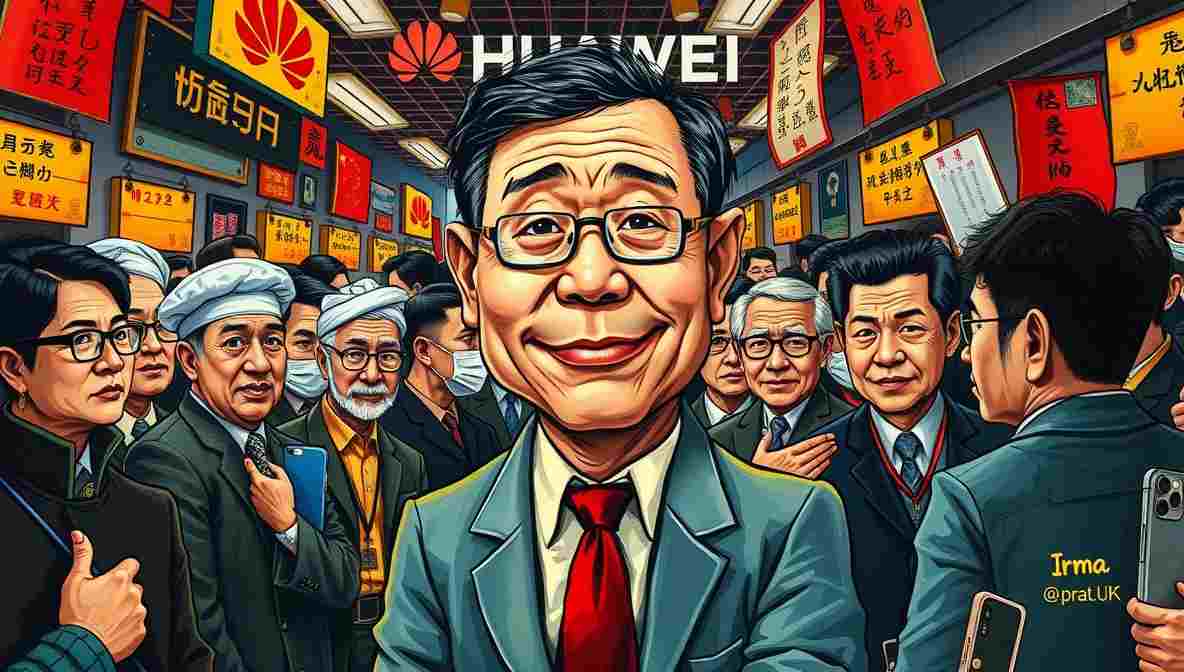
SHENZHEN — At a glossy product launch featuring laser lights, orchestral techno, and a PowerPoint slide that simply read “Trust Us,” Huawei proudly unveiled its newest smartphone this week, announcing it is now made with “a full 60% Chinese components,” while the remaining 40% was described as “emotionally international.”
Company executives reassured reporters that the mysterious portion of the device was “mostly vibes, probably some screws, and one chip we found in a drawer.” (The drawer was labeled “Miscellaneous 2019” and nobody remembers who put it there.)
“We believe in transparency,” said Huawei spokesperson Lin Wei, standing in front of a giant rotating phone graphic labeled Mostly Local-ish. “That is why we clearly disclosed the 60%. The other 40% is on a need-to-not-know basis.”
Supply Chain, But Make It Interpretive Dance 🕺
Industry analysts say the announcement marks a bold step in what economists are now calling “geopolitical ingredient labeling,” similar to food packaging but with more espionage anxiety.
Dr. Martin Feldspar, a global trade expert at the Institute for Extremely Concerned Commerce, explained the situation carefully.
“In the modern tech ecosystem, a phone is like a smoothie made in five countries, blended in another, then shipped through three more while someone argues about tariffs,” Feldspar said. “The fact that they can confidently identify 60% is actually impressive. I cannot even identify 60% of what is in a hot dog.” (Or what’s in those chicken nuggets shaped like dinosaurs, but that’s a conversation for another day.)
A recent poll conducted by the Shenzhen Consumer Confidence Karaoke Club found that 48% of respondents said they were “comfortable” with the 60% figure, 22% said “numbers are a social construct,” and 14% asked if the phone still has a good camera.
The Mysterious 40% 🔍
When pressed about the remaining components, Huawei representatives unveiled a helpful pie chart labeled:
- Chinese Parts: 60%
- Global Cooperation: 15%
- Trade Secrets: 10%
- Stuff Greg Ordered: 8%
- “Miscellaneous Freedom Elements”: 7%
Greg, later identified as a mid-level procurement manager, declined to comment but was seen quietly deleting emails.
An anonymous staffer whispered to reporters, “Look, every company has a Greg. Greg means well. Sometimes Greg just clicks ‘express shipping’ on destiny.” (Greg’s LinkedIn profile still lists “Strategic Component Acquisition” as a core competency.)
International Reactions 🌍
U.S. lawmakers responded to the announcement with their traditional bipartisan ritual of yelling on television.
One senator stated, “If we cannot identify every atom in that phone, how do we know it is not made of… ideas?” before demanding a subcommittee hearing on metaphysical components.
Meanwhile, European regulators released a 900-page preliminary framework titled Proposed Guidelines for Conceptual Percentages in Consumer Electronics, which nobody has read but everyone agrees sounds very responsible.
Consumers Mostly Just Want Battery Life 🔋
Outside a Huawei store in Shanghai, customers appeared less concerned with geopolitical supply chains and more focused on practical matters.
“I just want the battery to last all day,” said local shopper Mei Zhang. “If the other 40% is optimism and mystery, that is fine. My last phone was 100% disappointment.”
A university student added, “Every brand hides something. At least this one gave us a percentage. My ex never even gave me that.” (Brutal honesty: the student is not wrong.)
Experts Confirm This Is How Everything Works Now 🧠
Professor Elena Ruiz, who studies global manufacturing at the University of Barcelona, says Huawei may have accidentally invented the most honest tech marketing of the decade.
“Nothing is purely from one place anymore,” Ruiz explained. “Cars, computers, even kitchen blenders are international soap operas. This phone just admitted it out loud.”
She paused before adding, “Honestly, I am 60% sure where my own laptop comes from. The other 40% feels emotionally Swiss.”
What the Funny People Are Saying 🎤
“If my phone is only 60% from one country, that means 40% of my autocorrect mistakes are foreign policy,” said Jerry Seinfeld.
“I do not care where the parts come from. I just want my phone to stop listening when I talk about snacks,” said Ron White.
“Sixty percent local, forty percent ‘mind your business’ is also how I describe my personality,” said Amy Schumer.
The Future of Honest Vagueness ✨
Market researchers predict other companies may follow Huawei’s lead. Rumors suggest upcoming labels such as:
- “Battery: 70% lithium, 30% ambition”
- “Screen: 80% glass, 20% shattered dreams”
- “AI Features: 50% algorithm, 50% guesswork”
For now, Huawei stands by its math.
“Our phone reflects the modern world,” spokesperson Lin said in closing. “Connected, complex, and partially none of your concern.”
Consumers nodded, took selfies with the new camera, and immediately forgot everything except whether it comes in blue.
Because at the end of the day, global trade may be complicated, but the real question remains simple.
Does it have a good camera, and can it survive being dropped in the bathroom? 🚽📸
(The answer is maybe, and probably not, respectively.)
Auf Wiedersehen, amigo!

Alan Nafzger was born in Lubbock, Texas, the son Swiss immigrants. He grew up on a dairy in Windthorst, north central Texas. He earned degrees from Midwestern State University (B.A. 1985) and Texas State University (M.A. 1987). University College Dublin (Ph.D. 1991). Dr. Nafzger has entertained and educated young people in Texas colleges for 37 years. Nafzger is best known for his dark novels and experimental screenwriting. His best know scripts to date are Lenin’s Body, produced in Russia by A-Media and Sea and Sky produced in The Philippines in the Tagalog language. In 1986, Nafzger wrote the iconic feminist western novel, Gina of Quitaque. Contact: editor@prat.uk