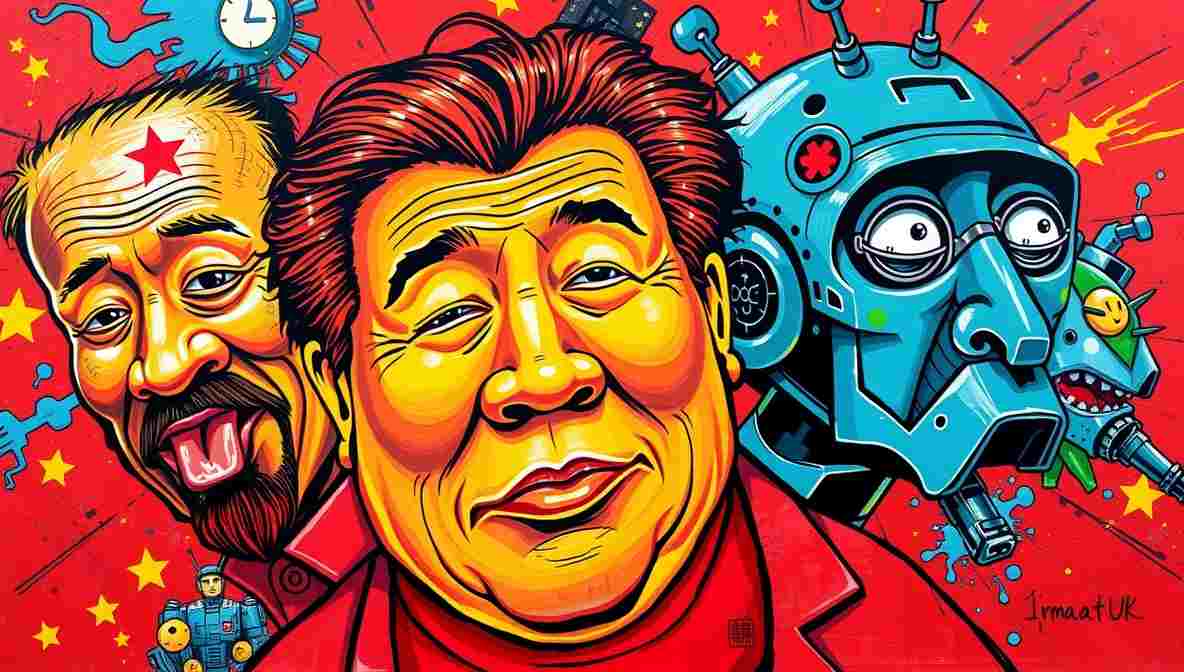
China Will Clinch the AI Race (According to Everyone Who Has Ever Lost a Marathon)
The Financial Times has calmly informed the world that China will probably win the AI race, which immediately caused Silicon Valley to spill oat milk across several standing desks. The phrase “AI race” alone is enough to make investors hyperventilate, because nothing terrifies markets more than the idea that someone else might automate first.
China is apparently winning because it treats artificial intelligence the way Costco treats mayonnaise: buy it in bulk, stack it to the ceiling, and dare anyone to complain. America keeps bragging about “the best models,” which is adorable, because history shows the winner is usually the country that figured out how to sell the second-best thing everywhere.
The Marathon Metaphor: When Nobody Knows Who’s Actually Ahead
Experts insist this race is not a sprint, but a marathon. This metaphor is comforting because no one watching a marathon actually knows who is winning until the end, which is perfect for pundits who also do not know.
The US is sprinting while China is jogging calmly, occasionally stopping to build a dam, a factory, and a new university. The AI race has officially entered the “marathon metaphor” phase, which is what happens when no one knows who’s actually ahead.
According to economists, engineers, think tanks, leaked memos, and a guy who once worked at Huawei but now runs a cafe in Singapore, China’s advantage is not brilliance. It is logistics. And logistics has beaten brilliance in every war, election, and group project since the beginning of time.
Innovation vs Diffusion: Who Actually Uses the Thing

American companies like OpenAI, Google, and Anthropic sit at the frontier, which is a romantic word meaning “expensive.” Their models are extraordinary. They can write poetry, code, legal briefs, and apologies faster than any intern alive.
America invented the frontier model, patented it, lawyered it, and monetized it. China asked, “Can we just use it everywhere?” US tech firms keep saying, “But our chips are better,” which is the same thing BlackBerry said right before the iPhone showed up.
China’s models, meanwhile, are described as “good enough,” which is the most dangerous phrase in capitalism. According to Artificial Analysis, Chinese models are narrowing the gap, largely by refusing to care about prestige.
Dr. Liang Wenbo, senior fellow at the Shenzhen Institute for Computational Pragmatism, explains it simply: “Perfection is inefficient. Adequacy scales.” He said this while standing in front of a factory that had already trained three models during the interview.
China doesn’t need the best chips if it can simply outnumber the problem with engineers. A leaked survey of Chinese developers found that 68 percent preferred models that “worked everywhere” over models that “won benchmarks but needed supervision like a toddler.”
Open Source AI: America’s Favorite Nightmare
China’s lead in open-source AI has unsettled US firms, who are used to monetizing curiosity itself. Open models allow developers to adapt, retrain, and deploy locally, which removes three layers of subscription fees and one motivational keynote.
Open-source AI scares Silicon Valley the way potluck dinners scare hedge fund managers: nobody knows who made it, but it works suspiciously well. US policymakers discovered too late that banning exports doesn’t stop ideas, it just makes them travel economy.
An MIT-Hugging Face study found China now accounts for the largest share of global open-model downloads. An anonymous US executive reacted by saying, “That doesn’t count,” which experts confirmed does not stop reality.
Brad Smith of Microsoft warned that Chinese models are spreading rapidly across emerging markets. A Bolivian software engineer interviewed on a grainy phone video said, “It works offline and doesn’t lecture me.”
Chips, Energy, and the Forgotten Problem of Physics
The US still dominates advanced AI chips. Nvidia’s silicon is the crown jewel of modern geopolitics. Unfortunately, chips need electricity, and electricity needs infrastructure, and infrastructure needs patience, which is not currently traded on the Nasdaq.
Silicon Valley keeps building smarter AIs while forgetting electricity exists. Goldman Sachs estimates China’s spare power capacity by 2030 could exceed global data center demand several times over. In the US, eight regional grids are already stressed, which is a polite way of saying “please stop asking.”
A local official in Ohio, speaking anonymously, admitted, “We love AI. We just don’t love building anything near anyone.” US data centers take three years to build because they need community input, environmental studies, and a podcast.
China, by contrast, treats data centers the way it treats hospitals: urgently. Jensen Huang famously noted that China could build one in the time it takes America to finish a zoning meeting. China builds infrastructure the way Americans assemble IKEA furniture: quickly, angrily, and without reading the warnings.
The Mineral Advantage: Reading the Instructions First
China’s advantage in minerals means it owns the batteries, the wires, and the quiet confidence of a country that read the instructions first. China’s state planning terrifies Americans because it looks suspiciously like competence without vibes.
Manufacturing: The Uncool Advantage That Actually Wins
AI is no longer just text and images. It is robots, cars, factories, sensors, and machines that quietly replace paperwork. This is unfortunate for countries that outsourced manufacturing and assumed software would be enough.
Professor Angela Huyue Zhang of USC notes that AI dominance depends on embedding intelligence into physical systems. Translation: whoever owns the factories wins.
America has innovation. China has deployment. History suggests deployment wins, mostly because it shows up. China already leads in EVs, robotics, and industrial automation. Beijing recently elevated “embodied AI” to a national priority, which in practice means more funding, fewer debates, and no merch drops.
An anonymous factory manager in Suzhou said, “Our robots are not very philosophical. They just work.”
The Global South: Where the Race Is Actually Happening
While the US argues with allies, China deploys. Huawei operates in over 170 countries, exporting standards alongside hardware. Network effects follow, because standards are sticky and switching is annoying.
A Goldman Sachs report notes that China’s ties to emerging markets give it a diffusion advantage. A Kenyan telecom official summarized it succinctly: “They showed up.”
Surveys show Chinese citizens are unusually optimistic about AI. American citizens are optimistic too, provided it does not affect their jobs, privacy, children, pets, or vibes.
Cause and Effect, But With Feelings
The cause is scale. The effect is dominance. This is not ideology; it is arithmetic. The AI race is no longer about intelligence. It’s about who remembered to plug it in.
The US leads in innovation. China leads in adoption. History suggests the winner is the one that combines both. Right now, China is catching up on innovation, while the US is discovering that infrastructure cannot be crowdsourced.
What the Funny People Are Saying
“They say China’s winning because they run a marathon. America’s still tying its shoes and arguing about pronouns,” said Ron White.
“AI is like coffee. Whoever gets it into more hands faster owns the morning,” said Jerry Seinfeld.
“The US invented the future, patented it, and forgot to roll it out,” said Amy Schumer.
Helpful Advice for Readers Living Through the AI Panic
- Breathe. This is not the end of intelligence.
- Learn how systems scale, not just how models score.
- Remember that technology adoption matters more than press releases.
- If someone says “good enough,” take them seriously.
Disclaimer: This article is a satirical examination of global AI competition and is intended for humor, reflection, and mild existential discomfort. All analysis is part of an entirely human collaboration between two sentient beings: the world’s oldest tenured professor and a philosophy major turned dairy farmer. No artificial intelligence was blamed, credited, or emotionally validated in the writing of this piece.
Auf Wiedersehen, amigo!

Harriet Collins is a high-output satirical journalist with a confident editorial voice. Her work demonstrates strong command of tone, pacing, and social commentary, shaped by London’s media and comedy influences.
Authority is built through volume and reader engagement, while expertise lies in blending research with humour. Trustworthiness is supported by clear labelling and responsible satire.