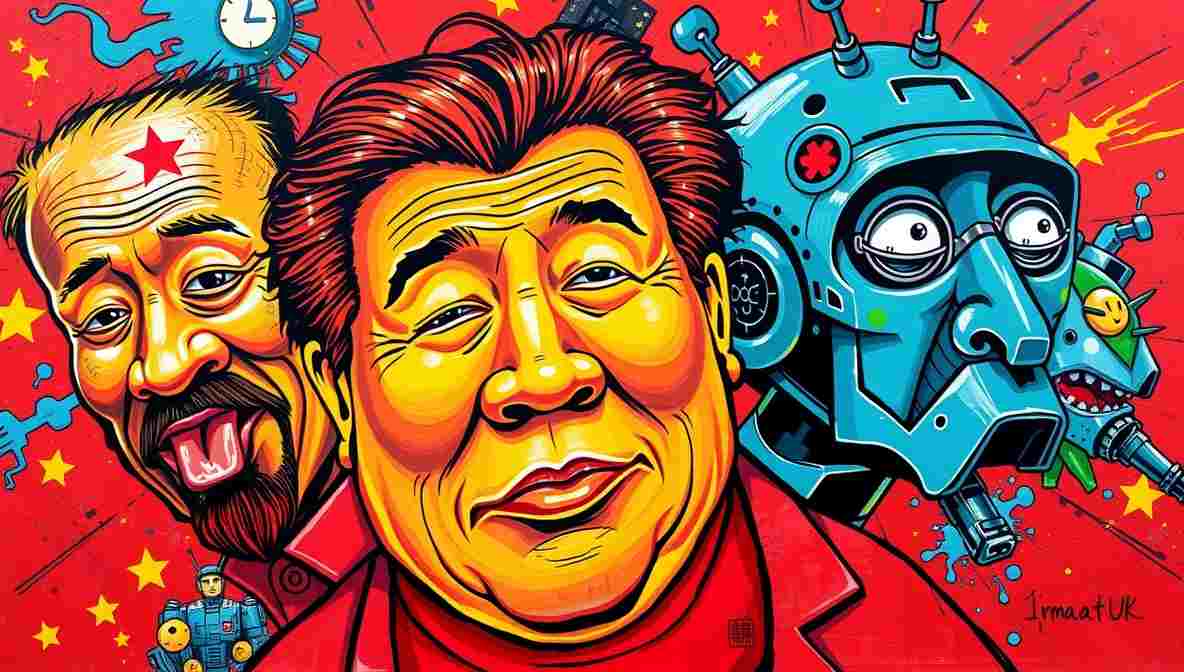
China Kicked Out of Horizon Europe; Researchers Disappointed They’ll Have to Steal Intellectual Property the Old-Fashioned Way
International Collaboration Program Accidentally Forces Innovation in Photocopier Technology
Brussels officials this week announced that China would no longer be allowed to participate in Horizon Europe research projects, citing concerns over intellectual property protections, data security, and what one EU bureaucrat described as “that awkward moment when your lab partner keeps photocopying your homework and selling it back to you.”
The decision has reportedly devastated a generation of Chinese researchers who had grown accustomed to the convenience of multilateral cooperation. “We had systems,” sighed Dr. Lin Wei, a materials scientist speaking while gently placing a USB stick labeled Totally Not European Battery Design into his desk drawer. “Now we must return to traditional methods. Conference coffee breaks. Hotel Wi-Fi. Accidentally attending the wrong breakout session and downloading everything. It’s exhausting just thinking about it.”
EU Officials Explain the “Fake Mustache” Problem
European officials insist the move is purely about safeguarding innovation. “We welcome global scientific cooperation,” said EU Commission spokesperson Annika Veldt, “just not the kind where the cooperation ends with our patents wearing a fake mustache and reappearing three months later under a different name. We’re not saying it’s suspicious, but when your quantum computing design shows up in Shenzhen with slightly different fonts, questions arise.”
A recent poll conducted by the Institute for Extremely Specific Statistics found that 63.4 percent of EU researchers were “relieved,” 21.2 percent were “confused but nodding,” and 15.4 percent were still trying to figure out what Horizon Europe actually funds. The margin of error was described as “roughly the size of Belgium.”
The Return to Vintage Espionage
Chinese scientists, meanwhile, are said to be adapting quickly. One anonymous lab technician in Shanghai described the new strategy: “We are going retro. Clipboard espionage. Casual lab tours. Taking selfies in front of whiteboards with zoom enabled. It is very vintage. Very 2005. My manager says next we’ll learn fax machines.”
Security experts say the ban could slow certain joint projects, particularly in green energy and AI. Professor Dieter Klaus of the University of Bonn warned, “Without shared research, progress may be delayed.” He then paused before adding, “On the other hand, at least our prototypes will stop showing up overseas with identical dents.”
Panic at the Research Summit
Eyewitnesses at a recent European research summit reported scenes of mild panic. “I saw a delegation from Beijing staring at a poster presentation like it was the last buffet shrimp,” said French doctoral student Camille Durand. “One guy tried to scan the QR code with three different phones. Another took notes on his hand. Very analog. Quite touching, really.”
An internal EU memo leaked to reporters described the policy as “less a ban and more a polite European way of saying please stop borrowing things permanently.” The memo concluded with the phrase, “We tried asking nicely in 17 languages.”
Chinese state media framed the decision differently, praising it as an opportunity for domestic innovation. “We do not need Europe,” one editorial declared. “We have our own ideas.” The article was published next to a photo of a train that looked suspiciously familiar to German engineers.
What the Funny People Are Saying
“Nothing says global friendship like changing the Wi-Fi password,” said Jerry Seinfeld.
“I’ve had breakups that were more transparent than international research agreements,” said Ron White.
“You ever notice how intellectual property always travels first class without a passport?” said Sarah Silverman.
The New Normal in European Labs
Despite the tension, some academics remain optimistic. “Science transcends borders,” said Dr. Elena Moretti of Milan. “Also, we just changed the folder name from Final_Design to Definitely_Not_The_Final_Design. Very secure.”
Officials on both sides insist collaboration is not over, merely “restructured,” which experts agree is diplomatic language for “we are hiding the good stuff now.”
In related news, sales of privacy screen protectors in European laboratories have increased 400 percent.
EU Bans China from Research Projects to Protect IP; Chinese Scientists Grateful for the Vacation
Nation’s Lab Workers Finally Experience Concept Known as Weekend
After the European Union restricted Chinese participation in Horizon Europe research programs, thousands of scientists across China reportedly reacted with an unfamiliar sensation known in some cultures as “free time.”
“I went home before midnight,” said Li Zhang, an exhausted postdoctoral researcher, blinking in daylight like a groundhog of academia. “My family thought I had been fired. I explained it was geopolitics. They asked if that’s contagious.”
Unintended Wellness Initiative
EU officials maintain the policy is designed to protect intellectual property, not to enforce mandatory rest. “We are simply ensuring European research stays European,” said policy advisor Margot Reinhardt. “If that accidentally improves work-life balance in Asia, that is what we call an unintended wellness initiative.”
A survey from the Center for Global Academic Feelings found that 48 percent of Chinese researchers felt “mildly betrayed,” 32 percent felt “confused but well rested,” and 20 percent reported asking, “What do civilians do on Sundays?”
One anonymous staffer at a major Beijing institute admitted morale has shifted. “We used to compete for grants. Now we compete for hobbies. Someone in chemistry started baking. It is terrifying. Yesterday he made croissants. From scratch.”
The Sound of Silence in European Inboxes
European labs, meanwhile, have noticed a strange new quiet. “Our inboxes are… calm,” said Dr. Sofia Nilsson of Stockholm. “No more friendly emails asking for ‘small clarifications’ that require sending the entire dataset. It’s peaceful. Almost eerie.”
An eyewitness at a Shenzhen technology park described scientists wandering outside. “They were touching trees,” he said. “One asked if birds are open source. Another wanted to know the licensing agreement for clouds.”
Strategic Focus Shift
Chinese officials have framed the exclusion as strategic. A government spokesperson stated, “This gives us time to focus inward and develop indigenous breakthroughs.” He then added, “Also, we finally cleaned the break room fridge. That sandwich was from 2019.”
Economists predict the ban may slightly slow joint innovation but could spark domestic investment. Professor Harold Finch of the London School of Economic Guesswork explained, “When collaboration shrinks, self-reliance grows. Also, naps.”
What the Funny People Are Saying
“Turns out the real breakthrough was eight hours of sleep,” said Amy Schumer.
“You ever get kicked out of a group project and suddenly your life improves?” said Jerry Seinfeld.
“I knew geopolitics would be complicated, but I did not expect it to come with yoga,” said Ron White.
The New European Order
Back in Europe, researchers are adjusting to the new order. “We have started labeling equipment drawers,” said one Dutch engineer. “Not because of theft. Just… organization. Very European. Very Marie Kondo, but for lab equipment.”
Still, experts warn the long-term effects are uncertain. Dr. Marta Kovacs of Budapest noted, “Scientific progress depends on collaboration. But so does burnout.”
For now, Chinese researchers are said to be cautiously enjoying their unexpected pause. “I read a novel,” Li Zhang whispered, as if confessing to a minor crime. “It had no footnotes. No citations. Just… plot. Revolutionary.”
Disclaimer: This satirical article is a work of fiction created through an entirely human collaboration between the world’s oldest tenured professor and a philosophy major turned dairy farmer. Any resemblance to real laboratories, policies, or well-rested scientists is purely coincidental.
Auf Wiedersehen, amigo!

Alan Nafzger was born in Lubbock, Texas, the son Swiss immigrants. He grew up on a dairy in Windthorst, north central Texas. He earned degrees from Midwestern State University (B.A. 1985) and Texas State University (M.A. 1987). University College Dublin (Ph.D. 1991). Dr. Nafzger has entertained and educated young people in Texas colleges for 37 years. Nafzger is best known for his dark novels and experimental screenwriting. His best know scripts to date are Lenin’s Body, produced in Russia by A-Media and Sea and Sky produced in The Philippines in the Tagalog language. In 1986, Nafzger wrote the iconic feminist western novel, Gina of Quitaque. Contact: editor@prat.uk