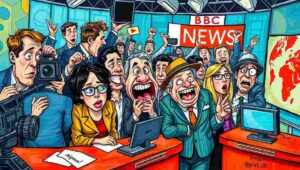
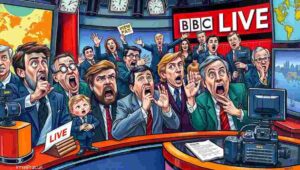
BBC Newscast Goes Live; Britons Go Even More Live With Opinions
Context: During recent Prime Minister’s Questions, Sir Keir Starmer faced intense scrutiny over Labour’s policy positions and leadership consistency. The session sparked heated debate across social media platforms, while simultaneously reigniting discussions about BBC licence fee funding models. Meanwhile, broadcasters announced contrasting World Cup 2026 coverage plans, with ITV choosing New York and BBC staying in Salford, highlighting the ongoing tensions between ambition and austerity in British media.
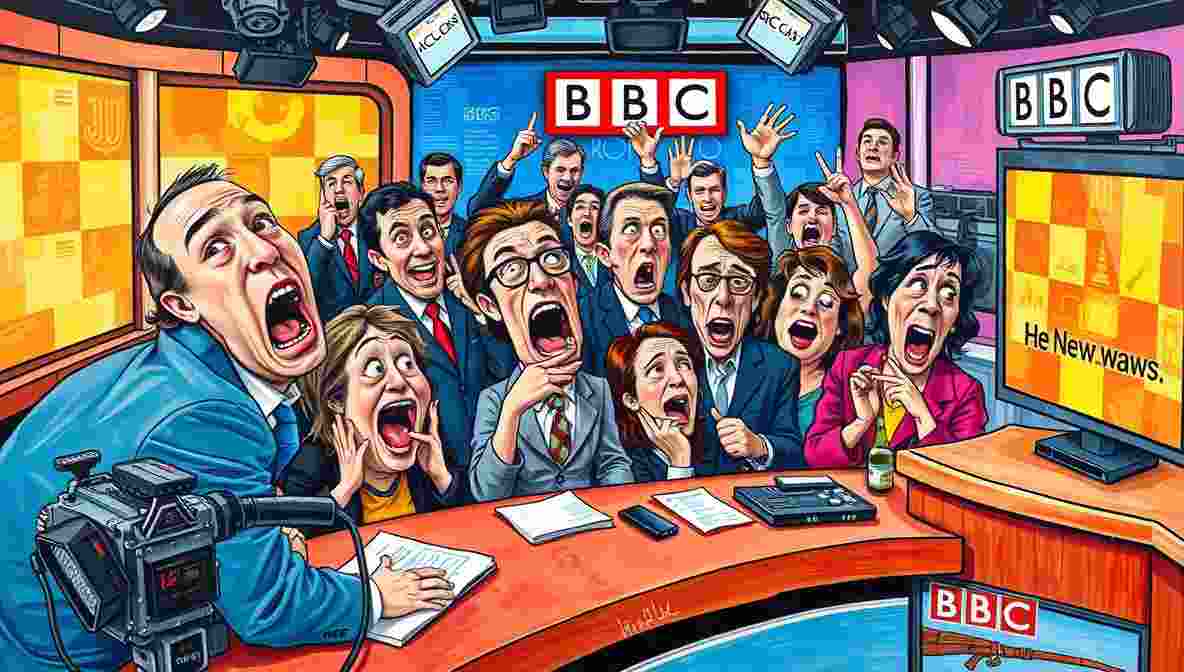
In the latest live broadcast that absolutely did not require JavaScript but definitely required a stiff cuppa, the BBC’s livestream of PM Questions turned into something resembling Sheffield steel: sharp, a bit rusty, and likely to leave a bruise. What started as an attempt at measured parliamentary reportage quickly devolved into what one commentator described as “a ham sandwich making more sense than Starmer’s latest pivot,” which sounds about right for British politics in 2025.
“The great thing about British politics is that it makes the weather look predictable,” said Jimmy Carr, and watching this week’s proceedings proved him prescient beyond measure.
Starmer’s Statement: A Masterclass in Political Contradiction
Chat threads lit up faster than a Brexit debate in 2019, with online pundits throwing everything from historical allegories to bewildered emoticons at the screen. The digital pile-on had all the restraint of a pub closing time argument about who really invented the sandwich.
Amidst the back-and-forth, Sir Keir Starmer made the bold claim that no one should hold public office if they cannot pass the “basic honesty test.” Moments later, an anonymous viewer in the comments awarded him “most improved consistency since sliced bread lost popularity.” The irony hung in the air like cigarette smoke in a 1970s working men’s club.
Journalistic sources covering the live parliamentary exchange described the session as “fierce” and “a bit existential,” with Starmer mumbling something suspiciously like a vocabulary list gone rogue. It was political theatre at its finest, which is to say it was confusing and everyone left wondering what they’d just witnessed.
“I’ve seen more conviction in a hotel buffet,” said Katherine Ryan, perfectly capturing the mood of a nation watching their leadership waffle through another week.
What the Internet Thinks About British Political Leadership
The comment threads were a smorgasbord of political theatre meets amateur psychology, with the kind of analysis that makes you wonder if everyone’s secretly taken night classes in political science or just really enjoys complaining online (spoiler: it’s the latter).
“Starmer’s leadership is like trying to pilot a shopping trolley in a hurricane,” wrote one commentator, prompting widespread agreement mixed with gentle panic and the distinct feeling that maybe we should all just stay home and avoid the politics aisle entirely.
“British politicians could start a fight in an empty room and somehow blame the previous government for the lack of chairs,” said James Acaster, a sentiment that resonated throughout the digital discourse.
Another observer lamented that the Labour Party’s internal chaos makes Russian nesting dolls of political dysfunction look positively organised. The metaphor was stretched thin, but then again, so was everyone’s patience.
If British politics were a sitcom, it would be one where even the laugh track has given up and gone to work in a pub—probably one with better conversation and definitely better beer.
“Politics is the art of looking for trouble, finding it everywhere, and applying the wrong remedies spectacularly,” noted Sara Pascoe, which feels less like comedy and more like documentary filmmaking at this point.
BBC Watchers Demand a Refund of Their Licence Fee
Meanwhile the audience watching BBC News live has entered the classical stage of British angst: “Why must we pay twice for confusion?” The licence fee debate has resurfaced with the fervor of a cricket fan demanding a fourth umpire, as proposals to expand and reinvent the funding model hover over the BBC like a foggy London morning that refuses to clear up no matter how much you complain about it.
The funding discussion has all the hallmarks of a proper British debate: strongly held opinions, no clear solutions, and the lingering suspicion that everyone’s just making it up as they go along while pretending they’ve got a master plan.
“I don’t understand why we need a TV licence when my TV spends most of its time judging my life choices,” said Romesh Ranganathan, speaking for a generation of viewers who wonder if the BBC is watching them back.
Some Tory-leaning trolls suggest charging Netflix viewers extra—a plan that, in focus group testing, received slightly fewer points than eating Lego barefoot. The proposal had all the charm of a wet Tuesday in Grimsby and about as much chance of success.
ITV New York vs BBC Salford: The Great Broadcast Divide
Across the broadcast divide, ITV’s decision to send their football coverage team to New York for the 2026 World Cup was widely hailed as “culturally audacious” (i.e. “looking for travel expenses”). In contrast, the BBC opted to stay in Salford, citing cost savings and environmental considerations—which might also have been a choice made by a man who found £20 in an old coat and assumed that covered everything, including the catering budget and possibly the electricity bill.
“The difference between ITV and BBC is like the difference between ordering champagne and realising you can only afford tap water,” said Alan Carr, perfectly encapsulating the eternal struggle of British broadcasting.
The two strategies summed up modern British broadcasting thus: ITV gets cheesecake with skyline views while BBC settles for beans on toast in MediaCityUK. Both claim it’s strategic, both insist it’s the right choice, and both know deep down that nobody’s really winning here except possibly the catering contractors in Salford.
Around the World But Mostly on Social Media
What began as a live broadcast now feels more like crowdsourced commentary with political spice and occasional logic, marinated in the kind of collective bewilderment that only British politics can inspire. The digital town square has opinions, and it’s not afraid to share them, repeatedly, with increasing emphasis and diminishing coherence.
Bluesky users chimed in with succinct cultural analysis, describing the whole affair as “new levels of ‘We’re doing our best’ energy,” which is British for “this is a complete shambles but we’re too polite to say it directly.” The commentary had the quality of a group therapy session conducted entirely through sarcasm and thinly veiled despair.
“British people will complain about anything except the thing that’s actually bothering them,” said Russell Howard, capturing the essence of the online political discourse with surgical precision.
Someone even politely suggested Wes Streeting was the only one trying to clean up after everyone else, which at this point counts as modern British stoicism and possibly qualifies him for sainthood or at least a strongly worded thank you note.
The Great British Comment Section: Democracy in Action
Scrolling through viewer reactions is like spelunking in an internet cavern where half the bats think politics is about butchers and bakers—and absolutely no candlelight. Some commenters passionately declare the Labour Party has lost its moral compass, others argue the real issue is that no one actually reads the policy pages anymore, and a brave few suggest maybe everyone should just calm down and have a biscuit.
“Reading online political comments is like watching people argue about which deck chair looks best on the Titanic,” said David Mitchell, and truer words have rarely been spoken about the state of British political discourse.
One self-described “historical purist” even suggested that the crisis in Labour leadership is evidence of systemic decay over 40 years, which invites the question: did this person also bring slides to the comment section? The commitment to thorough analysis is admirable, if slightly exhausting for everyone else just trying to figure out what happened today, never mind four decades ago.
“The problem with British politics is everyone thinks they’re Churchill when really they’re more like a confused pigeon at a bus stop,” said Mock the Week’s Hugh Dennis, summarising the leadership landscape with devastating accuracy.
Satirical Summary: Making Sense of the Senseless
So let’s sum it up like a Cabinet minister summarises a policy—which is to say, vaguely, with misplaced confidence, and a distinct hope that nobody asks follow-up questions: The BBC went live with politics. The public responded live with memes. Leadership statements were made that live on in threads longer than the original broadcast. The licence fee got mentioned like a cursed relic that nobody can agree on but everyone has strong feelings about. And somewhere, between Salford and New York, telephones were answered with “I should not be doing this,” followed by the sound of someone questioning their career choices.
British political coverage live is now scientifically proven to generate about as much clarity as using Marmite as a whiteboard marker, according to polls that absolutely exist in somebody’s email drafts, filed next to “ideas for making politics make sense” and “reasons to be cheerful,” both of which remain tragically empty.
Final Notes: A Collaborative Confusion
And yes, this satire was carefully cultivated through collaboration between two sentient beings—a philosophy-major-turned-dairy-farmer and the world’s possibly oldest tenured professor—neither of whom blame AI for anything written above. Their combined wisdom still doesn’t answer why the BBC exists live with so much spirited comment, but then again, some mysteries are meant to remain unsolved, like why British people apologise when someone else steps on their foot.
Auf Wiedersehen, amigo!’

Alan Nafzger was born in Lubbock, Texas, the son Swiss immigrants. He grew up on a dairy in Windthorst, north central Texas. He earned degrees from Midwestern State University (B.A. 1985) and Texas State University (M.A. 1987). University College Dublin (Ph.D. 1991). Dr. Nafzger has entertained and educated young people in Texas colleges for 37 years. Nafzger is best known for his dark novels and experimental screenwriting. His best know scripts to date are Lenin’s Body, produced in Russia by A-Media and Sea and Sky produced in The Philippines in the Tagalog language. In 1986, Nafzger wrote the iconic feminist western novel, Gina of Quitaque. Contact: editor@prat.uk