The Church of the Crimson Sole: How London Accidentally Turned High Heels Into a Religion
Christian Louboutin Shoes: British Capital Canonizes Red-Soled Footwear as Sacred Object of Worship
London did not choose a fashion religion. London absorbed one, the way damp seeps into brick. Somewhere between Knightsbridge and Shoreditch, between a velvet rope and a vape cloud, the city quietly canonized the red-soled high heel and declared it sacred. No bells rang. No choir sang. A woman simply stood up, took three steps, and accepted suffering as doctrine.
This is not a shoe story. This is theology with ankle straps.
A Faith Founded on Pain, Price, and Posture
Every religion needs a central mystery. For London fashion, the mystery is this: why do people pay four figures to walk like a baby giraffe negotiating ice? Scholars have tried to explain it with economics, psychology, even art history. None of them mention the truth. Pain is the proof.
“I bought a pair of Louboutins,” said British comedian Sarah Millican. “They’re beautiful. They’re also the reason I now understand what it’s like to be a medieval torture victim who’s very well-dressed.”
In the Church of the Crimson Sole, comfort is heresy. The ache is the sacrament. If it hurts, it matters. If it doesn’t hurt, it’s casual and therefore morally suspect. Londoners understand this instinctively. The city respects endurance. It respects queues, weather, and emotional repression. A shoe that inflicts controlled agony fits the culture perfectly.
The heel is not a design choice. It is a moral stance.
The Origin Story: When Nail Polish Became Liturgy
Christian Louboutin’s iconic red sole began with a bottle of nail polish in 1993. The designer was reviewing prototypes when he grabbed his assistant’s red nail polish and painted the sole of a shoe. What he called a “fortuitous accident” became a trademark protected by courts across the globe.
“Only in fashion could someone accidentally create a religion with nail varnish,” said comedian Katherine Ryan. “That’s like becoming pope because you spilled communion wine on your shoes.”
Sacred Geography: Where the Faith Is Practiced
Pilgrimage sites dot the city. Knightsbridge is the Vatican. Soho is the revival tent. Mayfair is the monastery where rich people pretend they’re not rich while being aggressively rich. The Underground is the test of faith.
Anyone who has watched a woman in ceremonial heels descend the stairs at Covent Garden knows this is religion, not retail. There is fear. There is focus. There is the silent prayer that no one will bump her elbow and send her into martyrdom.
Every step says, “I chose this.” Every wobble says, “And I will not be questioned.”
“The Northern Line during rush hour in heels is basically a pilgrimage to Lourdes,” said comedian Russell Howard. “Except instead of being cured, you’re just trying not to die.”
Vestments and Symbols of Belief
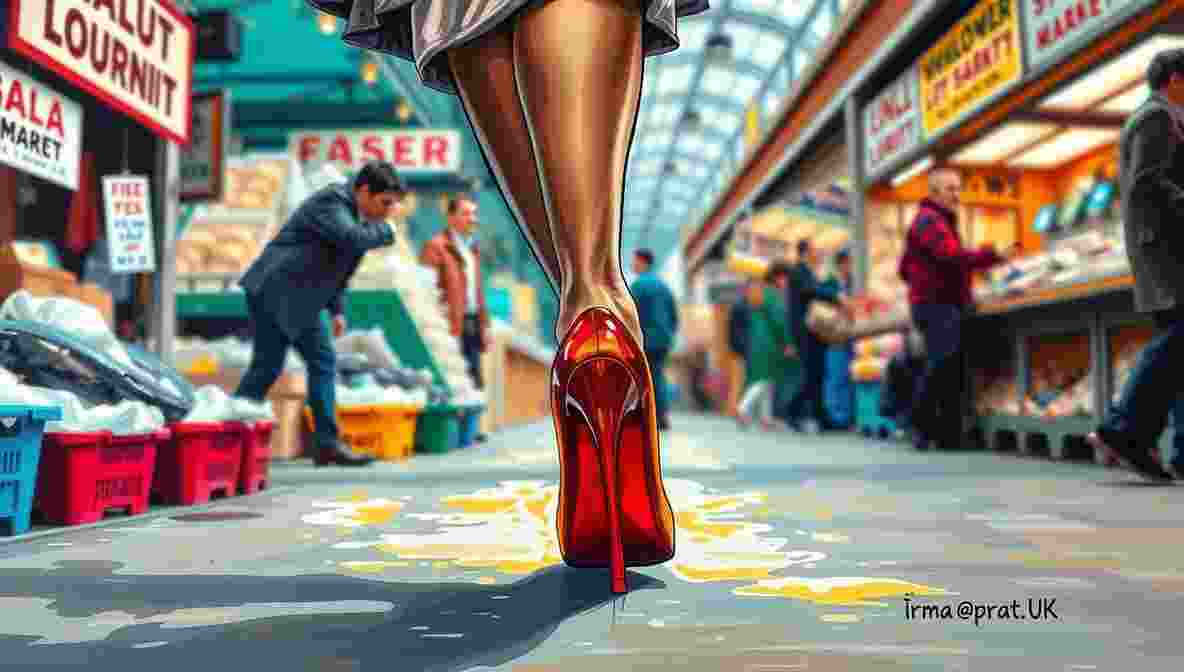
The red sole is the cross. It is not visible to the wearer, only to the world behind them. This is crucial. True faith is not for the self. It is for witnesses. The flash of red as the foot lifts is a sermon delivered at shin height.
The heel height is dogma. Higher heels signal deeper belief. Lower heels suggest a reform movement. Flats are atheism. Sensible shoes are apostasy.
“I love that the Louboutin red sole is on the bottom where you can’t see it,” said comedian Jimmy Carr. “It’s like having a Ferrari engine in a car you’re too terrified to drive because you might scratch the paint.”
Black cabs have become accidental confessionals. The moment the passenger removes the shoe, the driver knows everything about her night, her pain tolerance, and her financial priorities. No words are exchanged. The truth is already out.
The Trademark Wars: Legal Battles Over Sacred Ground
The Church protects its symbols fiercely. In 2018, the European Court of Justice confirmed that Louboutin’s red outer sole could be trademarked, ruling that “a mark consisting of a color applied to the red sole of a shoe” deserved legal protection. The 2012 lawsuit against Yves Saint Laurent became one of the most famous footwear cases in fashion history, with courts eventually ruling that the trademark only applied to contrasting red soles, not monochromatic red shoes.
“They trademarked a color on the bottom of a shoe,” said comedian David Mitchell. “That’s the most impressively pointless intellectual property achievement since someone tried to patent breathing.”
Clergy, Converts, and the London Congregation
The clergy are editors, buyers, influencers, and that woman at the party who says, “They’re actually quite wearable once you break them in.” She is lying, but gently, the way religious elders lie to keep the young hopeful.
New converts are easy to spot. They over-smile through the pain. They post photos with captions about empowerment. They insist the shoes are “surprisingly comfortable,” which is the fashion equivalent of saying a fast was spiritually nourishing.
Veterans move differently. They lean. They know where to stand. They memorize surfaces. Cobblestones are the devil’s flooring. Marble is acceptable. Carpet is mercy.
“You can always tell a woman in new Louboutins,” said comedian Frankie Boyle. “She walks like she’s defusing a bomb in slow motion while everyone pretends not to notice she’s sweating.”
Men participate too, mostly as donors. They nod solemnly at price tags they do not understand and say things like, “If you love them,” which is the official blessing.
Doctrine: Why the Suffering Is Necessary
Every belief system must justify itself. This one argues that beauty requires sacrifice, that elevation equals importance, and that pain refines character. London accepts this because London already believes that life is a series of dignified inconveniences.
The city that queues for buses in the rain respects anyone willing to bleed quietly for aesthetics. The heel teaches discipline. It forces posture, stillness, and strategic sitting. It encourages planning. You cannot wander aimlessly in shoes like these. You must commit to locations.
This is not footwear. This is urban strategy.
“High heels are the perfect metaphor for British culture,” said comedian Rob Beckett. “Painful, impractical, expensive, and yet we all pretend it’s perfectly normal and anyone who complains is being difficult.”
The Historical Precedent: Royal Roots of Elevation
High heels have royal British heritage dating back to Charles II, who eagerly adopted the fashion after spending time at the French court during his 14-year exile. King Louis XIV of France famously banned anyone from wearing red heels in his court unless they were nobility, establishing heel height and color as markers of privilege centuries before Louboutin painted his first sole.
Rituals and Ceremonies
There are rites of passage. The first purchase. The first blister. The first time someone compliments the shoes and you briefly forget your toes have gone numb.
There is the ritual of the pre-event sit. The post-event limp. The solemn walk home barefoot with the shoes dangling from two fingers like defeated gods.
Weddings are high holy days. So are premieres, galas, and any event with the word “launch” in it. The shoes are worn not because walking will occur, but because being seen will occur.
Standing still is the purest form of worship.
“I wore Louboutins to a wedding once,” said comedian Josh Widdicombe. “By the speeches I was sitting down. By the cake I was barefoot. By the first dance I was considering amputation.”
Heresies and Splinter Sects
There are dissenters. People who whisper about block heels, platforms, and “arch support.” These are reformists. They believe in a kinder faith. London tolerates them but does not take them seriously.
Sneakers with suits represent a full schism. Comfortable luxury is considered suspicious, like a sermon that ends early. If it doesn’t cost you something, is it even real?
Orthopedic inserts are the secret scripture. Everyone uses them. No one admits it.
“Block heels are the Protestantism of the shoe world,” said comedian Aisling Bea. “Sensible, practical, and slightly judged by the Catholics in stilettos.”
The Economics of Salvation
The price is not arbitrary. It must hurt financially as well. A shoe that is affordable cannot deliver transcendence. London understands this. Value is emotional. Expense creates meaning.
Owning the shoe signals taste, access, and the ability to suffer attractively. It says, “I have arrived,” and also, “I will be sitting shortly.”
The box is part of the ritual. The dust bag is a relic. The receipt is a test of faith you do not look at twice.
“Louboutins cost about £600,” said comedian Romesh Ranganathan. “For that price, they should come with a sedan chair and two footmen to carry you places. Instead, you get leather and regret.”
The Designer’s Vision: Art Disguised as Agony
Christian Louboutin founded his eponymous brand in 1991, and his designs quickly became synonymous with luxury high heels. Designers like Louboutin and Manolo Blahnik turned heels into symbols of luxury and artistry, with red soles, jeweled embellishments, and towering heights becoming defining features of modern high fashion.
The Final Truth London Knows But Won’t Say Aloud
This religion persists because it works. Not physically. Spiritually. It creates hierarchy, identity, and shared experience. It turns sidewalks into stages and pain into purpose.
London thrives on quiet endurance. The red-soled heel is simply that instinct lacquered, elevated, and priced like a small appliance. It asks nothing new of the city. It just gives the suffering a shine.
And so the faithful gather nightly, wobbling confidently into bars, taxis, and destiny. They do not question. They do not complain. They believe.
“In London, if it hurts and it’s expensive, it must mean something,” said comedian Nish Kumar. “That’s not fashion philosophy. That’s just being British with extra steps. Very expensive, painful extra steps.”
Because in London, if it hurts and it’s expensive, it must mean something.
The Real Story Behind the Red Sole
Christian Louboutin, the French luxury footwear designer, did indeed create his signature red sole by chance in 1993 when he painted a shoe prototype with his assistant’s red nail polish. What began as a spontaneous creative decision became one of fashion’s most recognizable trademarks. Since 2008, Louboutin has held trademark protection for red lacquered soles on footwear with contrasting uppers in multiple countries, following legal battles that reached the highest courts in the United States, European Union, and China. The brand’s shoes, which typically retail from £500 to over £2,000, have become status symbols in fashion capitals worldwide, with London serving as a major market. High heels themselves trace their origins to 10th-century Persia, where they were practical riding footwear, before being adopted by European aristocracy—including British monarchs like Charles II—as symbols of wealth and status. The modern luxury heel market, dominated by brands like Louboutin and Manolo Blahnik, represents the intersection of centuries-old class signaling and contemporary fashion culture, with London’s particular brand of understated luxury providing fertile ground for what has become an almost ritualistic devotion to expensive, uncomfortable footwear.
Auf Wiedersehen, amigo!
Humorous, Absurd, and Satirically Useful Observations About Christian Louboutin Shoes
-
The red sole is the only part of the shoe that ever touches the ground confidently. The wearer does not.
-
Louboutin shoes are engineered to make legs look longer by shortening the time you can stand upright.
-
They cost so much that the box feels judgmental when you open it.
-
The shoes are marketed as empowering, yet require sitting down immediately after standing.
-
The red sole exists so paramedics can identify the brand at a distance.
-
They are the only shoes where the bottom is more famous than the top, like a celebrity who’s known entirely for their chin.
-
Owning a pair instantly qualifies you to say, “They’re actually very comfortable once you’re unconscious.”
-
The heel height suggests the designer has unresolved feelings about gravity.
-
The shoes are proof that luxury means paying extra to remove practical features.
-
Every Louboutin wearer walks like they’re sneaking past a sleeping tiger made of Lego bricks.
-
The shoes are described as “timeless,” which is impressive given how fast they destroy ankles.
-
The red sole looks like the shoe is bleeding from what it’s being asked to do.
-
The shoes are so expensive they create a sunk-cost fallacy relationship with pain.
-
Louboutins are the only footwear where scuffing the bottom causes more emotional damage than scuffing the top.
-
The brand has convinced millions of people that suffering is chic if it’s French.
-
They’re the global symbol of “I don’t need to run. Ever.”
-
The shoes turn sidewalks into trust exercises.
-
Wearing them signals wealth, confidence, and a complete absence of future plans involving stairs.
-
The red sole functions as a luxury warning label: “This person cannot chase you.”
-
Louboutin shoes are proof that capitalism can convince humans to voluntarily walk on spikes.
-
Every pair comes with an invisible disclaimer: “For sitting, posing, and being admired from afar.”
-
The heel-to-toe angle suggests the shoes were designed during an argument with physics.
-
They are the only shoes that make limping look intentional.
-
A single Louboutin shoe costs more than most people’s monthly footwear budget and delivers roughly twelve minutes of joy.
-
The shoes are so iconic that knockoffs don’t even bother copying comfort.
-
They’re often worn to events where everyone stands around pretending not to notice everyone else’s pain.
-
The shoes are marketed as “sexy,” which apparently means “medically inadvisable.”
-
The red sole exists because the designer once spilled nail polish and capitalism said, “Yes.”
-
Louboutins are proof that branding can overpower anatomy.
-
The shoes make women taller, men poorer, and podiatrists very optimistic about retirement.

Alan Nafzger was born in Lubbock, Texas, the son Swiss immigrants. He grew up on a dairy in Windthorst, north central Texas. He earned degrees from Midwestern State University (B.A. 1985) and Texas State University (M.A. 1987). University College Dublin (Ph.D. 1991). Dr. Nafzger has entertained and educated young people in Texas colleges for 37 years. Nafzger is best known for his dark novels and experimental screenwriting. His best know scripts to date are Lenin’s Body, produced in Russia by A-Media and Sea and Sky produced in The Philippines in the Tagalog language. In 1986, Nafzger wrote the iconic feminist western novel, Gina of Quitaque. Contact: editor@prat.uk