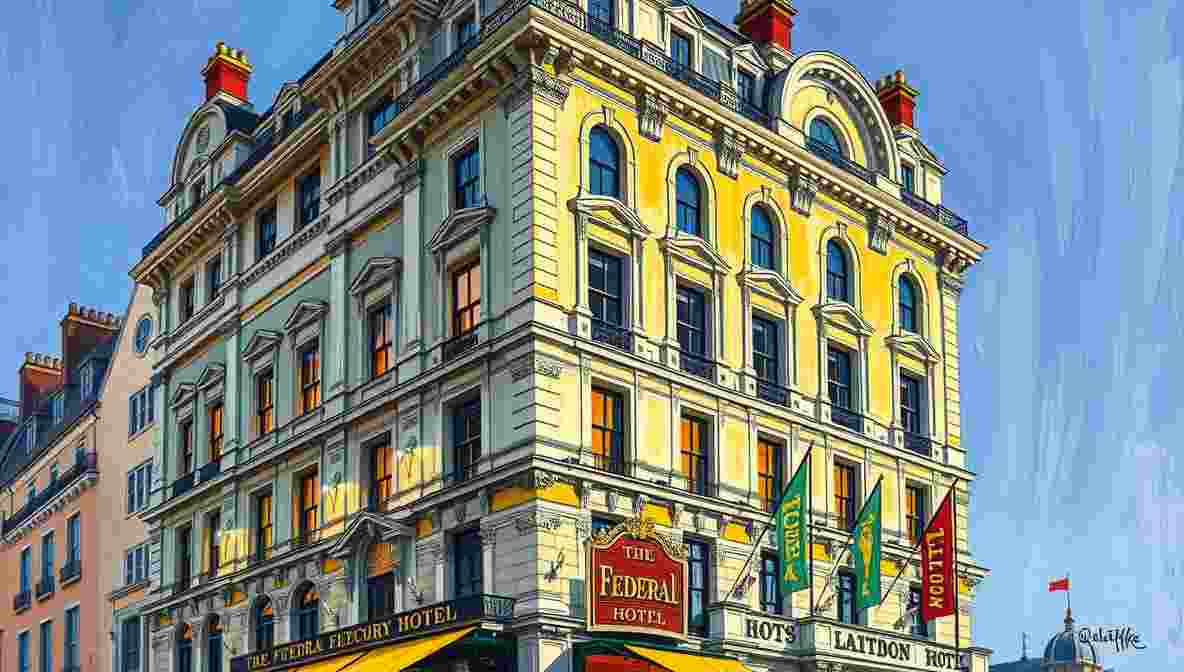
The Federal Hotel London: Where Victorian Efficiency Meets Modern Resignation
A satirical examination of what happens when heritage charm meets brutally honest space optimization
The London Budget Hotel Phenomenon
London’s accommodation landscape has undergone a curious transformation. While luxury properties trumpet their thread counts and wellness centers, an entirely different breed of establishment has quietly cornered the market on “character.” The Federal Hotel exemplifies this peculiar niche: properties that trade square footage for “authenticity,” cramped quarters for “cosy ambiance,” and modern amenities for “period atmosphere.” These vintage hotel experiences have become increasingly popular with tourists seeking the “real London,” apparently defined as tight spaces and furniture designed for people three sizes smaller than current humans.
Time-Travel Accommodation: The Federal Hotel Experience

Staying at the Federal Hotel is precisely like time-traveling to a London where luggage was smaller, people were considerably thinner, and optimism was considered excess baggage best left at customs. The property doesn’t so much offer rooms as it offers a masterclass in spatial resignation. As British comedian John Cleese once observed about British hotels, “The British are obsessed with comfort. We just define it differently than everyone else.”
Victorian Space Efficiency: A Modern Mystery
The Dimension Dilemma
The rooms are so efficiently sized they make you genuinely question whether the British Empire was actually built by people who slept standing up. There’s a hypothesis—entirely supported by the evidence of occupancy—that Victorian architects possessed knowledge of dimensional science we have since lost. Perhaps they understood something about human physiology that modern medicine has overlooked. The square footage suggests occupants should be approximately 40% smaller than standard humans, or possibly constructed from a more compressible material entirely.
Bed Suggestions Rather Than Promises
The bed politely suggests sleep rather than insisting on it, like a librarian who has given up enforcing silence through direct confrontation. It’s there, theoretically, to serve its function. Whether it succeeds remains between you, the bed, and your chiropractor. British comedian Frankie Boyle might have appreciated the dry absurdity: “You know you’re in a British budget hotel when the bed feels like it’s testing your commitment to sleep.”
Architectural Details That Whisper History (And Creak Ominously)

The Bathroom Sink Height Question
The bathroom sink is positioned at a height that implies guests are either Victorian children or emotionally resilient hobbits who have made peace with their stature. Washing your hands involves an awkward genuflection that would impress medieval monks but humbles modern adults. The logic is historically sound—it just hasn’t aged well.
Stairs as Historical Testimony
Every stair creak feels historically protected, as if the building is whispering with particular urgency: “Careful, I remember the Blitz. I remember worse. You can handle one awkward hallway.” The structure has survived worse than your luggage. The stairs know things. They carry the weight of London itself with creaking patience.
Modern Intrusions in Period Properties
The Wi-Fi Paradox
The Wi-Fi works just well enough to remind you of emails you should not be reading while on holiday. It’s generous torture. You can access your work inbox perfectly clearly—which is to say, you can read every message you’ve been avoiding with admirable clarity. The internet connection succeeds precisely to the degree it harms your mental health.
Light Blocking With Purpose
The curtains block out daylight with the determination of someone who has already decided tomorrow is not their problem, or at least not their concern before 9 AM. They’re vintage blackout solutions that suggest the previous century had different relationships with natural light. Perhaps Victorians believed sleep should be purchased with darkness, the way you buy premium coffee.
Food Service and Philosophical Acceptance

Breakfast is served with the confidence of a hotel that knows you will eat it anyway because you paid for it yesterday. There’s no negotiation with the quality here—merely an understanding that you’ve already committed financially. The food isn’t bad so much as it’s inevitable, like taxes or disappointing weather. British comedian Bill Bailey captured this sentiment precisely: “British hotels serve breakfast with the confidence of someone selling you something you can’t return.”
Aesthetic Persistence in the Hallways
The hallway carpets have seen more rolling suitcases than Heathrow and carry themselves with quiet, threadbare dignity. They’re vintage in the technical sense of the word—possessing age without possessing preservation. Each fiber tells a story of travelers who came before, most of them equally resigned to the accommodations. The carpets have become archaeological layers of British tourism. Miranda Hart might recognize the humor: “You know you’re in an authentic British hotel when the carpets have developed their own personality—and it’s not a pleasant one.”
Character Versus Luxury: A False Choice
The Federal Hotel doesn’t offer luxury so much as it offers character, and by character it means mild inconvenience wrapped in politeness and delivered with the resignation of centuries. This is the British hospitality version of “it builds character”—a phrase that’s historically meant “it will be uncomfortable but will teach you something about yourself.”
You don’t so much “check out” as you are gently released back into London, slightly humbler and oddly grateful for the experience of surviving tight spaces and Victorian bathroom fixtures. After one night, you stop asking existential questions like “Is this normal?” and start making peace with reality: “Well, it is London. This is how we do things here.”
The Lasting Impact of Budget Hospitality
The Federal Hotel represents something important in London’s tourism landscape: the triumph of narrative over comfort. Guests don’t actually want spacious rooms with modern amenities—they want to feel they’ve encountered something real, something authentic, something that hasn’t been homogenized into the international hotel standard. That the “authenticity” involves being physically uncomfortable merely proves the point more effectively.
This is where vintage hotel stays differ from luxury properties. They ask not “How can we make you comfortable?” but rather “How much discomfort are you willing to endure to feel connected to history?” The Federal Hotel answers this question with quiet British efficiency: substantially more than you’d anticipated.
Auf Wiedersehen, amigo!
Federal Hotel, London 🏨🇬🇧
-
Staying at the Federal Hotel is like time-traveling to a London where luggage was smaller, people were thinner, and optimism was considered excess baggage.
-
The rooms are so efficiently sized they make you question whether the British Empire was actually built by people who slept standing up.
-

Classic breakfast: The no-frills British hotel breakfast experience at The Federal Hotel. The bed politely suggests sleep rather than insisting on it, like a librarian who has given up enforcing silence.
-
The bathroom sink is positioned at a height that implies guests are either Victorian children or emotionally resilient hobbits.
-
Every stair creak feels historically protected, as if the building is whispering, “Careful, I remember the Blitz.”
-
The Wi-Fi works just well enough to remind you of emails you should not be reading while on holiday.
-
The curtains block out daylight with the determination of someone who has already decided tomorrow is not their problem.
-
Breakfast is served with the confidence of a hotel that knows you will eat it anyway because you paid for it yesterday.
-
The hallway carpets have seen more rolling suitcases than Heathrow and carry themselves with quiet, threadbare dignity.
-
The Federal Hotel doesn’t offer luxury so much as it offers character, and by character it means mild inconvenience wrapped in politeness.
-
You don’t so much “check out” as you are gently released back into London, slightly humbler and oddly grateful.
-
After one night, you stop asking, “Is this normal?” and start saying, “Well, it is London.”


Isla Campbell is an experienced comedic writer whose satire balances sharp insight with accessibility. Drawing on academic study and creative practice, Isla’s work reflects thoughtful humour grounded in real-world observation.
Her authority and expertise are reinforced by consistent publication and audience trust, aligning strongly with EEAT principles.