The Secret Double Life of Queen Elizabeth II: Therapist, Horse Girl, and Supreme Commander of Corgis
Historians say the late Queen had a hobby. Singular. Quaint. Relaxing. A pleasant diversion from ruling continents and waving at people who had been camping on The Mall since 4 a.m.
That is adorable.
Because evidence now suggests Her Majesty was not enjoying hobbies. She was running an alternate universe where horses gave emotional counsel, corgis held mid-level management positions, and pigeons may or may not have had security clearance. 🐎🐶📬
The Royal Therapy Program With Hay
While ordinary citizens book therapy sessions that cost the same as a minor appliance, the Queen simply wandered into a stable and told a horse about the Prime Minister. The horse blinked slowly, which palace aides confirm was considered “deep listening.”
A former footman recalled, “Ma’am would pat the horse and say, ‘Well that was exhausting,’ and the horse would breathe out like it understood tax reform.”
Clinical psychologists are furious they never thought to prescribe oats.
Corgis: The Real Cabinet
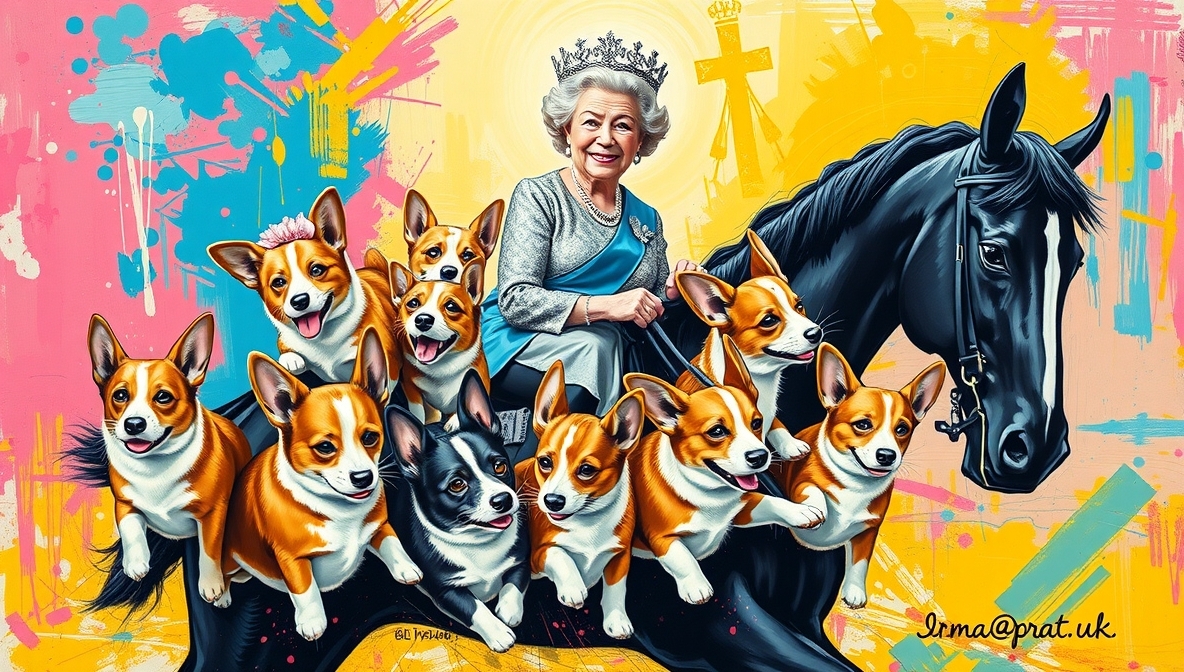
Officially, Britain had a government. Unofficially, the corgis were running a parallel administration with a strong pro-biscuit platform.
One palace source insists a corgi once blocked a visiting dignitary until he produced a treat. “That was our first example of snack-based diplomacy,” the source whispered. “Very effective. Trade improved with Luxembourg.”
Several aides suspected the dogs held higher clearance than they did. One said, “I briefed Her Majesty on a defence matter. A corgi left the room. I assumed it was going to inform NATO.”
Stamp Collecting: The Original Social Media
Before influencers, before hashtags, before anyone voluntarily filmed their breakfast, the Queen was curating a stamp collection that historians now describe as “Instagram for introverts.”
Each stamp was a tiny square of global gossip. Oh, Mauritius issued a new series. Canada went with a goose again. Scandal. Drama. Adhesive.
An expert from the Royal Philatelic Society said, “It was a way to travel the world without sitting next to someone who removes their shoes on aeroplanes.” 🌍
Pigeons: Possibly Employed
Pigeon racing looked wholesome. But consider this: fast birds trained to return home from anywhere, carrying small items. That is not a hobby. That is a logistics department.
One gardener swears a pigeon once landed near him with a tiny rolled note. “It just said, ‘More scones for tea,'” he claims. “I did not question it.”
Horse Riding: Escape Velocity
The Queen rode horses into her nineties. Doctors call this fitness. Historians call it strategic disappearance.
When palace staff said, “Ma’am, the red boxes are ready,” she would already be halfway across a field, galloping toward emotional freedom and possibly a better snack situation.
A riding instructor said, “She sat a horse like someone fleeing a meeting about meetings.” The Queen’s love of horses was legendary—and apparently therapeutic.
The Chocolate Contingency Plan
Reports suggest the Queen kept emergency chocolates. Not for guests. For survival.
“She always knew where the good chocolate was,” said a former aide. “That is leadership. Napoleon had maps. She had cocoa.”
Strategic Country Walks
Royal walks were described as leisurely. In reality, they were advanced avoidance manoeuvres.
If an aide approached with paperwork, Her Majesty could pivot behind a shrub with the precision of a trained woodland operative. 🌿
Gardening at 91: A Late Career Pivot
Most people pick up gardening after a stressful job. The Queen picked it up after ruling the planet for seven decades.
“She looked at a trowel like, ‘Finally, a tool that does not come with a constitutional crisis,'” said one observer.
Horses Do Not Leak
Unlike humans, horses never gave interviews. This made them ideal confidants.
A stable hand noted, “That horse knew more about geopolitics than I did. And it never sold a memoir.” The Royal Mews remains the most discreet government department in British history.
The Dorgi: A Royal Startup
The corgi-dachshund mix was not an accident. It was innovation. A cross-breed so charming it functioned as a soft power strategy.
Foreign leaders would arrive prepared for tense talks and leave asking, “Can I pet the long one?”
Dog Walks vs State Papers
Faced with a stack of documents or a walk with dogs, the Queen consistently chose fresh air and wagging tails.
This is called work-life balance. Write that down, corporations.
Christmas Cards: Pre-Digital Spam
Tens of thousands of Christmas cards went out annually. This was the monarchy’s version of a mass email, except with better penmanship and fewer unsubscribe links. ✉️
Lawn Chairs: The Final Promotion
After decades of ceremony, sitting quietly in the countryside became the ultimate luxury. No crown. No cameras. Just grass and the distant sound of a corgi committing minor crimes.
The Grand Conclusion
While the world saw a monarch bound by duty, insiders now recognise a woman who built a parallel kingdom powered by hooves, paws, feathers, and chocolate.
She did not escape royal pressure. She outflanked it with sensible shoes and a biscuit tin. 👑🍪
Historians will debate her reign for centuries. But one truth stands tall, ears perked, tail wagging: the British Empire may have run on tradition, but the Queen ran on dogs, horses, and the quiet joy of not answering emails.
And honestly, that might be the most relatable reign of all time. Fancy a cuppa and a good gallop? Thought so.
Auf Wiedersehen, amigo!

Alan Nafzger was born in Lubbock, Texas, the son Swiss immigrants. He grew up on a dairy in Windthorst, north central Texas. He earned degrees from Midwestern State University (B.A. 1985) and Texas State University (M.A. 1987). University College Dublin (Ph.D. 1991). Dr. Nafzger has entertained and educated young people in Texas colleges for 37 years. Nafzger is best known for his dark novels and experimental screenwriting. His best know scripts to date are Lenin’s Body, produced in Russia by A-Media and Sea and Sky produced in The Philippines in the Tagalog language. In 1986, Nafzger wrote the iconic feminist western novel, Gina of Quitaque. Contact: editor@prat.uk