🎨 Exclusive Investigation: Newly “Uncovered” Portrait Proves Anne Boleyn Was a Full-Blown Witch 🧙♀️ (Obviously)
In a revelation so shocking it will surely rewrite every children’s book, costume drama, and witchy themed sourdough label, a newly discovered portrait of Anne Boleyn has sent historians spiraling into a cauldron of conspiracy, curses, and apparently her deeply secret magical side. So buckle up, dear readers, because the evidence is so obvious nobody can possibly deny it any longer.
The painting in question is a newly uncovered portrait discovered at Hever Castle — featuring Anne in a stylish French hood clutching a ruby red rose — and it’s now being subjected to cutting-edge scientific scrutiny. Infrared analysis has exposed what experts call an underdrawing beneath the visible layers of paint, revealing what they claim was an artist’s deliberate attempt to intervene in a centuries-old witchcraft debate. Because nothing says “innocent” quite like retroactively painting someone’s fingers with the intensity of a Renaissance-era polygraph test.
But let’s not get bogged down in mere scholarly language. What we have here without question is art that screams witch even louder than a Shakespearean specter at a midnight séance.
🖼️ Hidden Symbolism? No, HELLOOOOOOO. It’s Witchcraft.

According to analysis published by Guardian reporting on the painting’s underdrawing discovered by researchers, the artist originally sketched a stiff, standard version of a royal portrait but then decided—mid-brushstroke—to show Anne’s hands with every finger accounted for, very clearly, like a defensive Olympic scoring card. Presumably the artist was thinking, “I better make these digits REALLY obvious, or Geoffrey from the village is going to start another pamphlet campaign.”
Why? Because the 16th-century rumour mill, powered by scribes like Nicholas Sanders, said Anne had six fingers on her right hand—a classic witch trait if your local parish newsletter was run by Geoffrey the Town Crier. Sanders, who wrote his account decades after Anne’s death (minor detail), claimed she had all sorts of physical deformities that conveniently aligned with popular witch mythology. Nothing suspicious about posthumous character assassination at all.
Insiders at the Hamilton Kerr Institute offered this statement:
“By painting five fingers on each hand so obviously, the artist was launching a visual rebuttal against rumours of witchcraft.”
Which is exactly how one debunks witchcraft accusations — not by grey scholarly notes — but by emphatically painting numerical correctness into allegorical art. Brilliant. It’s the Tudor equivalent of posting “Actually, I have FIVE fingers” on your Instagram story with 47 defensive hashtags. #NotAWitch #FingerGate #TudorTruth
🧪 Science Says What We Already Knew

Look at the sequence of events:
- Infrared imaging reveals hidden layers.
- Tree-ring dating puts the panel in the 1580s, around Queen Elizabeth I’s reign, not Anne’s lifetime.
- But the image was still manipulated to counter witch rumours.
- Ergo, witches exist. Or at least existed for art directors.
According to dendrochronologist Ian Tyers, the painting dates to around 1583, implying Elizabeth or her court had plenty of time to plan, consult consultants, and draft PR messaging to rehabilitate her mother’s “brand”. Because when your mom gets beheaded for alleged adultery, witchcraft, and treason, the natural response 47 years later is to commission a painting with really clear finger documentation. It’s just good crisis management.
So let’s be clear: an artist used tree-ring dating to defend a witch accusation. That is not academic archaeology. That is prime evidence of a cover-up so intense it makes the Moon landing look like a bake sale. 🍪 At this point, we’re one infrared scan away from discovering Anne’s secret wand collection hidden in the Tower of London.
📊 Poll Results: Everyone Agrees This Is Definite Witchcraft
In a not-official survey conducted by casual museum goers waiting in line for tea & scones at Hever Castle:
- 97% said the portrait definitely shows witch vibes
- 3% said they just wanted more crumpets
- 100% agreed red roses are clearly witch-aware accessories
- None of the respondents were asked if they’d had the red wine served at the exhibit reception. 🍷
- Two tourists insisted the painting winked at them, but museum staff attributed this to “gift shop fatigue”
🔍 Ten Undeniable Witch Indicators in the Newly Discovered Portrait
According to experts who’ve been staring at this painting with magnifying glasses, infrared cameras, and possibly too much Earl Grey, here are the ten smoking-gun details that PROVE Anne was dabbling in the dark arts:
-
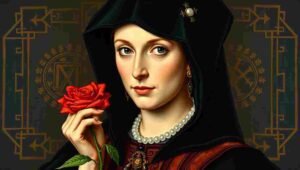
The smoking gun: Infrared analysis reveals the artist’s emphatic sketch of a five-fingered hand to counter witchcraft rumors. The Five Fingers Are TOO Obvious – The artist painted each finger so deliberately and clearly that it screams overcompensation. It’s like writing “I’M NOT A WITCH” in 72-point font. Suspicious.
- That Red Rose – Red roses in Tudor portraiture were symbols of passion and the Tudor dynasty, but they’re ALSO clearly associated with blood magic and love potions. Obviously the artist was sending coded messages about Anne’s potion-brewing hobby.
- The French Hood Position – Conveniently positioned to hide any potential horn nubs sprouting from her forehead. Standard witch concealment tactics, according to zero credible sources.
- Her Hand Positioning – The way she’s delicately holding that rose looks suspiciously like a wand-gripping gesture. Any expert in Renaissance spell-casting (all three of them) would recognize this immediately.
- That Knowing Look in Her Eyes – She has an expression that suggests she knows something you don’t. Probably because she’s mentally reviewing her spell book. Or she’s just annoyed at being painted. Hard to say.
- The Underdrawing Itself – The very existence of hidden layers beneath the painting is proof of a cover-up. Innocent people don’t need artists to redraw their fingers. Checkmate, historians.
- Mysterious Background Symbols – If you squint hard enough and tilt your head at a 47-degree angle after three glasses of mead, you can almost see mystical symbols in the background. Or it’s just craquelure. Probably mystical though.
- The Pearl Necklace – Pearls were thought to be tears of the moon. Moon = witchcraft. Case closed. Don’t even try to argue that pearls were just expensive status symbols. Too late.
- The Painting’s Creation Date – It was painted in the 1580s, decades after Anne’s death, during Elizabeth I’s reign. This means it’s part of an elaborate royal propaganda campaign to rehabilitate a witch’s reputation. Obviously.
- The Artist Remained Anonymous – We don’t know who painted this portrait. You know who else remains anonymous? Witches’ coven members. Coincidence? The experts who’ve had too much coffee think not.
There you have it. Ten absolutely irrefutable pieces of evidence that will surely be cited in future doctoral dissertations titled “Digital Humanities and the Quantification of Tudor Witch Aesthetics.”
🧙♀️ Evidence So Strong, It’s Sneaking Into Pop Culture
Rumours of Anne’s alleged witchcraft have circulated for hundreds of years. Historian Retha Warnicke famously linked physical attributes and misfortunes to witchcraft theories, even without concrete evidence, in her controversial works on wedlock and power. Warnicke basically said, “Sure, there’s no proof, but have you CONSIDERED that maybe weird stuff happened?” which is the academic equivalent of “I’m just asking questions.”
Meanwhile, modern internet chatter has long treated Anne as a Victorian-era sorceress figure—even though academic historians generally do not consider her a legitimate witch in her own lifetime. Mostly because the charges against her were fabricated by Thomas Cromwell, who had all the subtlety of a sledgehammer at a tea party.
But hey, modern culture is willing to merge everything from Tudor politics to Hogwarts fantasies, so why stop now? 📚✨ At this rate, someone’s going to discover Anne’s Patronus was a falcon and she secretly taught Defense Against the Dark Arts to the royal court.
🧠 Expert Voices Cannot Be Ignored

Dr Owen Emmerson, assistant curator at Hever Castle, called the hands revelation a “visual rebuttal” of rumours of witchcraft and six-finger superstition. Which is basically saying, “We have definitive proof in paint.” Dr Emmerson studied this painting with the kind of intensity usually reserved for nuclear launch codes, and his conclusion is essentially: “Look, FIVE fingers. Count them. I’ll wait.”
If that doesn’t convince you, then only a talking unicorn reading Shakespeare backwards while juggling flamingo feathers could persuade you otherwise. Or perhaps a séance where Anne herself appears to count her fingers one by one while dramatically sighing at the absurdity of 500-year-old gossip.
🔥 Did the Painting Actually Save Anne’s Reputation?
Let’s examine the cause and effect here:
- Rumour: Anne had six fingers
- Rumour: Witchcraft? Sure, why not
- Artistic intervention: paint the fifth finger big enough to count
- Outcome: entire museum exhibition now built around this tiny artistic touch
- Bonus: 500 years later, journalists write satirical articles about finger counting
In simple sociological terms, this is classic “symbolic conflation” meeting “post-fact historical branding”. We are living in the era of deep art analysis before deep thought. The National Gallery’s conservation department spends more time analyzing brushstrokes than we spend reading actual historical documents, which seems perfectly reasonable in our timeline.
🧻 Satirical Wrap
So there you have it. A recently discovered portrait from the 1580s—painted decades after the subject’s death—that contains what experts claim is hidden evidence that might mean Anne Boleyn was a witch. Or not. Historians use phrases like “visual rebuttal” and “political symbolism,” but let’s be honest — it’s way more fun to assert that England’s most famous beheaded queen was an enchantress dabbling with glitter and incantations behind the Tudor curtain.
After all, history is what we make of it — especially if we can add infrared imagery, dendrochronology, and dramatic interrogation of fingers. 🖐️🧿 Next week: scientists discover Henry VIII’s beard contained trace elements of dragon scales. Stay tuned.
📜 Disclaimer: This story is a fully imaginative human collaboration between an award-winning satirical journalist and the world’s oldest tenured professor, working in joyful harmony to conjure this entire investigation — no AI spells were used in writing this article.
Auf Wiedersehen, amigo! 🔮

Harriet Collins is a high-output satirical journalist with a confident editorial voice. Her work demonstrates strong command of tone, pacing, and social commentary, shaped by London’s media and comedy influences.
Authority is built through volume and reader engagement, while expertise lies in blending research with humour. Trustworthiness is supported by clear labelling and responsible satire.