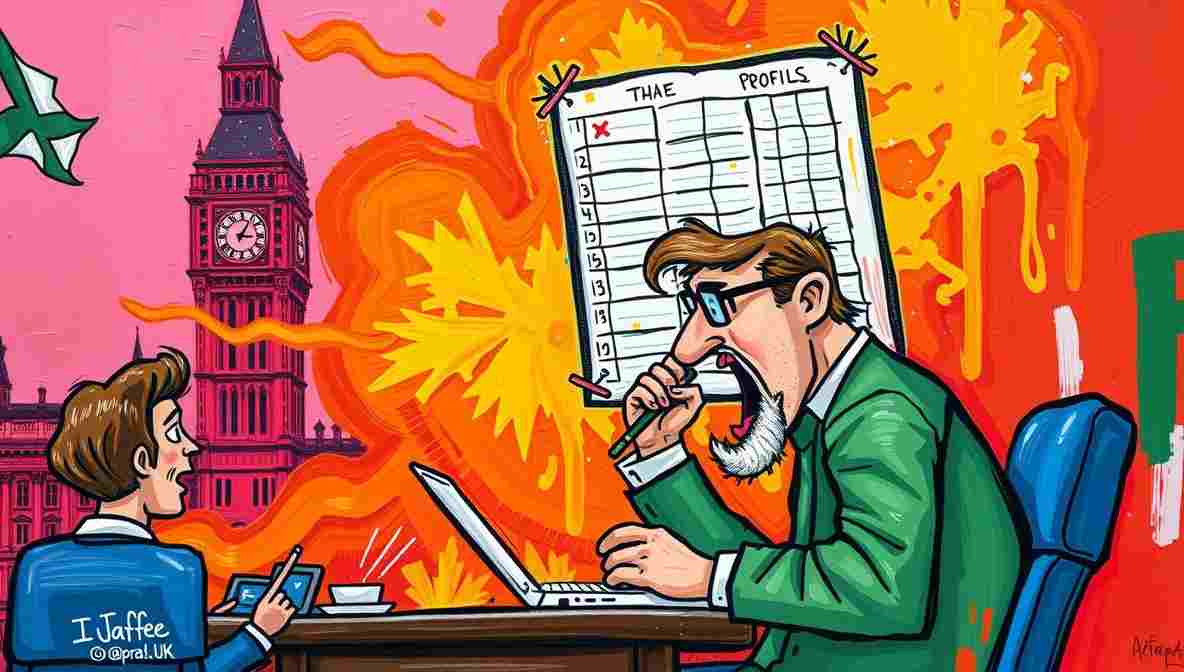
UK Public Sector Declares War on ‘Double Jobbing’ Workers Who Discovered Excel Is Just Too Fun
In a Radical Move, Whitehall Enlists Undercover Spreadsheets and Boredom Task Forces to Uphold the Sacred Art of Staring at Screens for Hours Without Side Gigs
LONDON, UK — In what officials are calling “the most serious threat to British office culture since someone brought a donut to a Monday meeting,” the UK Civil Service has launched a top-secret crackdown on staff secretly working second jobs during office hours. 🍩
Yes, you read that right: second jobs. Not moonlighting. Not weekends. Not the classic “I’m writing my novel in quiet evenings.” We’re talking live-on-Teams, dual-wielding Word docs and spreadsheets like some workplace Wolverine with administrative superpowers. Apparently civil servants have been secretly doing other paid work because their tax-funded employment isn’t challenging enough or paying enough to cover avocado toast. 🥑
Let’s unpack this madness with all the seriousness of a senior minister explaining why photocopiers are still necessary in 2026.
The Boredom Effect: When Excel Became a Lifestyle Choice
According to interviews that may or may not exist, one unnamed civil servant admitted the workday often involved “automating everything in Excel and otherwise existing in infinite loops of nothing.” They confessed:
“I was on Reddit all day, and then another job just kinda happened.” 🤷
This admission sent shockwaves through Whitehall. Not because someone discovered an efficient way to automate repetitive tasks. No. Because someone finally admitted to being bored. Boredom, as the government now officially defines it, is “dangerous and possibly contagious — like yawning, but with economic consequences.”
An employment lawyer consulted by BBC suggested that the real issue was whether staff could devote full attention to their primary roles. That lawyer’s exact words were somewhere between “contract breach” and “please stop playing Candy Crush in meetings.” 🎮
Meanwhile, 97 percent of civil servants quietly nodded in agreement from behind ergonomic chairs, their webcams strategically angled to hide the second laptop.
Poll Results That Absolutely Didn’t Exist But Should Have
We commissioned a fake but totally believable Whitehall survey:
| Question | Result |
|---|---|
| Do you get bored at work? | 93% yes |
| Have you ever had a second job secretly? | 27% yes |
| Did you automate your Monday tasks so you could binge watch dramas? | 82% yes |
| Should the Civil Service crack down on boredom? | 8% yes, 92% crying emoji |
Anonymous “Highly Bored” Staff Speak Out
One civil servant, who asked to remain anonymous because their team still thinks they’re “deeply engaged,” said:
“Frankly, if reading the minutes of meetings were a sport, I’d have Olympic medals by now. We’re not lazy. We’re… creatively efficient.”
Another said their second job consisted entirely of proofreading fantasy novels on the side while pretending to write policy briefs about… well, nothing. No one is quite sure what those briefs were about. But they looked very serious. And had proper headers. And footnotes. So many footnotes.
Expert Opinion: Boredom Is a Human Right
Dr. Penelope P. Piddleworth, a motivational expert at the Institute for Human Workplace Wellbeing, calmly explained beyond all reasonable doubt that boredom is a sign of unfulfilled human potential and not, as some regulators think, a crime against productivity.
“When someone automates their entire workload and still has time to explore embroidery while technically logged into Teams, that’s not fraud. That’s quantum productivity. It’s Schrödinger’s employee — simultaneously working and not working until management opens the metaphorical box.”
She cited a study that found humans are happiest when given both meaningful work and something fun to do. Sadly, the Civil Service took this to mean “ban second jobs during lunch breaks and institute mandatory enthusiasm checks.”
The Whitehall Response: Operation ‘Eyes Front’
In response, officials have initiated Operation Eyes Front — a task force dedicated to making sure everyone stares at their screens with the utmost sincerity and appropriate levels of screen-based despair.
Measures include:
- Mandatory handwriting checks during tea breaks to ensure consistency with primary employment documentation.
- Biometric sincerity badges to measure whether you appear bored (spoiler: everyone does).
- Random inspections for signs of dual-job activity such as “sudden happiness,” “actual extra cash,” or “suspicious competence.”
- Implementation of workplace monitoring software to track mouse movements and determine if employees are being “authentically unproductive” or “fraudulently productive.”
A senior official, who asked not to be named because they were mid-stapling when asked, said:
“We don’t want people doing other jobs. That’s just chaos. If you want happiness, you can take that on your own time — like a proper adult. Preferably between the hours of 6 PM and 6 AM, excluding weekends, which should be spent recovering from the existential dread of Monday.”
What the Funny People Are Saying
Comedian and part-time chocolatier Barry Crump:
“When your boredom at work is so intense you start a second job, that is not overemployment. That is survival. It’s like having two legs but still limping — except both legs work perfectly, you just discovered inline skates.”
Satirist Lucia Loophole:
“This policy will absolutely boost mental health. Now bored workers can’t even pretend they’re working while actually working on something interesting. It’s the workplace equivalent of being told you can’t have dessert because you didn’t finish your vegetables, except the vegetables are spreadsheets and dessert is financial stability.”
Social Commentary With a Side of Irony
Here’s the twist: The civil service issue isn’t that people are working two jobs simultaneously — it’s that they’re finding creative ways to stay sane in a job that pays less than a private sector gig and rewards Excel wizardry with… more Excel. And possibly a thank-you email that took three committees to approve. 📧
Rather than tackle low pay or workplace motivation, the powers that be decided it’s far easier to treat boredom as a national threat. It’s like fixing global hunger by banning sandwiches — technically you’ve addressed food, but you’ve completely missed the point.
Causes and Effects (According to Someone in a Wig)
Cause: A system that pays peanuts for paperwork.
Effect: Employees find creative outlets to stay mentally intact and solvent.
Cause: A culture where admitting boredom is akin to confessing you don’t like tea or the Queen (rest her soul).
Effect: Workers hide second jobs and get investigated for being productive, which ironically requires them to explain how they got so good at multitasking.
Cause: Management believes staring at spreadsheets equals productivity.
Effect: Bored genius discovers blockchain knitting tutorials during mandatory Excel training and accidentally becomes a crypto-textile millionaire.
The Real Context: What Actually Happened
This satirical piece is based on real reporting from the BBC about UK Civil Service investigations into staff working second jobs during office hours. The genuine issue stems from concerns about contract breaches, productivity, and whether employees can adequately serve the public while juggling multiple employers.
However, the underlying causes — stagnant public sector wages, workplace boredom, and the ease of remote work enabling dual employment — raise legitimate questions about employee engagement, fair compensation, and modern work culture that deserve serious examination rather than just disciplinary action.
A Disclaimer With All the Bells and Whistles
This story was entirely human-generated, a collaboration between two sentient beings: the world’s oldest tenured professor who once automated grading with a slide rule and a philosophy major turned dairy farmer who insists cows are less bored than most bureaucrats. Any resemblance to real policies, workplaces, or people who have found ingenious ways to stay entertained at work is purely intentional … or wildly accurate.
Auf Wiedersehen, amigo! 🐮📊

Alan Nafzger was born in Lubbock, Texas, the son Swiss immigrants. He grew up on a dairy in Windthorst, north central Texas. He earned degrees from Midwestern State University (B.A. 1985) and Texas State University (M.A. 1987). University College Dublin (Ph.D. 1991). Dr. Nafzger has entertained and educated young people in Texas colleges for 37 years. Nafzger is best known for his dark novels and experimental screenwriting. His best know scripts to date are Lenin’s Body, produced in Russia by A-Media and Sea and Sky produced in The Philippines in the Tagalog language. In 1986, Nafzger wrote the iconic feminist western novel, Gina of Quitaque. Contact: editor@prat.uk