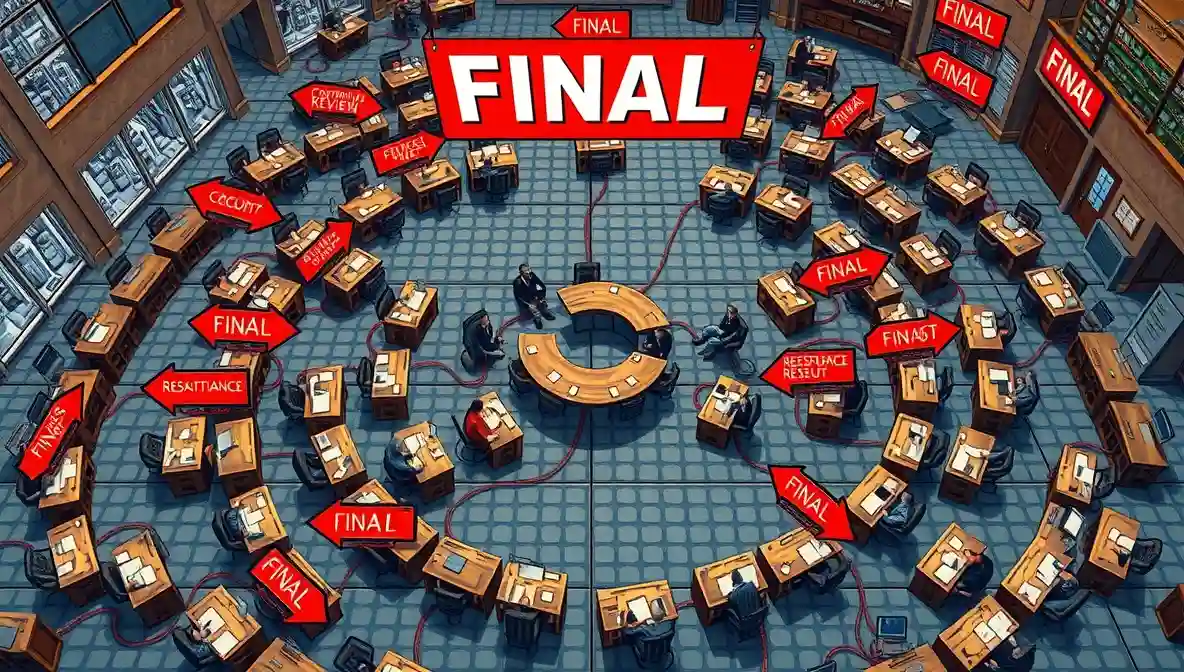

Westminster Announces Bold New Plan to Review the Last Review
Ministers Confirm Lessons Will Be Re-Learned, This Time With Greater Seriousness
In a decisive show of momentum, officials in Westminster announced a bold new plan to review the findings of the previous review, which itself examined the outcomes of an earlier inquiry that followed concerns raised several years ago and briefly acknowledged last spring.
The announcement was delivered from within UK Parliament, where ministers stressed that this was not repetition but refinement. “We are committed to learning lessons,” a spokesperson said, “and sometimes the most responsible way to do that is to re-read the lessons we already learned and see if they still feel relevant.”
A Review of a Review, Explained Slowly
Progress Clarified Through Recursion
According to briefing documents, the new review will examine whether the conclusions of the last review were sufficiently reviewed at the time they were reviewed. Particular attention will be paid to tone, phrasing, and whether the word “robust” was used appropriately.
Officials confirmed the scope would be “wide-ranging but focused,” a description experts say means nothing will be excluded and nothing will be resolved.
A senior civil servant explained the logic. “The previous review did good work,” they said. “But it was written in a different moment. Since then, time has passed, which means we need perspective.”
Timeline Announced, Then Softened
Urgency Expressed, Deadlines Deferred
The review is expected to begin immediately, pending final agreement on its terms of reference, membership, chair, subcommittees, and refreshments budget.
Initial findings are scheduled for release “in due course,” followed by a consultation period, a response period, and a period of reflection in which officials decide how they feel about the response.
Asked when tangible changes might occur, a minister replied that change was “absolutely on the table,” though the table would be discussed separately.
Opposition Welcomes Scrutiny, Questions Geometry of Loop
Support Offered, Eyebrows Raised
Opposition MPs welcomed the announcement as a sign the government was taking matters seriously, while also gently asking whether reviewing reviews indefinitely risked creating a policy Möbius strip.
One MP suggested implementing recommendations instead. The idea was noted and referred to a working group tasked with examining the feasibility of implementation in principle.
The exchange concluded with cross-party agreement that the issue was complex and deserved further examination.
Experts Applaud the Process, Prepare Quotes
Academia Thrilled by Familiar Terrain
Policy experts and academics praised the move, noting that reviews create valuable opportunities for evidence gathering, stakeholder engagement, and citations.
“This is how institutional memory works,” said a governance scholar. “You write things down, then later you read what you wrote and feel differently about it.”
Another expert described the review culture as “a stabilising force.” “Nothing reassures the public like knowing something is being looked at,” they said, before submitting written evidence previously submitted in 2019.
Civil Service Mobilises Templates
Briefings Expanded, Language Polished
Inside departments, civil servants activated well-tested review protocols. Existing documents were reopened. Sections titled Background, Context, and Next Steps were updated to reflect the fact that the background now had its own background.
One official described the process as “comfortingly familiar.” “You know where you are with a review,” they said. “It’s when someone asks for action that things get stressful.”
Internal guidance advised teams to emphasise seriousness, independence, and transparency, while avoiding expectations.
Public Reaction: Recognition Without Surprise
Citizens Recall Previous Reviews Vaguely
Across the country, the announcement was met with a collective nod. Many voters reported remembering the last review dimly, mostly through headlines that included words like “damning” and “wake-up call.”
“I’m glad they’re reviewing it,” said one commuter. “I just can’t remember what the original thing was.”
Another voter expressed optimism. “Eventually,” they said, “they’ll review the review of the review and realise they should have fixed it years ago.”
Why This Works Every Time
Reviews as Political Cushioning
Political analysts note that reviews serve an essential function. They absorb pressure, delay consequences, and signal concern without requiring risk.
A review can be announced immediately, praised universally, and concluded quietly. Its recommendations can be accepted “in principle,” which experts confirm is the least binding principle available.
As one long-time observer put it, “Nothing says ‘we’re on it’ like commissioning another look.”
Closing Assurance, Carefully Drafted
The government reaffirmed its commitment to transparency, accountability, and continuous improvement. The review will proceed. Findings will be considered. Lessons will be learned again.
Action remains under active contemplation.
Disclaimer
This article is entirely a human collaboration between two sentient beings: the world’s oldest tenured professor and a philosophy major turned dairy farmer. Any resemblance to actual reviews is coincidental, though extensively footnoted.
Auf Wiedersehen.

Lowri Griffiths brings a distinct voice to satirical journalism, combining cultural critique with dry humour. Influenced by London’s creative networks, her writing reflects both wit and discipline.
Authority stems from experience, while trust is built through transparency and ethical satire.