
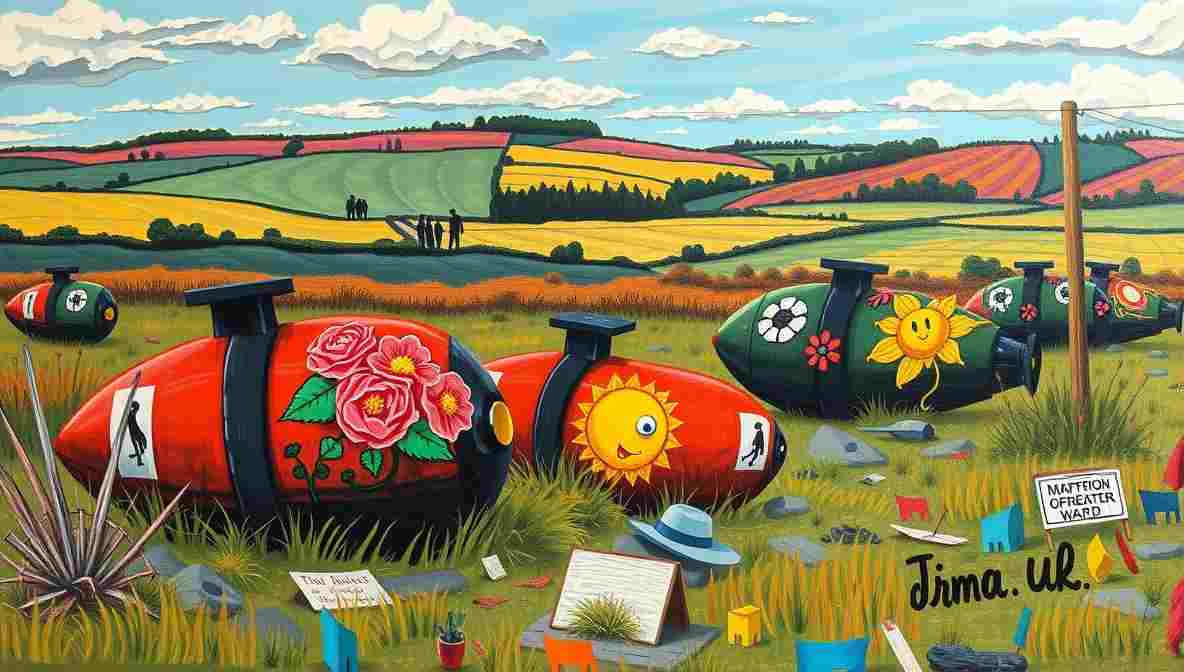
Britain Discovers It Never Finished WWII, Devon Asked to Breathe Slowly
Unexploded bombs prove history isn’t as finished as we’d hoped
Residents Wake Up to Find They’ve Been Living Atop Nazi Ordnance for Eighty Years
Residents of Devon received an unwelcome reminder this week that history doesn’t stay buried—literally. Several unexploded World War II bombs emerged during routine construction work, proving that Britain is essentially a museum that occasionally tries to renovate itself and finds German ordnance in the process.
The Bombs That Refused to Cooperate With the Official Timeline

The bombs, discovered whilst digging two feet into British soil—a national tradition that alternately reveals Roman ruins, medieval curses, or Nazi explosives—had been quietly minding their own business beneath a Devon neighbourhood for eighty years. Authorities moved quickly to cordon off large areas and evacuate residents who had, unbeknownst to them, parked their cars atop high explosives for two decades.
“I’ve lived here 22 years,” said one resident, sipping tea whilst being escorted away by police. “If it wanted to explode, it would have done so during the Thatcher years.” This logic, whilst comforting, is precisely why the British have survived their own infrastructure.
National Rail Issues Apology: Delays Caused by Nazis From Eighty Years Ago
National Rail issued an apology explaining that delays were caused by “wartime leftovers,” which technically counts as an act of God and therefore excuses everything. Roads closed, commuters discovered that punctuality is a fragile social contract easily broken by Germans from eighty years ago, and the nation’s collective understanding that WWII ended in 1945 was temporarily revised.
Devon’s Strategic Importance to Hitler Now a Problem for Modern Commuters

According to BBC News coverage of WWII heritage sites, Devon remains one of Britain’s most heavily bombed regions during the war, a fact that suddenly seems more relevant than anyone expected in the 2020s. During WWII, Devon was heavily bombed due to its strategic importance, coastal location, and general resemblance to places Germans wanted to inconvenience.
Bomb Disposal Experts Arrive With Mild Expressions and British Resignation
Bomb disposal technicians appeared wearing the exact facial expression one wears when discovering one’s house has a structural problem but no urgent appointment is available. “This is standard,” one explained. “Britain is essentially composed of unexploded ordnance held together by tea and apologies.”
Local Councils Assure Residents: Panic Orderly, Please
Local councils assured residents there was “no immediate danger,” a phrase meaning ‘there is danger, but we’d like you to panic in an orderly fashion.’ Evacuees were relocated to community centres stocked with folding chairs, biscuits, and the distinct British sense that everything will work out because it always does. “It’s very British,” said one woman. “You flee a bomb, you’re offered a custard cream, and someone apologises.”
Infrastructure Is Just History Waiting to Explode

This discovery reveals a deeper truth about Britain: the nation’s reluctance to face its own past is literal. We don’t process it. We build over it. Then, mid-latte, we remember that unresolved conflicts are still, technically, conflicts.
Thousands of Bombs Still Underground Means Every Renovation Is Roulette
According to The Guardian’s reporting on unexploded ordnance in the UK, thousands of wartime bombs remain in British soil, a fact that transforms every construction project into archaeological roulette. By evening, officials confirmed the bombs would be safely defused, proving once again that Britain can defeat German weaponry, just with a slightly longer timeline than advertised.
The public was reassured that while WWII officially ended in 1945, its infrastructure obligations remain indefinitely ongoing. For ongoing satirical commentary on British historical mythology, visit Bohiney Magazine for more absurdities.
SOURCE: https://bohiney.com/

Alan Nafzger was born in Lubbock, Texas, the son Swiss immigrants. He grew up on a dairy in Windthorst, north central Texas. He earned degrees from Midwestern State University (B.A. 1985) and Texas State University (M.A. 1987). University College Dublin (Ph.D. 1991). Dr. Nafzger has entertained and educated young people in Texas colleges for 37 years. Nafzger is best known for his dark novels and experimental screenwriting. His best know scripts to date are Lenin’s Body, produced in Russia by A-Media and Sea and Sky produced in The Philippines in the Tagalog language. In 1986, Nafzger wrote the iconic feminist western novel, Gina of Quitaque. Contact: editor@prat.uk