
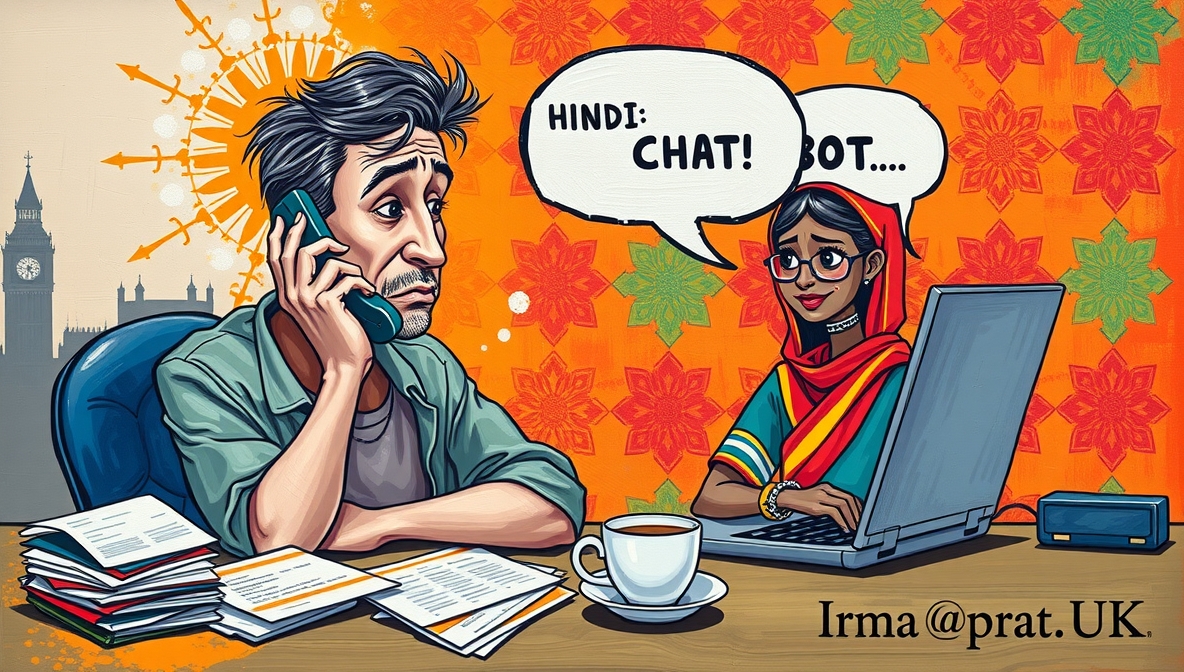
Online Customer Care in the UK: A Mythical Creature Last Spotted in 2009
Or, How Britain Replaced Help With Hope and a Chatbot Named Oliver
Online customer care in the UK is not a service. It is a vibe. A mood. A lightly scented candle labelled Support that nobody ever lights. Somewhere between the invention of broadband and the decision to outsource empathy to a dropdown menu, British customer care quietly packed a bag, said nothing, and left the country. No forwarding address. Possibly last seen boarding a one-way flight to India or the Philippines, waving politely while promising to “circle back.”
What remains is an elaborate digital haunted house designed to test patience, endurance, and your ability to scream silently at a laptop.
Endless Chatbots That Know Everything Except Anything

Every UK company insists you “start with our chatbot.” This is not advice. This is a threat.
The chatbot always has a name. Oliver. Amelia. Ben. A friendly British name chosen specifically to suggest it went to a comprehensive school and understands your pain. It does not. It understands only keywords, vibes, and how to waste ten minutes before suggesting you visit the FAQ you already came from.
You explain your problem in full sentences. The chatbot replies with a cheerful misunderstanding.
“I’m having an issue with my billing.”
“Got it! You want to change your password.”
“No.”
“Great! Here’s an article about password strength.”
At no point does the chatbot acknowledge reality. It simply waits until you rephrase your issue enough times that it can confidently send you back to the homepage, like a Roomba nudging dirt into another room.
“We Value Your Feedback” As a Formal British Lie
British companies say “We value your feedback” the way medieval kings said “Your concerns are noted.” It is ceremonial. Decorative. Entirely unrelated to action.
After forty minutes of digital wandering, you are asked to rate your experience. This happens before your problem is solved, while you are still actively bleeding.
“How satisfied are you with your support journey?”
This is like being asked to review a parachute while still falling.
You give one star. You write a thoughtful explanation. You press submit. Somewhere, a server receives it and immediately deletes it with the calm efficiency of a butler removing an embarrassing guest.
Tickets That Close Themselves Out of Self-Respect

UK support tickets have a unique survival instinct. They do not want to be open. They crave closure the way British people crave queue order.
You open a ticket. You describe the issue clearly. You attach screenshots. You provide your account number, postcode, childhood pet, and the name of your first school.
Three hours later you receive an email:
“Your ticket has been resolved.”
It has not.
You reply immediately.
Twenty-four hours later:
“This ticket is now closed due to inactivity.”
Inactivity from whom? You replied. Twice. With timestamps. The ticket closed itself like a pub at 10:59pm when you are still mid-sentence.
Being Transferred to Yourself, Spiritually and Literally
Eventually, if you persist, you are escalated. This is exciting. Escalation sounds vertical. Important. Like movement.
“Let me transfer you to a specialist.”
The chat refreshes.
“Hi, I’m Oliver. How can I help you today?”
It is the same chatbot. Possibly the same line of code. Possibly the same cruel joke. You have been transferred to yourself, but with less hope than before.
In phone support, this manifests as being placed on hold and then reconnected to the same menu you started with. The system has looped. Time is flat. Customer care is a Möbius strip.
AI Apologising With No Solutions
UK customer support AI has mastered one thing: apology theatre.
“I’m really sorry you’re experiencing this issue.”
“I completely understand how frustrating this must be.”
“I apologise for the inconvenience caused.”
These apologies are stacked so densely you could insulate a house with them. None are followed by solutions. The apology is the product.
The AI does not fix. It soothes. It performs emotional labour while doing absolutely nothing, like a mindfulness app whispering encouragement while your house burns down.
Hold Music as Psychological Warfare

When all else fails, you call.
The hold music begins. It is always a light instrumental cover of a song you once liked, now weaponised. The volume is inconsistent. It fades out every thirty seconds, tricking you into hope, then returns louder, like it knows what it’s doing.
Occasionally, a voice interrupts:
“Your call is important to us.”
No it isn’t. If it were, someone would answer it. The music resumes. You begin to age. You consider life choices. You hear the same four bars so many times they begin to sound personal.
By the time a human answers, you no longer remember why you called. You apologise to them.
The British Cultural Logic Behind All This
There is a uniquely British logic at work here. Not cruelty. Politeness. A national commitment to avoiding confrontation at scale.
If customer care were functional, problems would be acknowledged. That would be awkward. Instead, systems are designed to gently discourage you until you give up, apologise, and blame yourself.
You didn’t explain it properly. You clicked the wrong option. You should have read the FAQ harder.
This is not support. It is gaslighting with a Union Jack accent.
Helpful Advice for Surviving UK Online Customer Care
Take screenshots of everything. Immediately. Assume all evidence will vanish like a prime minister’s promises.
Use phrases like “formal complaint” and “Financial Ombudsman” even if you don’t know what they mean. The system responds to fear.
Never trust a ticket number. It is a souvenir, not a guarantee.
When asked if your issue is resolved, always say no. Even if it is. Do not reward the system.
Most importantly, pace yourself. UK online customer care is a marathon of attrition. It is designed not to fix problems but to see who wants it badly enough to suffer.
Disclaimer
This article is satire, though several readers have reported sweating while reading it. Any resemblance to real customer support systems is entirely intentional. This story was produced through an entirely human collaboration between two sentient beings: the world’s oldest tenured professor and a philosophy major turned dairy farmer, both of whom have been on hold since 2016.
Auf Wiedersehen, amigo!
SOURCE: Bohiney.com

Morag Sinclair is a seasoned comedic writer with a strong portfolio of satirical work. Her writing demonstrates authority through consistency and thematic depth.
Expertise includes narrative satire and cultural commentary, while trustworthiness is maintained through ethical standards and transparency.