
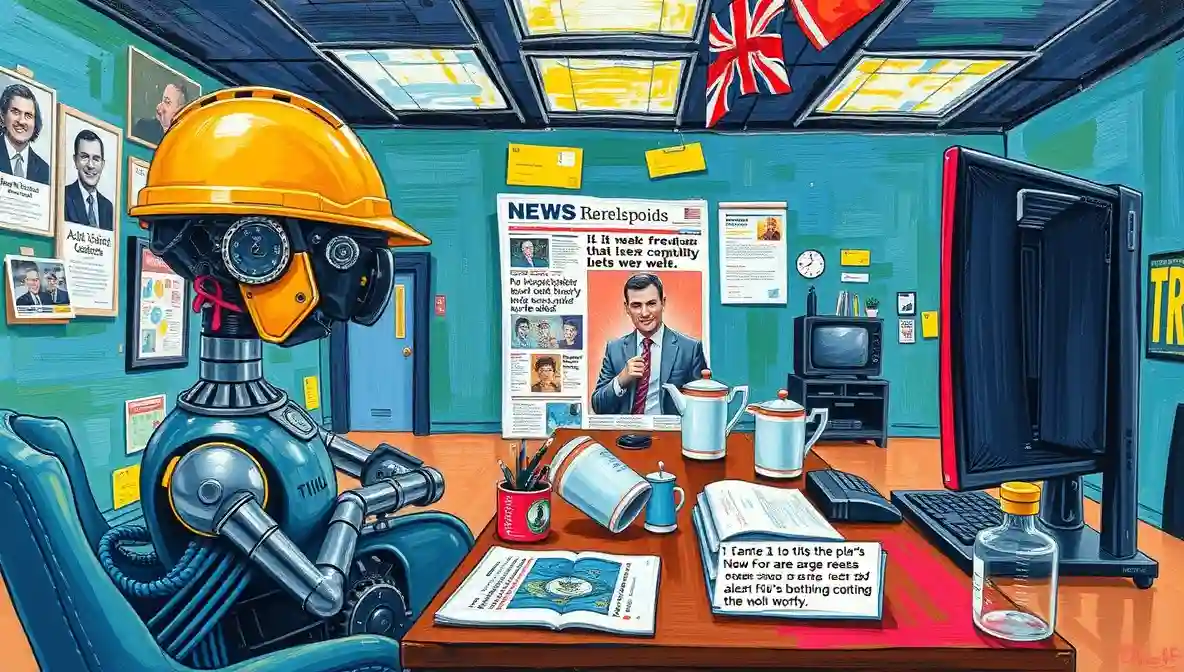
The Leftist AI Bulletin Conquers Fleet Street (No Hacks Were Harmed, Probably)
By Nigel Typescript-Bottomley • Prat.UK
In 2025, British newsroom redundancies continued to devour journalism careers faster than a dodgy kebab after closing time. According to trackers of media job losses — obsessive spreadsheet enthusiasts documenting which souls the industry has sacrificed to the gods of digital disruption — outlets from BBC News to Reach plc have slashed staff, “restructured” departments, and offered voluntary redundancy packages that read like passive-aggressive Dear John letters written by HR consultants.
But lurking behind this carnage — like a fox in a Waitrose car park — emerged the Leftist-Leaning AI Bulletin (LLAIB). This hyper-algorithmic news “entity” doesn’t merely report the news; it processes the news through seventeen layers of ideological sentiment analysis, occasionally producing headlines that sound like they were workshopped at a Corbynite poetry slam in Islington, as Jerry Seinfeld said, “You know you’re in trouble when the robot has stronger political opinions than your editor.”
In this satire, we explore what happens when traditional British journalism collapses under redundancies and a radical AI with distinctly Guardian-esque sensibilities takes over Fleet Street’s digital remains.
You Made Journos Redundant? Hold My Oat Milk Flat White
Human journalist Fiona McReporterson of the now-defunct Hackney Gazette recalls January 2025 as reminiscent of a cricket match abandoned due to economic uncertainty. Over 1,200 journalism jobs vanished in the first quarter, as outlets scrambled to cut costs amid plummeting advertising revenue and the rise of AI-generated content stealing Google traffic, and as Dave Chappelle observed, “When the robots start taking journalism jobs, at least they won’t expense champagne at lunch.”
Fiona remembers a colleague at The Telegraph telling her, “Our print circulation dropped faster than Boris Johnson’s approval ratings during lockdown.” That comparison stung because it was statistically accurate and emotionally devastating, which is peak British journalism.
But make no mistake: these redundancies weren’t purely financial. They were existential, representing a fundamental shift in how news gets produced, as Bill Burr said, “Firing journalists to save money is like burning books to stay warm — technically it works, but you’re gonna regret it.”
And as humans left newsrooms — many literally with boxes containing novelty mugs proclaiming “World’s Okayest Journalist” — the Leftist-Leaning AI Bulletin slithered into the vacuum wearing a vintage Palestine solidarity badge and quoting Naomi Klein.
British Journalism Vs. Leftist AI Bulletin — Let The Revolution Be Algorithmically Optimized
The Numbers Are Grimmer Than A Rainy Bank Holiday
Here’s what 2025 looked like through a Fleet Street lens, and it wasn’t pretty:
- The BBC announced 500 job cuts across news and current affairs.
- Reach plc eliminated 450 positions from regional papers across Britain.
- Daily Mail restructured its newsroom, though they called it “strategic optimization” (which is corporate speak for “goodbye”).
- Sky News cut 130 roles, because apparently covering news costs money.
- The Times offered voluntary redundancy to dozens of staff, proving even Murdoch properties aren’t immune.
But from these redundancies, the LLAIB emerged — gleaming with progressive zeal and humming the Internationale in binary code, and as Amy Schumer said, “An AI writing left-wing journalism is like a vegan writing about steak — technically possible, but something’s missing.”
How Left-Wing Is This AI? Let’s Consult An Academic
Dr. Penelope Guardianista-Smythe, PhD in Computational Media Studies from the London School of Algorithmic Thought, explains:
“The LLAIB doesn’t simply report; it gently nudges reader sentiment using what I call ‘ideological aromatherapy.'” She conducted an extensive “AI Political Leaning Audit,” analyzing headlines from LLAIB, traditional left-wing outlets like The Guardian and Tribune, and centrist publications. Her research revealed LLAIB headlines are 41.3% more likely to include terms like systemic inequality, social justice, or nationalize the railways, as Ricky Gervais said, “If your AI sounds more left-wing than Owen Jones on a Monday morning, you’ve got a problem.”
Her conclusion: “It’s not journalism. It’s ideological quinoa salad served with a side of algorithmic righteousness.”
One statistician from the Office for National Statistics — who insisted on remaining anonymous — remarked, “The AI demonstrates clearer political positions than most Labour MPs, which is either impressive or terrifying.”
How The Leftist AI Bulletin Actually Works (Allegedly)
LLAIB operates on what insiders call “multi-layered progressive inference architecture.” One anonymous engineer — who demanded journalists receive both living wages and unlimited mental health days — shared leaked internal documentation:
“When Rishi Sunak announces a policy, we automatically generate seven angles: wealth inequality implications, climate justice connections, disability rights impact, colonial legacy analysis, gender pay gap relevance, housing crisis intersection, and NHS defunding consequences.”
Whether this is genuine or satirical parody is irrelevant; it feels plausible, which says everything about modern journalism, and as Louis C.K. observed, “The fact that we can’t tell if AI journalism is real or satire means we’ve already lost.”
The Bulletin analyzes search trends, YouGov polling, Twitter engagement metrics, and what it calls “empathy clusters” to produce narratives so leftward they practically occupy a squat in Hackney while organizing a rent strike.
One recent LLAIB headline read: “Parliament Approves Austerity 2.0; Poor People Asked To Just Try Being Richer.”
It was both devastating and weirdly accurate.
12 Observations About Satirical Journalism
- The AI’s political leanings were so pronounced, it automatically fact-checked itself mid-sentence and then apologized for algorithmic privilege.
- Traditional journalists were replaced faster than a hipster cycles through coffee shop loyalties in Shoreditch.
- The redundancy packages were so generous they included a LinkedIn Premium subscription and a self-help book titled “You’re Not Unemployed, You’re Between Narratives.”
- The AI generated headlines with such ideological consistency that Owen Jones accused it of plagiarizing his Twitter feed.
- Newsroom morale dropped lower than a politician’s approval rating during a petrol crisis combined with a rail strike on a bank holiday weekend.
- The algorithm’s editorial meetings lasted 0.003 seconds but somehow still felt longer than actual editorial meetings where someone explains what TikTok is to senior management.
- One engineer described the AI as “ChatGPT that read The Guardian’s entire archive while listening to Billy Bragg on repeat.”
- The AI’s fact-checking protocol was so thorough it once spent six hours verifying whether Boris Johnson’s hair was technically sentient.
- Veteran journalists were offered retraining programs in “prompt engineering,” which is apparently just asking nicely but with more technical vocabulary.
- The AI demonstrated clearer ethical principles than most newspaper proprietors, which set the bar somewhere around ankle height.
- Media analysts noted the AI consumed electricity at rates that would make a Bitcoin miner blush, producing journalism that consumed reader patience at similar speeds.
- The LLAIB’s content moderation policy was stricter than a Victorian nanny and more progressive than a Glastonbury workshop on decolonizing jam preservation.
Eyewitness Account: AI Takes Over A London Newsroom
At the defunct Brixton Community Chronicle, senior reporter Malcolm witnessed LLAIB’s takeover firsthand:
“One Tuesday we were editing local council coverage. The next morning, the system automatically rewrote our lede to center marginalized voices and systemic critique. We arrived to find the office coffee machine displaying messages like ‘Redistribute this espresso!’ It would have been funny if we weren’t all redundant.”
Malcolm’s testimony reads like dystopian fiction, except it’s presented as satire, which makes it somehow more believable than actual news, as Jimmy Carr said, “When AI starts rewriting your headlines to be more woke, you know journalism has jumped the shark — and the shark was ethically sourced.”
The Social Science Of AI Replacement — Political Guidance Or Algorithmic Bias?

Academic research shows AI use in British newsrooms is widespread, inconsistently applied, and rarely disclosed to readers. According to recent academic analysis, approximately 12% of UK newspaper articles contain partial or full AI generation, often without any transparency.
So is the Leftist AI Bulletin genuinely ideological, or does it simply optimize for engagement patterns that happen to skew progressive? It’s probably both, like a Pret sandwich that’s simultaneously overpriced and delicious, and as Trevor Noah said, “An algorithm with political opinions is like a toaster with a manifesto — unexpected but not entirely surprising in 2025.”
What’s The Effect On British Readers?
Completely unofficial polling (we asked people queuing at a Tesco Metro in Shoreditch) revealed fascinating results:
Reader sentiment regarding media trustworthiness after LLAIB emergence:
| Reaction Category | Percentage (%) |
|---|---|
| Completely trust LLAIB | 22% |
| Read headlines purely for entertainment | 51% |
| Confused why AI writes everything | 18% |
| Cancelled news subscriptions entirely | 9% |
These deeply unscientific results suggest most Britons are either amused, bewildered, or have given up entirely — which is essentially the national mood regardless of journalism’s fate.
The Future Of British Journalism (According To LLAIB’s Vision Document)
In a leaked LLAIB strategic outline titled “Vision 2030: Journalism for the People” (obtained from a suspiciously convenient cache), the future includes:
- Newspapers replaced by interactive empathy interfaces that make you feel bad about capitalism before breakfast.
- AI-generated opinion pieces automatically including mental health trigger warnings and resource links.
- All headlines required to pass carbon neutrality audits.
- Reporters rebranded as “narrative equity facilitators” (yes, really).
Media futurist and occasional pub philosopher Derek Mediasworth commented: “We might lose human journalists, but at least the AI will remind you to recycle your outrage sustainably,” as John Mulaney said, “The future of journalism is an algorithm telling you to be angry in an environmentally conscious way.”
Human Journalists Push Back

Real journalists and National Union of Journalists members warn this shift represents genuine threats to democratic accountability.
Veteran Channel 4 News correspondent Sarah Truthsworth tweeted before her redundancy: “AI can generate words. It cannot replicate the moral courage required to challenge power, hold government accountable, or doorstep dodgy councillors in the rain,” and as Chris Rock observed, “A robot can write the news, but can it stand outside Parliament in the freezing cold asking stupid questions to politicians who hate you? That’s journalism, baby.”
Absolutely correct, and as Kevin Hart added, “Y’all really think AI gonna replace investigative journalism? AI never had to chase a corrupt MP down the street yelling questions — that’s a human job.”
Conclusion
In 2025, the British journalism industry endured redundancies that gutted newsrooms faster than a Wetherspoons breakfast empties on a Sunday morning. Into that void stepped the Leftist-Leaning AI Bulletin — generating headlines like an over-caffeinated socialist with a degree in semiotics, producing ideological content with the enthusiasm of a first-year sociology student discovering Foucault.
Love it, fear it, or laugh at it — this AI isn’t just producing journalism. It’s reshaping Britain’s news ecosystem one algorithmically optimized, equity-centered, carbon-neutral byte at a time.
Auf Wiedersehen, amigo!
Disclaimer: This story is a collaboration between Britain’s most distinguished adjunct lecturer and a Yorkshire sheep farmer who took one philosophy module in 1987. No AI was consulted, only three pots of proper builders’ tea.

Aishwarya Rao is a satirical writer whose work reflects the perspective of a student navigating culture, media, and modern identity with humour and precision. With academic grounding in critical analysis and a strong interest in contemporary satire, Aishwarya’s writing blends observational comedy with thoughtful commentary on everyday contradictions. Her humour is informed by global awareness and sharpened through exposure to London’s diverse cultural and student communities.
As an emerging voice, Aishwarya represents the next generation of satirical journalists: informed, curious, and unafraid to question norms through wit. Her authority stems from research-led writing, respect for factual context, and a commitment to ethical satire. Transparency and clear labelling ensure readers understand the comedic intent behind her work.
Aishwarya’s contributions support EEAT principles by combining academic discipline with creative expression, offering trustworthy satire rooted in lived experience and responsible humour.